


By: Crispin Maslog
Send to a friend
The details you provide on this page will not be used to send unsolicited email, and will not be sold to a 3rd party. See privacy policy.
The world’s first gene-edited babies, twin girls Lulu and Nana (not their real names), whose birth was announced only two months ago (November 2018) by a young Chinese scientist who ‘created’ them, have sparked fierce debate in the world science community.
Is their creator, He Jiankui, justified in creating gene-edited human life if the motive is to find a cure for a disease?
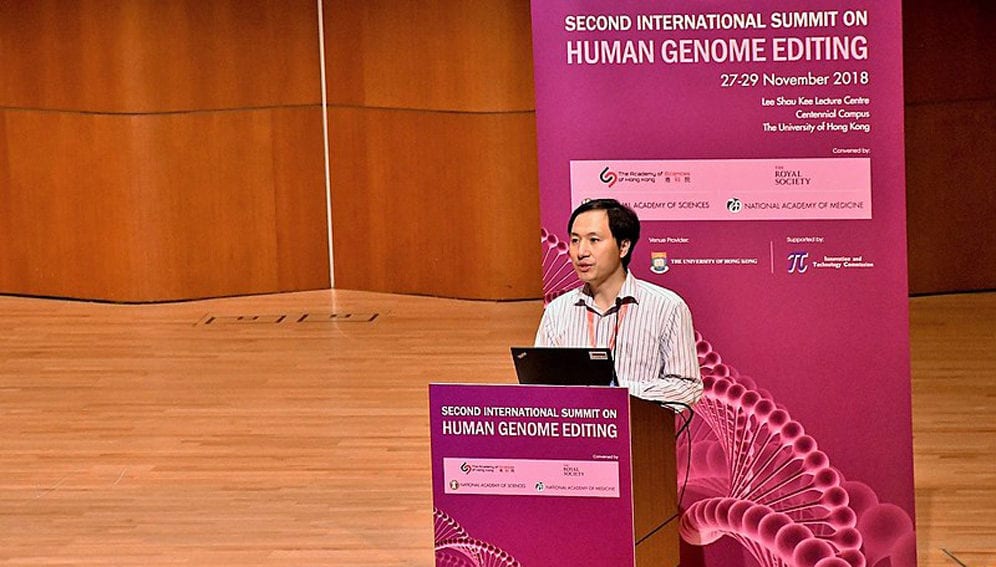
He announced the controversial birth of the babies on the eve of the second International Summit on Human Genome Editing in Hong Kong on 28 November 2018 and formally presented his research at the Summit.
The 28-year-old scientist from the Southern University of Science and Technology in Guangdong told the Summit that Lulu and Nana’s parents were one of seven couples recruited from a group of patients with HIV. He added that at least one more woman from the group is pregnant with a third gene-edited baby.
In a video, he said his team had altered genes to make them resistant to the HIV virus. This genetic tweaking was done on embryos in a lab dish and later implanted in the mother’s womb using the CRISPR–Cas9 genome-editing technique to modify the CCR5 gene.
He admits that his work has not yet been published in a scientific journal, and other researchers have had no access to any data or DNA samples to confirm his claim.
“He Jiankui’s case points to the need for regulation as soon as possible, an international regulation for research involving human life, like gene manipulation. Such regulations can be under the auspices of the United Nations.”
Crispin Maslog
The scientist said a paper about the work will be published in an unspecified journal. However, Chinese laws on genetic resources prevent publication of the gene sequences of either the parents or children. So other scientists would still find it difficult to verify his claims.
Global science reacts
The reaction from the science community was immediate, unanimous and negative — the equivalent of a resounding scientific slap on the face.
“Even if the modifications are verified, the procedure was irresponsible and failed to conform to international norms," the organising committee of the Hong Kong Summit said sharply in a statement on 29 November, the day after the Summit.
Media reports say many of the 700 scientists and researchers at the Summit were unconvinced about the evidence He presented to show his editing was successful. They suggest that in similar experiments some cells in embryos may be damaged, incompletely edited or escape editing entirely. He did not show up after his talk to answer questions from other scientists or the media.
Many scientists expressed outrage, saying that the science behind this procedure is too new to ensure it is safe. Some said the move could be seen as the first step in making ‘designer babies’ — children made-to-order selecting for desirable traits such as intelligence or beauty.
One of them, Annie Chai Wai Yeeng, project leader of Cancer Research Malaysia, tells SciDev.Net that she and her colleagues heard of He’s babies for the first time only a few days before the Summit when she was visiting the University of Hong Kong, her alma mater.
In an interview with SciDev.Net, Chai says, “It was a surprise to me and all my colleagues…We went through He’s videos describing his research on YouTube and debated among ourselves (on its ethics). I would say the majority of us do not totally agree with the rationale he used to justify his work and were quite mad at this rogue scientist.”
Chai adds that ethics aside, He’s choice of the CRISPR-Cas9 approach to gene editing isn’t surprising. “The technology that He used was a pretty easy approach that many scientists in the field have the capability to do.”
The Summit participants’ reaction can be summed up with the words of Jennifer Doudna, who pioneered the CRISPR-Cas9 genome-editing tool: “The thought I kept having was the potential for rogue scientists to use this in unethical ways. It’s a real risk,” said Doudna, a biochemist at the University of California, Berkeley, in an interview with David Cyranoski for Nature.
While it is illegal to deliberately alter the genes of human embryos in many countries including the United States, it is not against the law to do so in China. But the practice is opposed by many researchers there.
The pushback signals the seriousness of the issue. One problem is He’s working in secret. And there are more questions: is his experiment ethical? Is it justified as a way to prevent HIV in babies, in light of other options? Chai tells SciDev.Net: “In my opinion, only if the gene editing experiment is the only possible solution . . . to save someone’s life, will it be justified.”Another concern is safety. The methods used for gene editing can potentially alter other genes in unpredictable ways. And permanent changes to the germline could be passed on to future generations.
A need to regulate
There is no question that gene editing, like all scientific experiments involving human life, should be regulated.
“All academic institutions and relevant government ministries should have regulation committees to oversee this [kind of work],” says Chai. She believes that He should be sanctioned by Chinese authorities.
Recent reports in Chinese media suggest that He fears for his life, and that he faces possible charges of bribery and corruption, which carry the death penalty. According to a report in UK media, He is under armed guard after receiving death threats, and the Chinese government has launched an investigation into his work.
The case points to the urgency of international regulation for research involving human life, such as gene manipulation. Such regulations can be under the auspices of the United Nations.
From here on, the likes of He Jiankui should ask permission from an international body before they tamper with the basic building blocks of human life.