


By: Mohammed El-Said
Send to a friend
The details you provide on this page will not be used to send unsolicited email, and will not be sold to a 3rd party. See privacy policy.
[CAIRO, SciDev.Net] Environmental experts are warning that the ongoing war in the Gulf region is likely to leave a legacy of severe and long-lasting environmental damage, extending far beyond the immediate conflict zone.
The impacts, they say, could spread across the Eastern Mediterranean, affecting air, land, and marine ecosystems, and ultimately human and animal health.
Since the United States and Israel launched attacks on Iran on 28 February, sustained bombing on both sides has led scientists to repeatedly caution about risks of pollution to air, water, and food systems.
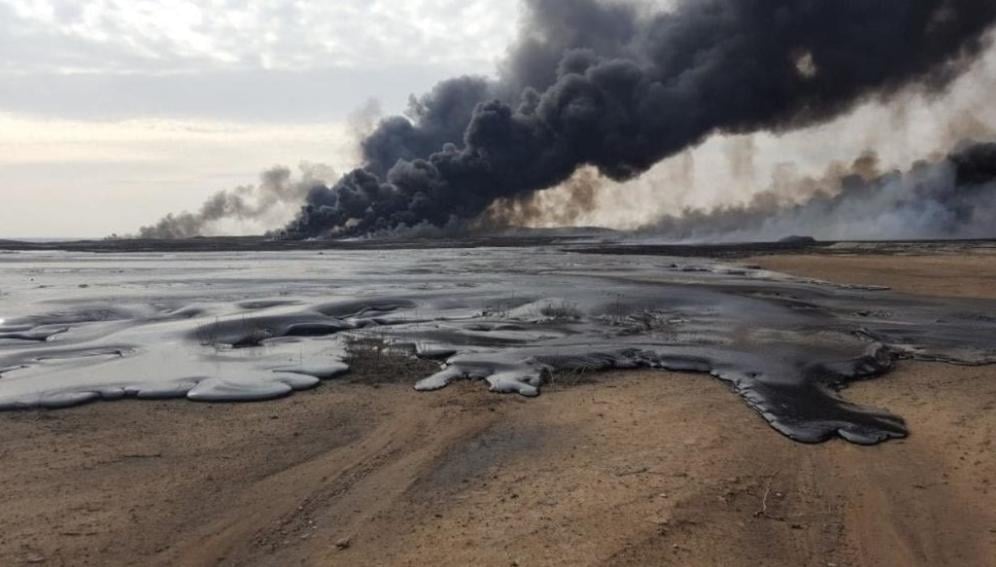
Fires in oil facilities and the destruction of industrial infrastructure are already releasing pollutants that may persist in the environment for years, if not decades, they warn.
“It is often less about the materials from the bombs themselves […] and more about what they are striking,” Richard Marcantonio, assistant professor of environment, peace and global affairs at the University of Notre Dame, in the US, told SciDev.Net.

“For example, if a building is destroyed that is lined with asbestos or an oil refinery and the fires continue extensively, it is these sorts of materials that tend to be the most impactful to human health risks.”
Toxic fallout
US-Israeli airstrikes on energy infrastructure near Tehran in early March ignited massive fires, sending thick plumes of black smoke over the Iranian capital. Reports indicated that oil storage depots and fuel transport networks in Tehran and Alborz province were among the targets.
As the crisis escalated, attacks spread to major oil and gas facilities, including the South Pars gas field and the Asaluyeh refinery. Iran’s retaliatory strikes across the Gulf, in Qatar, the United Arab Emirates, Saudi Arabia, and Kuwait, included a number of energy infrastructure targets.
A wide range of pollutants can be released during such conflicts, particularly as a result of bombing and the subsequent redistribution of materials, says Marcantonio.
Oil facility fires release toxic gases such as nitrogen oxides, sulfur oxides, carbon monoxide and hazardous organic compounds, explains Alaaeddin Alsbaiee, director of research and development at BASF Chemicals.
“Explosions and oil fires release large quantities of fine particles with diameters of less than PM 2.5, in addition to toxic carbon smoke, which are particles capable of reaching deep into the lungs and blood,” he told SciDev.Net.
These pollutants can spread over wide distances in the atmosphere by wind, raising pollution levels in areas near bombing sites and increasing the risk of respiratory diseases, especially among children and the elderly, Alsbaiee says.
The World Health Organization has already warned of risks posed by pollution from burning fuel depots in Tehran. Reports of so-called “black rain” following the strikes point to the presence of hazardous compounds in the atmosphere, including hydrocarbons, sulphur oxides and nitrogen compounds.
Soil, water contamination
According to experts, pollutants from explosions and fires can transfer to the soil, surface water, and groundwater.
Soil and groundwater contamination is among the most serious long-term consequences of war, says Marcantonio.
Pollutants resulting from bombing or fires can seep into the soil and groundwater layers and may remain in the environment for long periods if they are not treated by effective environmental cleanup processes, such as filtration or burning.
“Those pollutants can persist in the environment for generations or more,” Marcantonio warns.
Alsbaiee explains that oil facilities are among the most dangerous sources of environmental pollution during wars, because they combine air pollution resulting from fires with water and soil pollution resulting from oil leaks.
He adds: “Oil spillage into soil or water can also lower oxygen levels in the water, leading to the death of fish and aquatic organisms, as well as weakening soil fertility and affecting microorganisms necessary to maintain its biological balance.”
Threat to desalination
In the Gulf region, environmental risks are compounded by heavy reliance on seawater desalination for drinking water.
Experts warn that attacks on oil tankers at sea could be especially damaging. Large spills can spread on currents and winds, potentially reaching desalination plant intakes within hours or days. This scenario could disrupt water production or degrade water quality, raising the prospect of a dual crisis affecting both water and energy systems in the region.
Oil pollution can also damage desalination infrastructure directly. Hydrocarbon compounds may clog filtration membranes, reducing efficiency, increasing maintenance needs, and driving up energy consumption, says Mohamed Dawoud, a water expert at the Abu Dhabi Environment Agency, in the United Arab Emirates. In severe cases, plants may be forced to shut down temporarily to prevent contamination, he says.
A previous study indicates that oil spills resulting from maritime accidents or wars in the Gulf region can reach the intakes of desalination plants within hours or days, depending on the direction of the winds and sea currents.
Lasting consequences
Moreover, the environmental effects of war do not end when the fighting stops, researchers stress. While air quality may gradually improve once fires are extinguished, contaminants in soil and water can linger for decades.
Experiences from other conflict zones illustrate the scale of the challenge. In Gaza, for example, clearing millions of tonnes of debris is expected to take decades, with cleanup efforts themselves generating additional emissions and pollutants.
The pace of environmental recovery depends on several factors, including the type and extent of contamination and the characteristics of the affected ecosystems, says Alsbaiee. While some may be mitigated within months or years through remediation techniques, heavy oil pollution or groundwater contamination often requires long-term, complex interventions.
Panagiotis Kosmopoulos, a senior researcher at the National Observatory of Athens in Greece, agrees that the long-term impacts on air, soil, water and ecosystem health “may persist for years or even decades after the conflict ends”.
Given these risks, monitoring or air and water quality using satellites and ground-based monitoring stations is important, he says.
“Real-time environmental monitoring can help authorities and international organisations better understand the scale of pollution and take measures to reduce risks to public health and critical water infrastructure,” he tells SciDev.Net.