


By: Jigyasa Mishra and Mahima Jain
Send to a friend
The details you provide on this page will not be used to send unsolicited email, and will not be sold to a 3rd party. See privacy policy.
Unregulated online sales of portable ultrasound devices are facilitating covert sex-determination and abortion networks in India, write Jigyasa Mishra and Mahima Jain.
[Baghpat, Jhunjhunu, Bengaluru/India] When Manisha* was offered an illegal sex-determination test in India’s desert state of Rajasthan she was two-and-a-half months pregnant with her second child.
The man who approached her was an agent for ultrasound scanning services from Rajasthan’s Jhunjhunu district who offered her a discounted rate for determining the sex of the fetus.
Prenatal sex determination is illegal in India, where many families still prefer a son. Since Manisha’s firstborn is a girl, she was an easy target.
“Today, sex determination is no longer confined to clinics; it is enabled by cheap, portable technology and discreet online sales that are far harder to monitor.”
Devendra Kumar Dhama, founder of Navodaya Lok Kalyan Samiti
“He called my husband. We agreed to pay 10,000 rupees (US$120). But we were going to do it as part of an undercover decoy operation,” Manisha told SciDev.Net.
Manisha was taken deep into the desert. “There was no sight of anything or anyone else,” she recalled. She was asked to lie down in the back of the van. A radiologist performed the scan.
“He told me it was a girl. He asked me if I wanted to abort then and there,” she said.
On cue, the police arrived, and the radiologist and his accomplices were arrested. That was in 2023.
India’s 1991 census indicated a child sex ratio (0-6 years) of 945 girls per 1,000 boy babies. This alarmed activists and policy experts. They found that ultrasound technology was rampantly misused to determine the sex of a fetus, which led to high rates of female foeticide and a severely skewed child sex ratio.
In the 1990s, renowned economist Amartya Sen noted that over 100 million women were “missing” in Asian and African countries, particularly India and China, and one of the reasons was son preference.

As a response, in 1994, the government passed a law aimed at ending female foeticide. It was amended in 2003 and named the Pre-Conception and Pre-Natal Diagnostic Techniques (Prohibition of Sex Selection) Act, known as the PCPNDT Act. The law bans sex selection before or after conception and regulates the use of tools such as ultrasounds to prevent misuse leading to foeticide.
But three decades later, little has changed on the ground, experts told SciDev.Net. The 2001 Census indicated the child sex ratio dropped further to 927. The 2022 Sample Registration System survey showed the sex ratio at birth was just 904 in 2017-2019.
The problem is so persistent that the Indian state of Maharashtra is considering booking repeat offenders of the Act under the stringent Maharashtra Control of Organised Crime Act, according to reports.
The local chapter of the Indian Medical Council opposed the suggestion, noting that some cases registered under the Act are registered because of technical or procedural lapses in documentation. However, activists, doctors and lawyers point to a systematic violation of the law.
In India, a pregnant woman undergoes around two to four routine ultrasound scans to assess the growth of a fetus and detect anomalies. Scan centres are found in every part of the country. The law requires such centres to be registered, bars unregistered clinics, and restricts the sale and use of ultrasound machines to authorised centres and licensed practitioners. Radiologists need to register the purchase and resale of such machines as well. Labs need to record every procedure and all patients need to sign consent forms.
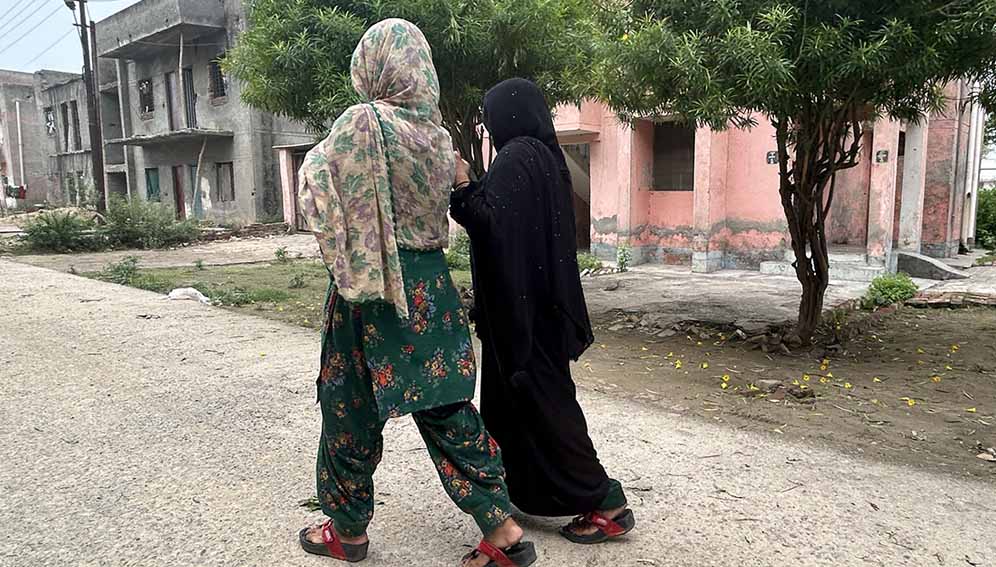
Shabiya and her mother. Indian women whose first-born is a girl may face higher mortality risks as son preference may push them into more pregnancies and shorter birth intervals.
But activists say law enforcement authorities can barely keep up with advances in ultrasound technology, such as portable devices which are now sold online.
Rajan Chaudhary, who runs Shikshit Rojgar Kendra Prabandhak Samiti (SRKPS), a non-profit to prevent sex-selective abortion in Rajasthan, has conducted several sting operations to bust such networks for two decades. Manisha worked with SRKPS in Jhunjhunu district to catch the doctor in the act.
Chaudhary said: “The device [used in Manisha’s case] was not even fully functional, and he was deceiving people for easy money.”
According to the UNFPA, unsafe abortion remains the third leading cause of maternal mortality in India; nearly eight women die daily due to causes related to unsafe abortion. Repeated sex-selective abortions can be extremely detrimental to the woman’s physical and mental health, experts note.
Discussions on sex determination often miss how deeply it impacts women. A 2018 World Bank paper found that in India, when a first-born is a girl, women are pressured to have more babies quickly, leading to severe anaemia, and gender-based violence.
Indian women whose first-born is a girl face higher mortality risks because son preference may push them into more pregnancies and shorter birth intervals—patterns the study links to 2.2 to 8.4 per cent of such women going “missing”.
Neelam Singh, a Lucknow-based gynaecologist who has fought illegal sex determination and abortion networks for over three decades, believes there will always be individuals willing to circumvent laws and regulations. “The root cause is India’s entrenched patriarchy,” she said, adding that “female foeticide and infanticide are practised across all religious groups, castes, literacy levels, and economic strata.”
The problem has also travelled with Indians migrating to the UK, where sex-selective abortion is prohibited. A UK government report found that there was a significant imbalance in the ratio of males to females at birth for children of Indian ethnicity in England and Wales for the period of 2017 to 2021.
“This may indicate that sex selective abortions are taking place,” the report noted, highlighting an estimated 400 sex-selective abortions in the five-year period.
UK birth registrations data shows that 118 boys were born for every 100 girls to Indian-origin mothers having a third child between 2023 and 2025: a ratio markedly higher than the UK national average of about 105.
“Indians see a son as an asset and a daughter as a liability,” Sumathi BG, an independent activist from Bangalore, explained. “Indian families want to determine the sex to abort female fetuses. That is the demand. And thus the supply of technicians, agents, quacks and doctors who want quick cash.”
Whack-a-mole
Portable and affordable ultrasound machines, both new and second-hand, are openly sold online and circulate through black markets, creating a whack-a-mole situation for authorities.
In the Jhunjhunu case, Chaudhary found that the radiologist ran a registered ultrasound centre in Jaipur, Rajasthan’s capital city, while also using a second-hand machine for an illegal and portable setup.
Sumathi said this is a common modus operandi across India: refurbished machines are rarely registered and licensed practitioners with one machine may have a second, portable one which is rented out.
For instance, in Mandya district in Karnataka, which has one of the lowest sex ratios in the state, quacks from Bangalore and Mysuru set up portable devices inside dingy jaggery factories located near sugarcane fields, Sumathi shared.
Agents brought ‘clients’ from faraway places. The sex determination and abortions were done in dangerous conditions. Police investigations revealed that hundreds of illegal abortions were conducted.
The police busted one racket in 2023, but another one came up within months, and more illegal operations were uncovered in 2025, she recalled. News reports revealed that the perpetrators used portable devices, but the police were unable to ascertain where the scanning machine was sourced from.
“Portable ultrasound machines are used to stay ahead of enforcement,” Singh noted.
Chaudhary explained: “Portability allows operators to move these machines across locations, set up temporary clinics, and shut them down quickly, making it extremely difficult for authorities to track, monitor, or catch them in the act.”
“This is a form of organised crime,” Sumathi added.
Across India, illegal sex determination operates in highly organised ways: mobile ultrasound units, often set up in cars or even autorickshaws, are common. In many cases, unsuspecting and often illiterate families are deceived by agents using pre-recorded videos or images of fetuses displayed on laptops, sometimes without any real examination taking place.
Over the years, Chaudhary has found that such machines are readily available with minimal verification, even when a registered licence is required.
“Refurbished ultrasound systems are 60-70 per cent cheaper while offering comparable performance for most routine clinical applications,” he said. The cost of new or pre-owned machines ranges from 200,000 rupees (US$ 2,148) for basic equipment to 5 million rupees (US$ 53,711) for high-end machines.
Hiding in plain sight
Advocate Varsha Deshpande, who won a United Nations Population Award in 2025 for her work advancing women’s rights and busting such illegal operations, said: “Networks of middlemen and brokers connect families to doctors who conduct illegal sex determination ultrasounds across India. Costs vary widely.”

Women’s rights advocate Varsha Deshpande addressing women against female feticide in Maharashtra.
Deshpande said in rural areas and among economically weaker sections, the service can be as low as 5,000 rupees (about US$53), while in cities it can go up to 200,000 rupees (US$2,148). There is an entire chain involved, with additional charges for the test and, in many cases, for subsequent foeticide if the fetus is female. Overall, these tests can range anywhere between 10,000 and 250,000 rupees (US$107 and US$2,650), Deshpande said.
In comparison, the penalties are pocket change for violators. First time offenders of the PCPNDT Act face imprisonment of up to three years, with a maximum fine of 10,000 rupees (US$107). Second time offenders face a maximum of five years of imprisonment and a fine of 100,000 rupees (US$1,074).
Such practices aren’t limited to illegal networks using portable machines. In registered centres, sex determination is performed and communicated to patients using codes. Signs such as “Prenatal determination of sex of the fetus prohibited” are common at radiology centres and gynaecologists’ clinics. But that’s hardly a deterrent.
Shabiya (not real name*), a 28-year-old from Uttar Pradesh’s Baghpat district, was taken to a scanning centre by her in-laws and her husband. They told her it was a routine checkup.
When she went in for the scan, the doctor told her: “Pray for the ultrasound report to be written with a blue pen instead of a red one.”
She was confused. “I had no idea what it meant,” she said. After the scan, the doctor told her: “Congratulations, I am using a blue pen”.
She realised blue ink meant a boy, while red meant a girl.
“My husband was relieved, and my in-laws patted his back. That’s when I got a sense of what had just happened,” she told SciDev.Net.
Her family paid 25,000 rupees (around US$ 268) to the doctor for determining the sex of the fetus.
In the western Indian state of Maharashtra, local activist Anandi Kale has uncovered several such networks in Solapur, Sangli, Beed, and Ahilyanagar districts. Like Manisha, she too has posed as a pregnant woman seeking sex determination tests. Doctors routinely used coded language, she noted.
“One of them simply wrote ‘100 per cent’ on my hand,” says Kale. Often used in local lingo to say someone’s doing well, here, getting 100 per cent means a male fetus. Anything less is a female fetus.
Such practices amount to a violation of the PCPNDT Act and can lead to imprisonment of up to three years for the first offence, along with fines, with stricter penalties for repeat offences. Medical practitioners violating the law may face suspension or cancellation of their license.

Neelam Singh, gynaecologist
Singh explained that under the PCPNDT Act, sex determination is permitted only in exceptional medical circumstances, such as when there is a history of chromosomal abnormalities in the family that could be fatal for the fetus.
“Any other use is illegal, yet violations remain widespread,” she said. Laws have barely prevented the misuse of technology.
Sumathi, who systematically uncovered several such networks in Karnataka, southern India, in the 2000s, says “it is the complete lack of medical ethics amongst doctors and nurses” and adds that India’s medical regulatory body “needs to take this seriously”.
SciDev.Net contacted India’s National Medical Commission and Ministry of Health for comment, but neither responded.
Organised crime
In 2022, a Parliamentary Committee found that over the last 25 years, 3,158 court cases were registered under the PCPNDT Act, but only 617 were convicted.
In the states of Rajasthan and Maharashtra, which had among the lowest sex ratios at birth (879 and 881 as per the 2022 data, respectively), there were hundreds of pending cases. In 18 of over 30 Indian States, there were no cases at all.
“The number of cases registered is nothing. It’s not even one per cent of what’s happening,” said Sumathi.
Singh noted: “The easy availability of second-hand ultrasound machines and the misuse of medical technology have made it even harder to regulate these illegal tests. This is not just a failure of law enforcement, but a deeply entrenched nexus that allows gender-biased sex selection to persist despite decades of prohibition.”
Every year, law enforcement agencies across the country announce raids and bust illegal networks. Yet the sale and use of such equipment continue largely unchecked. Crucially, there has been little sustained effort by the government or enforcement agencies to assess the scale of this market or understand how these networks adapt and persist, experts told SciDev.Net.
While laws to regulate such technology are decided by central government, health is a state matter in India. This means states with weaker implementation of the Act have thriving illegal operations.
Sabu George, a leading Delhi-based activist who has worked against female foeticide and infanticide for over four decades, told SciDev.Net that enforcement of the law varies widely across states.
Maharashtra is among the stricter states as far as the sale of ultrasound machines is concerned; Uttar Pradesh, Bihar, and Rajasthan continue to lag, George said.
“Couples seeking such tests often travel to other states to avoid detection,” George said.
Deshpande added: “Weak implementation of the PCPNDT Act [in some states] continues to enable such practices.”

Devender Kumar Dhama, founder of Navodaya Lok Kalyan Samiti, a charity focused on girls rights
Devendra Kumar Dhama, founder of Navodaya Lok Kalyan Samiti, a nonprofit working to advance the rights of a girl child and focusing on PCPNDT enforcement, told SciDev.Net: “Regulation is still trying to catch up with a marketplace that has already gone digital. Today, sex determination is no longer confined to clinics; it is enabled by cheap, portable technology and discreet online sales that are far harder to monitor.”
Very few Indian states have identified the need to regulate portable ultrasound technology.
In December 2025, Karnataka’s state health minister Dinesh Gundu Rao told the State Assembly that despite various regulations, people were using ultrasound technology to determine the sex of the fetus and spoke of the urgent need to control the practice. SciDev.Net reached out to Rao for a comment but didn’t receive a response.
Dhama warns that without tighter tracking of ultrasound sales, oversight of digital platforms, and whistleblower protection, “enforcement of the PCPNDT Act will remain reactive”.
He says this is a governance challenge at the intersection of technology and deep-rooted son preference. “The way forward demands smarter regulation that is as agile and networked as the systems it seeks to control,” he added.
SciDev.Net spoke to several women who helped with decoy operations. They said years later, they continue to receive calls from individuals linked to the accused. There’s pressure on them to withdraw complaints, assist in securing bail, or secure the accused’s release from jail in exchange for bribes.
Manisha, now a mother of two girls, gets these calls too.
Even where arrests are made, justice is not always delivered.
Kale recalled a decade-old case in Maharashtra where a doctor kept four large dogs chained within his premises. Investigations revealed the doctor and his wife were feeding the aborted fetuses to the dogs.
“Although he [the doctor] was arrested, he was released on bail and resumed his illegal practice,” she said. He was arrested on a second offence when female foetuses were found within a 15-kilometre radius of his clinic.
“These are the lengths people go to for the sake of having a boy instead of a girl child,” added Kale.
This article was produced by SciDev.Net’s Global desk.
* Full/real names have been withheld to protect the identity of some women interviewed for this article.