


By: Hazem Badr
Send to a friend
The details you provide on this page will not be used to send unsolicited email, and will not be sold to a 3rd party. See privacy policy.
[CAIRO, SciDev.Net] A devastating landslide in the western Sudanese village of Tarsin will be one of many to come unless preventative measures are taken, warn environmental scientists.
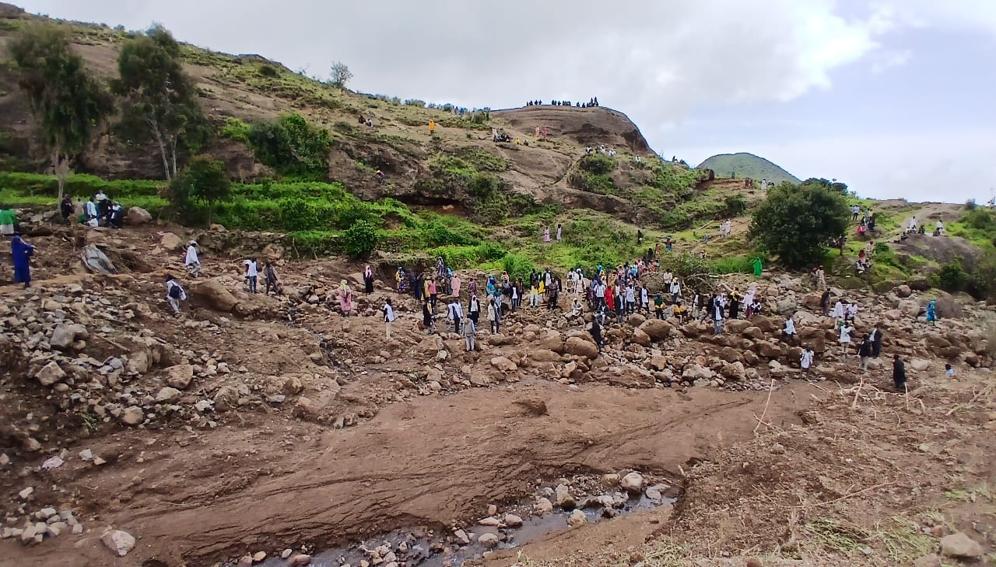
The village in the war-torn Darfur region was turned into a ruin on 31 August after days of heavy rain saturated the soil, causing rocks to tumble down the slopes of the Jebel Marra mountains.
Last week, Sudanese authorities said they had recovered at least 375 bodies from the rubble, including many children. UN agencies say the number of deaths is unverified, with ongoing search operations hampered by rugged terrain and persistent rainfall.
“The extreme climate the region is experiencing will increase the frequency of heavy rainfall in the coming years, and Sudan will face another trigger if preventive measures are not taken.”
Karem Abdelmohsen, associate researcher, Arizona State University, School of Sustainability
The tragedy reflects the harsh reality in Sudan where armed conflict has forced people to flee into the deep valleys of the Jebel Marra and live in temporary villages and shelters.
The settlements have become a death sentence for many, located in areas known to be at risk of deadly landslides at any time.
“There are factors that accelerate the occurrence of these landslides, as well as factors that slow them down,” said Karem Abdelmohsen, an associate researcher at Arizona State University’s School of Sustainability, in the US.
|
Keep Science Journalism Alive
SciDev.Net provides award-winning science news coverage free of charge. We rely on donations from readers like you. Donate to SciDev.Net now. |
||
|---|---|---|
“Unfortunately, armed conflicts have pushed the Sudanese to do things that increase the likelihood of their occurrence and the repercussions of climate change, represented by heavy rainfall, have accelerated the occurrence of this scenario.”
First line of defence
Extending vegetation cover is an effective solution that some countries adopt in areas at risk of landslides, such as Saudi Arabia’s Asir province.
The roots of trees and plants extend deep into the soil, binding it together and preventing it from sliding during heavy rains. Plant leaves also act as a shield to cushion the force of raindrops, limiting soil erosion.
Meanwhile, the roots absorb some of the rainwater and gradually release it, reducing soil saturation and increasing its cohesion.
In this way, vegetation becomes the first line of defence against landslides, explained Abdulmohsen, a researcher in geological and environmental sciences.
While some countries are investing in this solution, in Sudan it is “the complete opposite”, he said.
“Those who rushed to rugged areas far from armed conflicts cleared the vegetation cover to be able to settle.
“They built roads on the slopes without engineering planning and engaged in illegal mining and mining activities, which led to artificial seismic activity, all of which weaken the soil and rocks.
When heavy rains set in, it is “the trigger that sets off the fire, accelerating the occurrence of mudslides and rockfalls”, Abdulmohsen added.
Experts say the disaster in Tarsin illustrates the intersection of human factors, such as armed conflict, deforestation, and illegal mining, and environmental factors, such as heavy rainfall and the effects of climate change, which create the perfect conditions for a landslide of catastrophic proportions.
And it is not the first of its kind. In 2018, a landslide in Tarba, another small settlement in the Jebel Marra region, killed at least 19 people and injured dozens more.
Increased risk
“The extreme climate the region is experiencing will increase the frequency of heavy rainfall in the coming years, and Sudan will face another trigger if preventive measures are not taken,” warned Abdulmohsen.
These concerns are backed up by a 2024 study in the journal Scientific Reports, co-authored by Abdelmohsen, which predicted an increase in rainfall in the Nile basin this century.
“Sudan is in urgent need of addressing the threat of landslides that threaten villages and settlements in mountain valleys and gorges,” he added.
Elsewhere in the country, the rugged Nuba Mountains in South Kordofan and the Red Sea Mountains in eastern Sudan also host small villages on their slopes, which are similarly at risk.
Experts say the increasing risk of landslides calls for robust preventative measures, including relocating villages on mountain slopes, revegetating to stabilise the soil, and planning settlements away from steep slopes and gullies.
Monitoring slopes and vulnerable areas using geological surveys and early warning devices that detect soil movement is also essential to mitigating disasters before they occur.
Mohamed Al-Nayer, spokesman for the Sudan Liberation Movement, which controls the Jebel Marra region, told SciDev.Net: “We are open to all solutions, and we call on all international organisations to cooperate with us in implementing them.
“However, no proposal can be implemented unless the war, which is the primary cause of displacement to villages in the Jebel Marra valleys and ravines, stops.”
To prevent the tragedy of Tarsin village from being repeated in other villages in Jebel Marra, Al-Nayer urges international organisations to help relocate villagers to safe areas away from slopes prone to landslides. He is also asking for assistance to establish early warning systems capable of predicting such landslides well in advance.
Shible Sahbani, WHO representative in Sudan, told SciDev.Net. that a joint team of UN agencies, including WHO, had arrived in the area on Friday (5 September) to assess the situation.
He said the main challenge to a rapid response to the disaster was the difficulty of access, as the village is in a remote area, while the rainy season further complicates the task.
Regarding preventative measures to protect neighboring villages from the same fate, Sahbani said: “The assessment mission will conduct further investigations into this matter.”
This article was produced by SciDev.Net’s Middle East and North Africa desk.