


12/10/26
Extreme rainfall main climate threat to cocoa yields—study
By: Zoraida Portillo
Send to a friend
The details you provide on this page will not be used to send unsolicited email, and will not be sold to a 3rd party. See privacy policy.
[LIMA, SciDev.Net] Extreme rainfall is one of the biggest climate threats to cocoa yields in tropical regions, harming production even more than rising temperatures or water shortages, according to new research.
Cocoa production shortfalls threaten the livelihoods of nearly six million farmers who depend on the crop as their primary source of income, according to the study published in the journal PNAS.
However, researchers from Harvard University, in the US, say the drivers behind these shortfalls are poorly understood.
Analysing rainfall patterns in Ghana, Indonesia, and Ecuador—three of the world’s top cocoa producing countries—the scientists found that heavy downpours physically damage cocoa flowers and young fruit, disrupt insect pollination, and trigger fungal diseases from excess humidity.

Anna Lea Albright, a researcher in the Department of Earth and Planetary Sciences at Harvard University and corresponding author of the research, told SciDev.Net: “Heavy rains and winds can physically damage the flowers and young pods.”
“Cocoa depends on tiny insects for pollination, which heavy rainfall may disrupt, and very wet conditions promote fungal disease, particularly black pod, whose spores are splashed and spread by heavy rain.”
El Niño risks
The authors say their findings highlight how climate-crop forecasting can help smallholders adapt. They note that extreme rain is often predictable and tied to large-scale climate phenomena like El Niño.
During El Niño events, West Africa and Indonesia usually experience reduced rainfall, whereas coastal Ecuador and East Africa see severe downpours, the study finds.
Outside of El Niño events, the heaviest wet-season rainfall has been intensifying in West Africa, where about 70 per cent of the world’s cocoa is grown, says Albright.
Latin America accounts for 25 per cent of global cocoa production, with Ecuador—the region’s top producer—contributing about 12 per cent.
In Ecuador, an intense El Niño episode significantly increases the risk of a damaging rainy season, Albright noted. She says heavy rains along the Ecuadorian coast between February and April heavily impact harvest yields six to eight months later.
The findings take on a particular relevance as an intense El Niño event continues to strengthen ahead of expected peak in December.
Fungal diseases
Elizabeth Johnson, a cocoa specialist at the Inter-American Institute for Cooperation on Agriculture who was not involved in the study, told SciDev.Net that there is a direct link between heavy rainfall and fungal outbreaks.
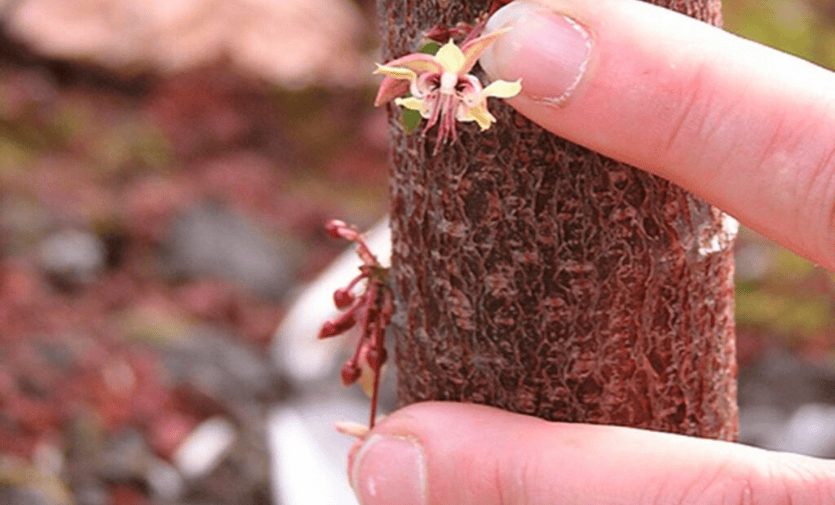
Cacao flower. Excessive rainfall can damage the flowers, which are essential for blooming and pollination of the plant. Image credit: World Agroforestry Center, under Creative Commons CC BY 3.0 license.
“These persistently humid conditions can favour the development and spread of several important fungal diseases,” Johnson said.
Peter Huybers, a researcher at Harvard University and co-author of the study, says black rot—also known as black pod disease—is a primary culprit.
“[The fungal] infection appears about a week after a rain event and spores disperse by splash,” he told SciDev.Net.
Direct physical damage to flowers and young pods also poses a risk during the wet season, as does waterlogging in low-lying coastal plains that can flood during El Niño events, he added.
Unanswered questions
However, independent experts stress that rainfall impacts vary based on farm conditions.
William Melo Zipacón, an agro-environmental researcher at the Alliance of Bioversity International and CIAT, noted that the same amount of rain does not impact all cocoa crops in Latin America equally.
“The effect of extreme rainfall is likely to be greater when it occurs on a system planted with susceptible clones, with inadequate levels of shade and low levels of technical management, especially deficiencies in maintenance and sanitary pruning,” Zipacón told SciDev.Net.
He added that while the analysis shows a link between climatic variables and reduced yield, it does not determine how much of that is to blame for damage to the plants, changes to pollination, or diseases.
“It’s a good approach to understanding the problem, but it raises new questions that should be addressed with detailed field studies,” he said.
Rey Gastón Loor, leader of the cocoa programme at the National Institute of Agricultural Research of Ecuador, argues that extreme rainfall does not necessarily mean yield loss.
“Cocoa plants need water stress, whether positive (water) or negative (drought), to be able to express flowering within their physiological cycle,” said Loor, who was not involved in the study.
He added that when rainfall is excessive or prolonged, the plant enters “an alert state” and when rainfall begins to decrease, it responds by flowering, which delays the harvest.
Equipping farmers with early warnings
Loor agrees, however, that farm management must adapt to extreme weather, especially during El Niño cycles.
“We’re talking about drainage for the low-lying areas, where, if the cocoa remains flooded for three or four days, the accumulated water must be drained,” he said, adding that sloping agroforestry systems are naturally safer from flooding.
Huybers believes a specific risk alert for cocoa crops would allow farmers to respond. The researchers are already working with partners in Ecuador and West Africa to translate heavy rain forecasts into actionable information for farmers.
An effective alert should link rainfall prospects with the most suitable times for pruning, sanitation work, fungicide application and drainage preparation, he said.
This article was produced by the Latin America and Caribbean edition of SciDev.Net