


07/10/26
Extreme heat increasing pregnancy complications—survey
By: Ruth Douglas
Send to a friend
The details you provide on this page will not be used to send unsolicited email, and will not be sold to a 3rd party. See privacy policy.
[SciDev.Net] Extreme heat has led to a marked increase in the risks faced by pregnant women and their babies, according to a survey of 1,000 healthcare professionals in countries including Brazil, India and Zimbabwe.
The survey, commissioned by the medical research foundation Wellcome, found that 73 per cent of maternal healthcare professionals had seen an increase in heat-related complications in the past five years. More than three quarters reported an increase in harm to the foetus or newborn babies over the same period.
The findings, which also include Australia and the UK, add to a wealth of scientific evidence linking extreme heat with poor pregnancy outcomes, including maternal deaths and pre-term births.
Nearly every health professional who responded said they had cared for a pregnant woman or baby whose health was affected by extreme heat.

The findings were released on Monday (5 October) at a pre-COP summit in Fiji, where Wellcome launched a global call to action on heat and women’s health, ahead of the UN climate summit COP31 in Antalya, Türkiye, in November.
‘Invisible killer’
Julia Gillard, chair of Wellcome and former prime minister of Australia, said no woman should have to fear that extreme heat will harm her baby.
“Extreme heat is an invisible killer, but pregnant women must not be invisible,” she said.
“Leaders have the evidence and solutions they need—now they must act.”
Around a quarter of the survey respondents had seen pregnancy complications that they believed were linked to extreme heat and which needed monitoring or treatment.
More than a third also reported low birth weight or restricted growth, dehydration and heat-related illness in newborns. Difficulties in feeding, breathing and temperature regulation were also common.
More than 90 per cent wanted more training and resources to protect pregnant women during severe temperatures.
Wellcome is calling on governments to prioritise pregnant women and their babies in national climate plans, with specific funded measures to protect them from extreme heat.
The charity has invested more than £20 million in research to understand the risks of extreme heat during pregnancy and test local solutions.
Low-cost solutions
Fortunate Machingura, Zimbabwe country director at the Wellcome Consortiums, leads research for HAPI Zimbabwe, a study looking at how measures designed with local communities can reduce heat risks such as dehydration during labour, preterm birth, and heat strain. The study is working with 1,600 women in urban South Africa and rural Zimbabwe.
Low-cost measures being tested include a heat alert system that provides personalised smartphone warnings, relayed by community health workers to women without phones, cooling kits that support hydration and sun protection, and reflective roofs to cool buildings.
Other interventions are even simpler: families share demanding tasks and schedule work for cooler hours, while male “heat champions” help fetch and store water.
For Machingura, these measures make it possible to protect pregnant women from the worst effects of heat.
“Advice means little if water is kilometres away,” she told SciDev.Net.
“HAPI engages families, women’s groups, chiefs and maternity services, asking men to share responsibilities women often carry alone.”
Demanding work, water insecurity and heat-retaining buildings add to the heat stress for women in the northeastern Mount Darwin district, home to the country’s first Climate Health Demonstration Laboratory, says Machingura.
She says early findings of the study here found significantly lower levels of dehydration among women who received the HAPI intervention compared with those who did not.
Record heat
The findings come as the European earth observation programme Copernicus declared August as the joint warmest month ever recorded, tied with July 2023. It also comes amid an intensifying El Niño event, which is affecting temperature patterns.
India has experienced acute heatwaves this year, with temperatures exceeding 45 degrees Celsius in some regions.
Neelam Singh is chief functionary of the Indian non-profit Vatsalya, which works to improve the health and wellbeing of women and girls, particularly in India’s Uttar Pradesh. She says the survey findings reflect the heat-related health challenges Vatsalya is seeing on the ground for women in pregnancy and after childbirth.
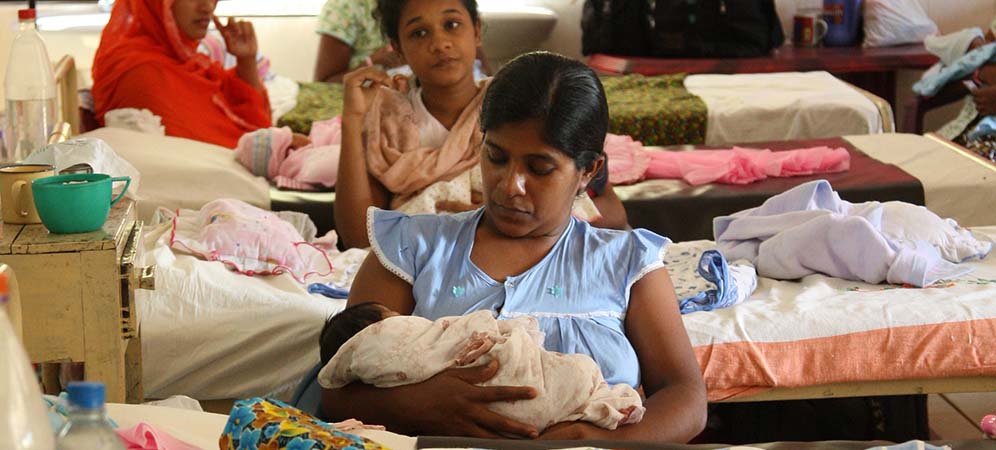
Mothers and their newborn babies in the pre-natal and post-natal care units of Mawannalla hospital, Sri Lanka. A survey commissioned by Wellcome found that 73 per cent of maternal healthcare professionals across five countries have seen an increase in heat-related complications in the last five years. Photo credit: Simone D. McCourtie / World Bank (CC BY-NC-ND 2.0)
“In particular, excessive heat can contribute to dehydration and physical exhaustion during pregnancy, while also potentially affecting foetal well-being and newborn health,” Singh told SciDev.Net.
“We have also observed that heat and associated dehydration adversely affect women during the postpartum period, including their ability to initiate and sustain adequate lactation,” she said, adding that data to quantify this is currently lacking.
Previous studies, however, have evidenced a clear link between heat and adverse pregnancy outcomes. A study published in the journal Environment International concluded that 1.4 per cent of premature births can be attributed to heat during the warm season—equivalent to 855 cases per million births. The study featured by SciDev.Net’s Latin America and Caribbean edition analysed data from 13 countries over a 40-year period.
Climate ‘faultline’
Speaking at a ministerial meeting organised by Wellcome in Fiji on Monday (5 October), Simon Stiell, head of the United Nations Framework Convention on Climate Change said extreme heat was making pregnancy the “new faultline” of the climate crisis.
Reflecting on the survey data, he said: “Behind those numbers are human stories: an expectant mother’s journey to clinic delayed by dangerous heat; a midwife working through unsafe temperatures; a newborn needing specialist care.”
He added: “A safe birth is already too often shaped by geography, income and access to care. Without action, extreme heat will widen that injustice.”
This piece was produced by SciDev.Net’s Global desk.