
Skip Navigation

News

  • Print
  • Comment
  • | Share

Artificial leaf that harvests solar energy makes debut

Source: Science

1 April 2011 | EN

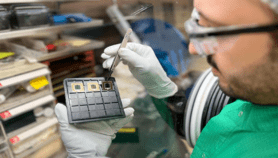
Daniel Nocera's lab research

Testing a water-splitting catalyst for the 'artificial leaf'

Donna Coveney/MIT

An artificial leaf that can turn sunshine into electricity was showcased last week at a chemistry meeting.

Its inventors hope they have overcome a key obstacle to making a cheap technology that could provide the poor with energy using just sunshine and water as inputs.

Daniel Nocera, a chemist at the Massachusetts Institute of Technology in the United States, told a meeting that he has built a silicon 'leaf' that is about the size and shape of a playing card. It is coated on both sides with catalysts and needs to be immersed in water to work.

When the silicon absorbs the sunlight, it passes the energy to the catalysts which split the water into hydrogen and oxygen molecules. The resulting hydrogen molecules can be collected and either burned directly or converted to electricity via a fuel cell. In either case the byproduct is water, so the leaf has the potential to create a cheap, clean and readily available source of fuel.

"You literally walk outside, hold it up and it works," said Nocera, who presented his unpublished work at the biannual meeting of the American Chemical Society.

"It's spectacular", Robert Grubbs, a chemist at the California Institute of Technology, told Science.

Nocera, who is also a founder of a spinoff company, Sun Catalytix, said that he hopes to commercialise the technology within 2–3 years.

He is also joining forces with Ratan Tata, chair of Tata Group, an Indian conglomerate, in the hope of producing a refrigerator-sized power plant that can convert sunlight and water into electricity.

Link to full article in Science

Link to SciDev.Net's spotlight Solar Power for the Poor

References

Science doi: 10.1126/science.332.6025.25 (2011)

Comments (8)

Dr.A.Jagadeesh ( Nayudamma Centre for Development Alternatives | India )

4 April 2011

Excellent. Such innovations will help generate energy on demand for developing countries.

Dr.A.Jagadeesh Nellore (AP), India

Nagesh Hegde ( India )

6 April 2011

Why go through such a complicated route to produce hydrogen? Almost every village produces cowdung. Why not produce biogas (methane) and then obtain hydrogen? The next step is to link it to a readily available fuel cell.
Nagesh Hegde

orion ( France )

8 April 2011

Cowdung is useful as a fertilizer in agriculture, sun is free.
Excellent innovation.

Tomorrow-360 ( Grenada )

26 April 2011

Good comment, I welcome this idea.

Omoaye ( Nigeria )

6 May 2011

This is a good work and well appreciated becasue it targets the rural poor. well done

Terry ( Red Plough International | Thailand )

13 January 2012

Fantastic. Bravo. This could do more to alleviate poverty than all the projects to date-if "the poor" are allowed to afford it.

DEV ( Albania )

13 January 2012

Orion - France - cowdung is used as fertiliser even after methane gas emmited by it used as fuel. Hence there is nothing like it's use "EITHER AS FERTILISER OR AS FUEL".

Eric Ferguson ( Netherlands )

15 January 2012

Of course it works, but it has no practical significance unless it is cost-competitive with other types of solar panels. The crucial price is how much useful energy flow you get per unit of investment (daily mean Watt per Euro). Land cost is probably of secondary importance.

Add your comment

This is your network: share your views on any of our articles by adding your comments.

You need to be signed in to post a comment or to email a consenting comment author. Please sign in or sign up.

All comments are subject to approval and we reserve the right to edit comments containing inappropriate/unsuitable language. SciDev.Net holds copyright for all material posted on the website. Please see terms of use for further details.

All SciDev.Net material is free to reproduce providing that the source and author are appropriately credited. For further details see Creative Commons.

Back to News
To the top