

Send to a friend
The details you provide on this page will not be used to send unsolicited email, and will not be sold to a 3rd party. See privacy policy.
[JOHANNESBERG] Scientists in South Africa have won an award for work that could lead to a safer, cheaper treatment for people bitten or scratched by rabid animals.
GreenPharm — a spin-off biotechnology company based at South Africa’s Council for Scientific and Industrial Research (CSIR) — won the country’s first Bio Business Plan award last month (9 December).
The scientists were awarded 100,000 rand (around US$10,600) in prize money and the possibility of investment of up to US$1.6 million.
When someone is bitten by a rabid animal, the ideal treatment is wound cleaning, neutralisation of the virus with an injection of antibodies and activation of the immune system with the rabies vaccine. But the expense of rabies antibodies means few supplies exist in developing countries, including most of Sub-Saharan Africa.
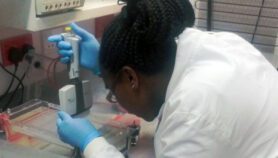
Zimbabwean plant biotechnologist Rachel Chikwamba, a research fellow at CSIR biosciences unit and principal investigator at GreenPharm, is leading a team using genetically modified tobacco to produce rabies antibodies.
The antibody drug, Rabivir, "is potentially cheaper than existing vaccines as it will be extracted using relatively simple technology from tobacco leaves, which are cheap to grow and can guarantee a reliable supply," says Chikwamba.
She says Rabivir is likely to be safer than current antibodies. Samples of human or equine antibodies can be contaminated with potentially fatal pathogens such as hepatitis, "especially in Africa where serious blood-borne infectious diseases are prevalent".
The drug is undergoing animal tests — due to be completed by the end of February — on infected mice, says Ereck Chakauya, a biotechnologist from the University of Zimbabwe and project manager at GreenPharm. Earlier laboratory tests indicated the antibodies were effective against the major African rabies strains.
If permission for human testing is obtained, CSIR plans to scale up production to supply the antibody to members of the Southern African Development Community. But Chikwamba warns: "It’s early days yet as the process entails completion of in vivo animal experiments, production of clinical batches and all phases of human clinical testing."
The rabies antibodies could also be used in the manufacture of cheaper diagnostic tests for rabies, and in capturing samples of the rabies virus in the laboratory for genetic characterisation, says Chikwamba.
Rabies, a viral infection of the nervous system transmitted by animal bites, kills around 50,000 people each year, mainly in Africa and Asia.
More on Funding