

By: Maina Waruru
Send to a friend
The details you provide on this page will not be used to send unsolicited email, and will not be sold to a 3rd party. See privacy policy.
A group of the world’s top environmental scientists have backed calls for replacing the gross domestic product (GDP) as a sole measure of a nation’s economic wealth with more inclusive indicators that would consider the impact of economic growth on the well-being of the environment.
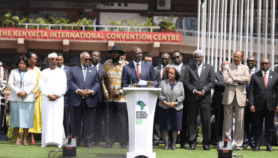
Relying only on GDP ignores important aspects of a nation’s well-being such as sustainable development and threats to the environment, they said in a report presented at the UN Environment Programme’s (UNEP) 12th special session of the governing council in Nairobi, Kenya, this week (20–22 February).
The report, ‘Environment and Development Challenges: The Imperative to Act’, was prepared by laureates of the Blue Planet Prize, known unofficially as the Nobel prize for the environment.
"Governments should recognise the serious limitations of GDP as a measure of economic growth and complement it with measures of the five forms of capital, built (produced); natural; human; social; and institutional/financial capital," the report said.
This would be "a measure of wealth that integrates economic, social and environmental dimensions, and is a better method for determining a country’s productive potential".
Bob Watson, lead author of the report, told SciDev.Net: "When we capture a people’s wealth by their ability to buy drugs to fight diseases caused by air pollution in the process of exploiting natural resources in order to create wealth, that cannot be said to a true measure of wealth."
"Wealth measurement must be more sophisticated … It must go beyond GDP and include ecosystems services, and the quality of water, air and food produced in a given area," he added.
The degradation of ecosystems services and loss of biodiversity resulting from human activities are widespread, said the report. This is especially so across the developing world, and even in many of the places where government and World Bank figures report impressive economic growth rates.
Watson said governments and policymakers should heed the laureates’ advice on the need for policy changes rather than waiting for technological innovations to solve problems.
The report said that agriculture, energy and transport subsidies that create environmental and human costs should be eliminated.
"Unclean technologies that deplete the environment … must not be subsidised by governments," said Camilla Toulmin, director of the International Institute for Environment and Development, based in the United Kingdom.
The report also calls for more investment in knowledge creation and sharing, through research and the training of policymakers, civil society and local communities.
Anada Tiaga, secretary-general of Ramsar Convention on Wetlands, told SciDev.Net, that a healthy environment was critical to striking a balance between nature and economic development.
Mustapha Darboe, deputy secretary in the ministry of Forestry and Fisheries in the Gambia, said: "A cost-benefit analysis factoring in human, social and environmental impact in assessing economic growth is critical. In Africa, ratings often do not look at the environment and ask what state of nature have we left behind for future generations as we seek grow richer".
The paper will form part of presentations made by UNEP at the UN Conference on Sustainable Development (Rio+20) in June.
Link to full report  [792kB]
More on Pollution