


23/05/25
Uganda’s snack crickets chomp on food waste
By: John Musenze
Send to a friend
The details you provide on this page will not be used to send unsolicited email, and will not be sold to a 3rd party. See privacy policy.
This article was supported by SGCI.
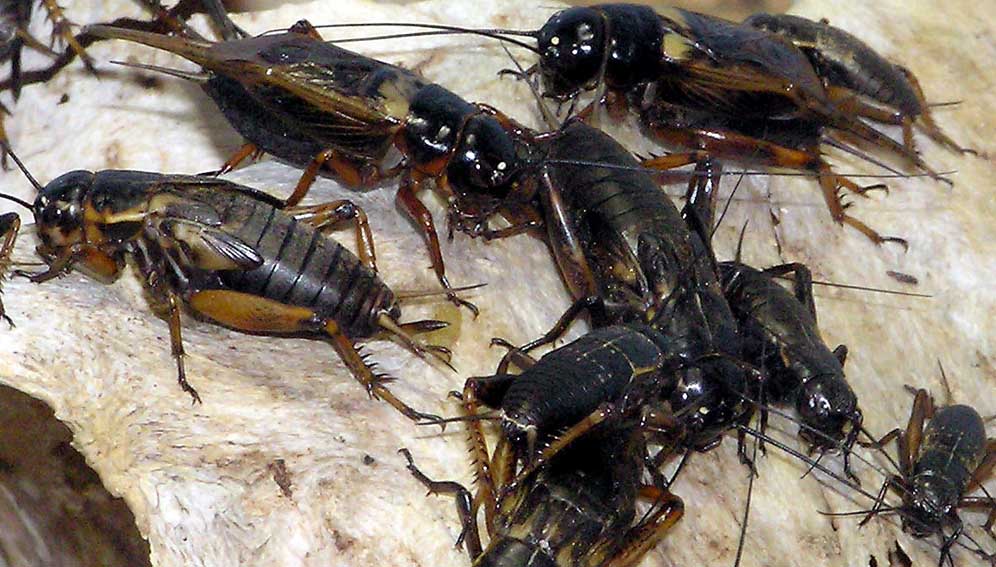
[KAMPALA, SciDev.Net] In Uganda’s Masaka district, Josephine Nabbanga tends to her growing colony of crickets.
High in protein, the insects are a popular snack in Uganda and an important food source for humans and animals.
Like many small-scale farmers across the country, Nabbanga used to rely on poultry feed to nourish her insects, an option she says was expensive and unreliable.
Things changed for her when researchers from Uganda Christian University (UCU) began supplying farmers with a new, locally formulated cricket feed made from domestic food waste.
The feed, designed specifically for cricket farming, is not only cheaper but more efficient.

Lead researcher Geoffery Ssepuuya talks to local suppliers of food waste, which he turns into cricket food. Photo courtesy of John Musenze.
“We saved a lot of money,” said Nabbanga.
“This is a game changer we intend to use for our piggery too, not just crickets.”
Nabbanga represents thousands of small-scale cricket farmers across Uganda struggling with both the rising cost of animal feed and the growing burden of uncollected urban food waste.
Double solution
Cricket farming provides a promising and eco-friendly protein alternative, but the cost of feed — around US$0 .68 per kilogram for poultry mash — has stunted its growth.

Formulated feeds for crickets processed from food waste. Photo courtesy of John Musenze
To address this, a team led by Geoffrey Ssepuuya, a senior lecturer at UCU, launched a project in September 2023 to develop low-cost, high-protein cricket feed from food waste.
“We are using one problem to solve another,” Ssepuuya said. “We have a waste problem and a feed problem. By converting food waste into cricket feeds, we are solving both at once.”
With support from the Science Granting Councils Initiative (SGCI), the project received US$29,473 in the first phase to develop and test the feed formulations, and US$63,750 in the second phase to build a cricket production facility, package the feed, and establish a system for sorting and collecting food waste.
Collected food scraps such as banana peels and rice are heat-treated, dried, ground into powder, and blended into nutrient-rich cricket feed.
According to Ssepuuye, the result is a feed comparable to commercial broiler starter mash, helping crickets mature in eight to ten weeks, compared to 12 weeks with traditional local feeds.
Ssepuuye said the feed was designed to support quick growth and high reproduction as crickets lay hundreds of eggs, so numbers can increase fast.
Clogged drains
According to the Kampala Capital City Authority (KCCA), only 45 per cent of the city’s 481 kilotonnes of solid waste is collected daily, leaving the majority to clog drainage systems and pollute the environment.
“Uncollected waste ends up in trenches, causing floods when it rains,” said Daniel Nuwabiine, KCCA spokesman. “We need partners and solutions like this. We welcome this innovation.”
Ssepuuya says up to three tonnes of food waste per day would be used, providing a cleaner, more sustainable feed than animal-based products.
“Go to the slaughterhouses and see the waste and smell what it produces,” he said. “Cricket farming doesn’t come with any of that burden.”
Beyond environmental benefits, the project has the potential to boost household incomes and national nutrition.
With a cheaper feed supply, farmers can scale up their cricket operations, sell both mature crickets and eggs and earn more.
Restaurants and markets, in turn, become suppliers of food waste, creating a circular economy.
The project team plans to seek certification from the Uganda National Bureau of Standards, a necessary step before large-scale commercial rollout.
SGCI is a multilateral initiative established to strengthen the institutional capacities of public science funding agencies in Sub-Saharan Africa to support research and evidence-based policies that will contribute to economic and social development.
This piece was produced by SciDev.Net’s Sub-Saharan Africa English desk.