


03/11/26
Paper records slow Tanzania’s digital health push
By: Syriacus Buguzi
Send to a friend
The details you provide on this page will not be used to send unsolicited email, and will not be sold to a 3rd party. See privacy policy.
This article is supported by SIDA
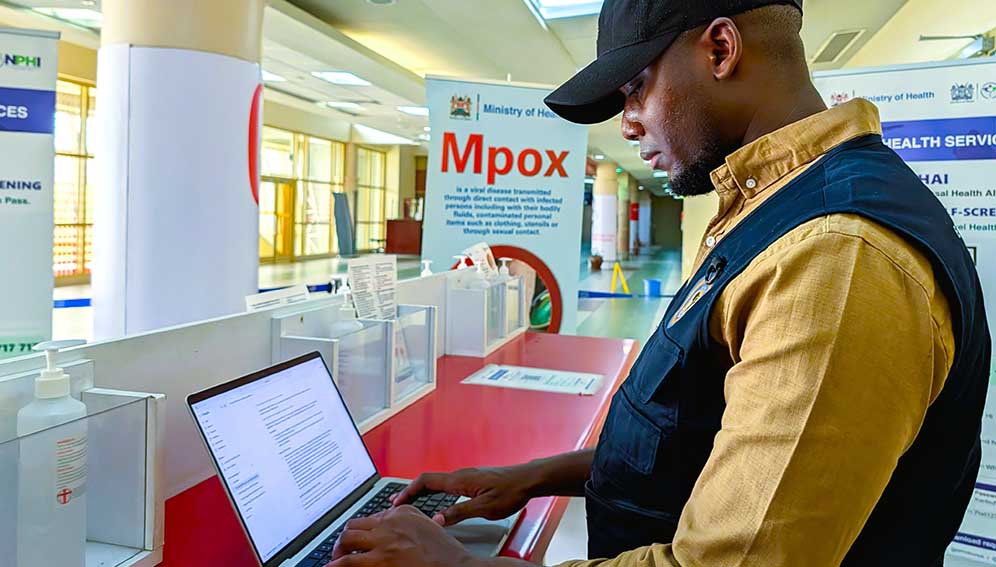
[DAR ES SALAAM, SciDev.Net] Electronic medical records, aimed at improving patient care, coordination, and efficiency, have become common practice in Tanzanian hospitals. But researchers warn that doubling up with paper records could be costing health workers valuable time and accuracy.
A study by researchers from Muhimbili University of Health and Allied Sciences (MUHAS) and the University of Dodoma found that unreliable infrastructure, system failures, and organisational constraints are slowing the full transition to digital records in the country.
The researchers say continuous training, better infrastructure, and stronger institutional support is needed to help Tanzania’s primary healthcare facilities ditch their paper records and go fully digital.
Published in the Records Management Journal, the study examined electronic medical record use among 41 healthcare professionals across six health facilities in Tanzania’s Iringa Urban and Manyoni districts.
The researchers assessed the practical use of the Government of Tanzania Hospital Management Information System (GoT-HoMIS), including access to computers, electricity and internet connections. They examined the challenges healthcare workers face alongside Tanzania’s digital health policies.
Training for digital health
For Joseph Makaranga, lead author of the study and a lecturer in the Department of Information Systems and Technology at the University of Dodoma, one challenge is ensuring healthcare workers have the skills to keep pace with changes in digital systems.
“The healthcare workers have been receiving capacity building training but the trainings are short-term,” he told SciDev.Net.
“Also, these digital systems are upgraded from time (to time), which requires an update in the skills, in addition to the fact there are new employees who also need to be trained. This leaves them with a skills gap.”
Makaranga wants to see the curriculum at health training institutions updated to include digital health. He also called on policymakers to set a firm deadline for completing the transition to digital systems and phasing out paper records across health facilities.
Infrastructure gaps
Introducing electronic medical records does not necessarily mean a health facility has fully transitioned to digital workflows, the study found. Transitioning away from paper requires reliable electricity, functioning hardware, internet connectivity, trained users, and ongoing technical support.
Makaranga warns that maintaining paper and electronic records in parallel increases the workload of health care staff and could affect the quality of health data.
In the six facilities assessed, technical problems—such as unreliable network connectivity, power outages, inadequate hardware, and system failures—accounted for more than half of reported challenges. Organisational constraints accounted for around a third, while staff capacity gaps were also common.
Paper records may still be needed when electronic systems are unavailable or established procedures demand physical documentation. But Makaranga warns that maintaining parallel systems increases staff workload and threatens overall health data quality.
Felix Sukums, a co-author of the study and senior lecturer and researcher in digital health at MUHAS, says the research provides concrete evidence of the challenges involved in moving from hybrid systems to paperless medical records in resource-limited settings.
He says the study offers “context-specific evidence” that could inform policy and practice on the integration of digital systems into Tanzania’s primary healthcare services.
Beyond the technology
Timothy Ayebare, a senior systems engineer at the East, Central and Southern Africa Health Community, a regional body comprising 11 member states, says the findings reflect broader challenges he has encountered across Sub-Saharan Africa.
He told SciDev.Net: “Building the technology is often the easier part. The greater challenge is creating the environment that allows it to truly transform healthcare delivery.”
Drawing on his experience building digital health infrastructure in Rwanda, Zambia, Malawi, São Tomé and Príncipe, and Mozambique, Ayebare says health facilities can have sophisticated digital systems but still depend on paper when connectivity, infrastructure, digital skills, technical support and institutional processes fail to advance at the same pace.
“When health workers remain dependent on paper and sometimes end up doing the same work twice, our next investment must go beyond software and strengthen the entire digital health ecosystem,” Ayebare added.
He stressed that digital health programmes should not be judged simply by the number of systems deployed, but by whether they reduce the burden on health workers, improve the quality and use of data, and improve healthcare delivery.
The researchers caution that, because the study covered only six facilities, further research is needed to know whether the findings reflect the situation across Tanzania.
This piece was produced by SciDev.Net’s Sub-Saharan Africa English desk.