


18/11/26
Ebola reporting by SciDev.Net speeds protection for responders
Send to a friend
The details you provide on this page will not be used to send unsolicited email, and will not be sold to a 3rd party. See privacy policy.
In brief
When a new Ebola outbreak was declared in the Democratic Republic of Congo (DRC) in May 2026, SciDev.Net was the first media outlet to report a critical shortage of personal protective equipment (PPE) for health workers in Mongbwalu, the outbreak’s epicentre.
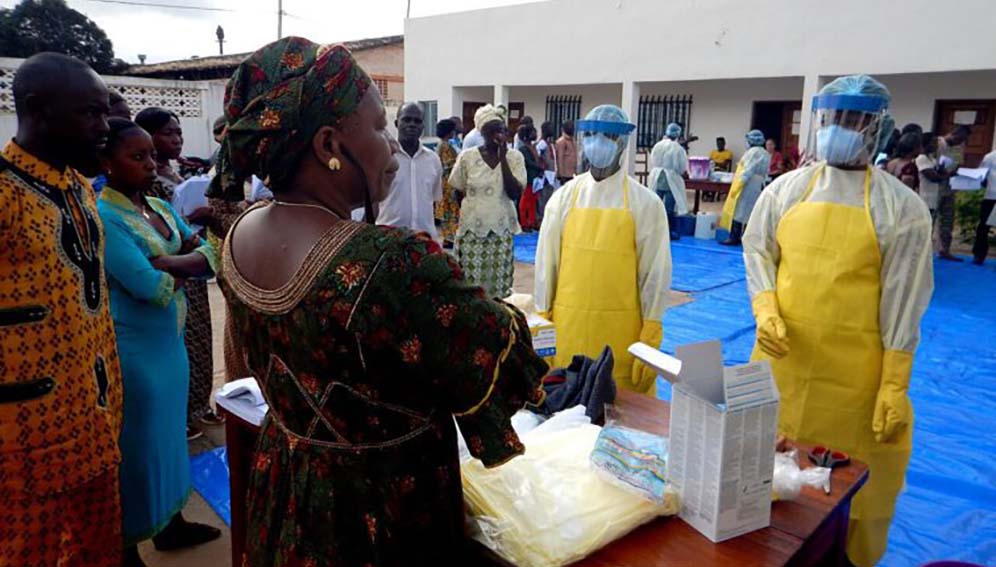
Lacking basic PPE, frontline medical staff faced severe infection risks while attempting to treat patients. SciDev.Net’s investigation exposed this life-threatening gap, prompting the DRC’s Public Health Emergency Operations Centre to investigate and confirm the findings. Subsequently, the centre dispatched emergency protective gear to the affected area, helping doctors and nurses to provide vital patient care safely.
Why it matters: Before the article was published, the fear of contracting the virus left many health workers hesitant to treat patients. The rapid delivery of protective gear—catalysed by SciDev.Net’s reporting—helped improve frontline safety for the emergency response in what became the country’s deadliest outbreak.
The big picture: Equipping healthcare personnel remains a systemic challenge across Africa, and particularly in the DRC, where exposure to infectious diseases among frontline workers can result in illness and death.
In numbers: The rare Bundibugyo species of Ebola virus at the centre of the outbreak has an average case fatality rate of around 40 per cent. The outbreak in DRC has become the nation’s largest and deadliest on record, reaching over 11,000 cases and 5,387 deaths by November.
Context
On May 15, 2026, the DRC officially declared its 17th Ebola outbreak, in the eastern Ituri Province’s Mongbwalu health zone. Genomic testing identified the virus circulating in DRC as the rare Bundibugyo species of Ebola virus, which has previously been linked to only two other outbreaks and for which there is no approved treatment or vaccine.
Lessons from the 2014–2016 West Africa outbreak showed that containment hinges on full-body protective gear to prevent contact with infectious body fluids. Through its local reporting network in the DRC, SciDev.Net was the first to expose that Mongbwalu’s frontline staff lacked these essential protective suits. The gap represented a major obstacle in the fight to contain the spread of the disease.
What action did SciDev.Net take?
After sources alerted our journalists to this situation, SciDev.Net launched a swift investigation to verify the claims on the ground. Kinshasa-based correspondent Maghene Deba led the reporting, gathering evidence from local health authorities, doctors, civil society members, and academic experts.
Frontline medical staff—notably Ruben Dedja, chief physician of the Mongbwalu health zone—spoke candidly to SciDev.Net. They described the distress and abandonment felt by many health workers over the lack of protective equipment.
On 20 May 2026—just five days after the outbreak was declared—SciDev.Net published the article DRC: Healthcare workers ill-prepared for the new Ebola flare-up. The story was translated into English and amplified across our digital platforms. To date it has been viewed more than 3,500 times in French and nearly 10,000 times in English.
What was the impact of SciDev.Net’s article?
The article triggered immediate government action. Following publication, an official from the DRC’s Public Health Emergency Operations Centre contacted Deba to verify the reported accounts. Public officials also contacted the reporter, Dedja, who confirmed the accuracy of his statements regarding the PPE shortage.
Two days later, the operations centre dispatched emergency personnel, Red Cross support teams, and protective gear directly to Mongbwalu.
By bringing critical frontline shortages to national attention, SciDev.Net’s reporting accelerated emergency supply delivery, safeguarded healthcare responders, and helped strengthen patient care during a major public health crisis.