


18/06/26
Can AI stop mass fish deaths on Lake Victoria?

By: Davis J. Weddi
Send to a friend
The details you provide on this page will not be used to send unsolicited email, and will not be sold to a 3rd party. See privacy policy.
This story was supported by the Pulitzer Center.
[DUNGA BEACH, Kenya] For years, fish farmers at Dunga Beach, along Kenya’s stretch of Lake Victoria, lived with a dread that never really left them. They could end one day looking out at cages packed with healthy tilapia and begin the next staring at a surface strewn with dead fish.
Their entire catch would be lost overnight, with little warning and even less explanation.
“Then one day in early February 2026, farmers’ phones began vibrating with text messages,” says fish farmer Paul Ochieng at Dunga Beach in Kisumu.
An AI-powered underwater monitoring system deployed in the lake had detected a dangerous drop in dissolved oxygen beneath the lake’s surface, triggering urgent SMS alerts to more than 300 fish farmers.
Within hours, led by leaders of the Dunga Beach Management Unit (BMU), they were towing cages, coordinating by phone, and shifting stock into safer waters. Ochieng says more than 450 cages of tilapia had been moved. This time, the mass deaths did not happen.
Instead of mourning another catastrophic loss, farmers and local fishmongers gathered on the shore in disbelief.
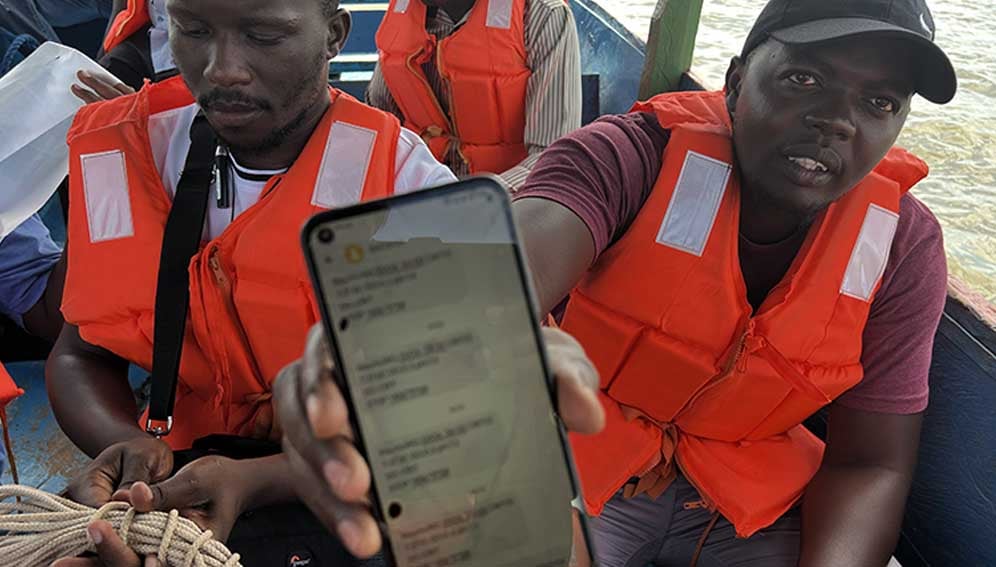
Dunga Fish farmer Didi Victor showing off text messages sent to his phone by the AI early warning system. Photo by Davis J. Weddi / SciDev.Net
Didi Victor, a fish farmer at Dunga Beach, tells SciDev.Net: “This is a miracle. This is one of its kind on Lake Victoria.
“We used to have fish kills, and we never knew what was happening.”
He waved his phone showing screenshots of the alert, pointing to the dissolved oxygen reading that had dropped below 2.0 milligrams per litre, the threshold fishers have come to fear.
What these farmers are calling a miracle is, in fact, the result of years of scientific investigation, local innovation and a partnership between public researchers and private technologists.
After years of studying repeated fish kills on the lake, the Kenya Marine and Fisheries Research Institute (KMFRI) decided to work with Nairobi-based ShoShin Innovation Hub to build and deploy an artificial intelligence (AI)-enabled early warning system designed to detect dangerous changes in water quality before they turn fatal.
Sensors are deployed underwater to collect water-quality data, which is sent through gateways to ShoShin’s servers in the cloud, where AI analyses the patterns. Farmers then receive simple SMS alerts with actions like “slow feeding” or “move cages” to avert fish deaths.
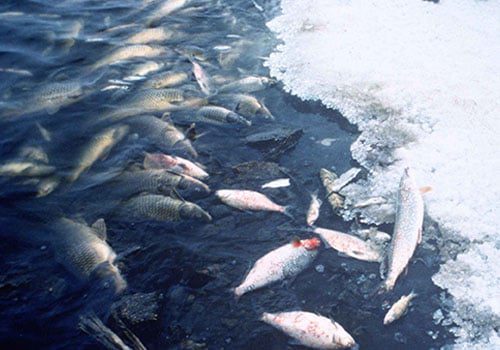
Dead fish floating in a cage. According to KMFRI many mass fish kill events on Lake Victoria happened when fish suffocated due to depleted oxygen and pollution.
For the farmers of Dunga, the stakes could hardly be higher. Between 2024 and 2025, fish deaths in the area had wiped out nearly US$1 million worth of stock, according to ShoShin Innovation Hub CEO Naftal Obwoni.
Cage farming on Lake Victoria had promised a new era of commercial aquaculture and income growth, but the promise kept colliding with a brutal reality: fish could die in huge numbers without warning, leaving farmers to absorb losses on feed, fingerlings, loans and labour.
These events were becoming all too familiar. For the last few years, cage farmers around Dunga Beach have reported repeated mass fish mortalities, part of a wider pattern that has shaken confidence in cage aquaculture on Lake Victoria.
According to a 2022 study by KMFRI researchers, more than three quarters of fish farmers in Kenya reported mortalities in their farms, with most facing losses of up to 10 per cent.
Fish ‘suffocating’
What made the deaths especially devastating for farmers was not only the scale of them, but their unpredictability. Farmers often knew something was wrong only when it was too late.
To address this, KMFRI scientists began piecing together what was happening beneath the surface. According to Chrispine Nyamweya, senior research scientist and assistant director at KMFRI, the fish kills are often linked to oxygen depletion triggered by a combination of environmental pressures.
He says that excess nutrients entering the lake from agricultural runoff can fuel plankton blooms. During the day, these microscopic plants produce oxygen through photosynthesis. But at night, they consume oxygen, and when plankton concentrations are high, dissolved oxygen levels can crash rapidly.
That risk is especially dangerous in cage farming areas, where large numbers of fish are concentrated in relatively small spaces.
“When we have an excess of these plants, at night they consume a lot of oxygen, depleting oxygen from the water column and hence suffocating fish,” Nyamweya explains.
Organic matter washed into the lake after heavy rains can make things worse. So can uneaten fish feed and decaying material on the lakebed, all of which consume oxygen as they break down, according to Nyamweya.
Polluted waters
In some cases, KMFRI researchers say, the problem is compounded by broader pollution pressures. Leaders at the Dunga BMU have raised concerns about waste from rivers that flow into the lake near cage farming areas. When river inflows change water quality, they say, the warning signs can show up quickly in the monitoring system.
“We are surrounded by River Nyando and River Kibos,” says Maurice Ouko, vice chairman of Dunga BMU.
“Immediately the rivers discharge the waste to the lake, the early warning is telling us that the oxygen is low.” When this happens, he says, local leaders quickly advise farmers to move cages further out into deeper water.
Ouko is particularly bitter about the pollution around Lake Victoria. He recognises that fish farmers themselves play a part in this, especially in how they deal with human excreta while working on the lake.
He says: “First, I blame myself, because pollution starts with I. As fishermen, where do we go when we are fishing there in the lake?”
But he primarily points the finger at industries around the lake.
“The main perpetrators are factories—the big factories which are in Kisumu,” Ouko says, adding that these industries release deadly pollutants into rivers that feed the lake.

KMFRI says it is regularly monitoring what flows into the lake and tracing likely pollution sources, while sharing findings with government agencies responsible for enforcement.
“We are a research institution. For us, it is to provide information on what is going on,” Nyamweya says, noting that regulation of effluent falls under the mandate of the National Environment Management Authority.
In 2025, the Lake Victoria Basin Commission (LVBC), under the East African Community for Nature (EAC4Nature) project, concluded a lake-wide survey aimed at acquiring credible, science-based data to guide environmental conservation strategies and policy making in the region.
Among other things, the survey measured pH, temperature, and dissolved oxygen, levels of calcium, magnesium, and chloride, and chemical oxygen demand, a critical indicator of organic pollution around Lake Victoria. Selected sites were also tested for heavy metals such as arsenic, mercury, and lead.
The LVBC says that during the survey, they also conducted phytoplankton monitoring to examine algal composition and abundance, providing insight into biological activity and potential risks of harmful algal blooms.
The survey supports Nyamweya conclusions that algal blooms are partly responsible for mass fish kills on the lake.
Speaking at the inaugural Lake Victoria Day celebrations in May 2026, LVBC executive secretary Masinde Bwire acknowledged that the lake is facing severe threats, including pollution and environmental degradation. “Unless urgent action is taken, these challenges could negatively affect biodiversity, fish production, water quality, and the livelihoods of surrounding communities,” he warned.
In Kisumu, the county government has been involved in various attempts to clean up the mess of waste flowing into the lake. One such effort was in 2023, where, together with a youth organisation called Osiepe Sango (Friends of Lake Victoria) Organisation, Kisumu governor Peter Anyang’ Nyong’o launched and participated in a clean-up exercise where he promised his government would work closely with organisations to conserve the lake.
The Kisumu Sustainable Waste Management Policy draft published in 2025 bans uncontrolled dumping and burning and states that enforcement measures and penalties will be applied consistently, with community reporting channels integrated into mobile platforms.
The document indicates that Kisumu generates between 400 and 500 tonnes of solid waste daily. It states that 60 to 70 per cent of this “remains uncollected or is improperly disposed of in open spaces, drainage channels, and near water bodies”.
Faced with these challenges, researchers looked for innovative solutions, which could turn the data collected at Dunga Beach into a system that farmers could use in real time to prevent mass fish deaths.
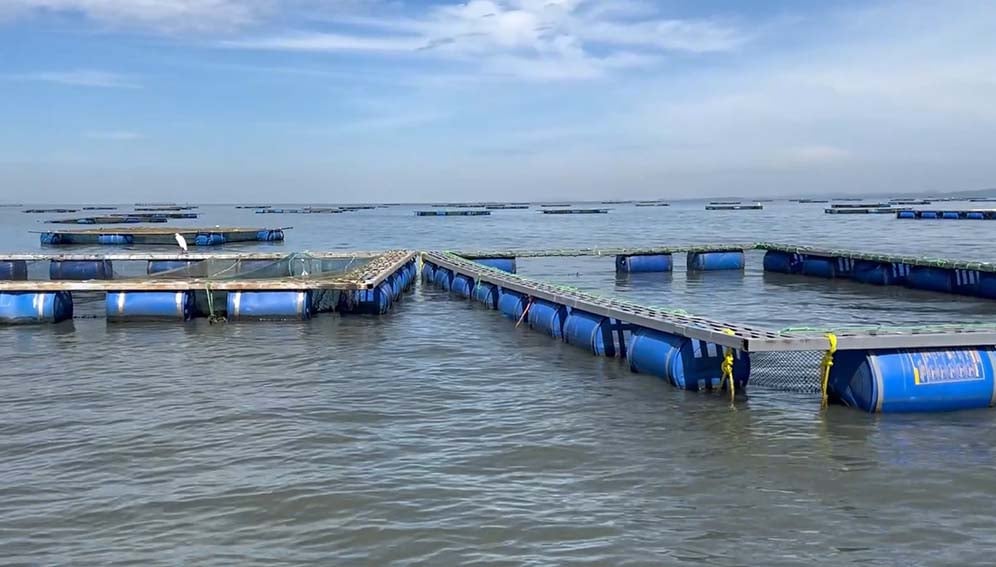
Fish cages on Lake Victoria at Dunga. Photo by Davis J. Weddi / SciDev.Net
To build the early warning platform, ShoShin worked with KMFRI scientists to identify the environmental signals most closely associated with fish kills, especially dissolved oxygen, temperature and other indicators of water stress.
ShoShin CEO Naftal Obwoni says they combined KMFRI’s existing research data with live sensor readings from Dunga Beach to train AI models to detect patterns and flag danger before farmers saw the first fish gasp at the surface.
This has resulted in a system that does more than measure water. It interprets risk and pushes alerts directly to farmers through their phones, using tools designed to be practical for people working on the lake.
Since the first warning alert was sent out in February, there have been no reports of mass fish deaths at Dunga beach.
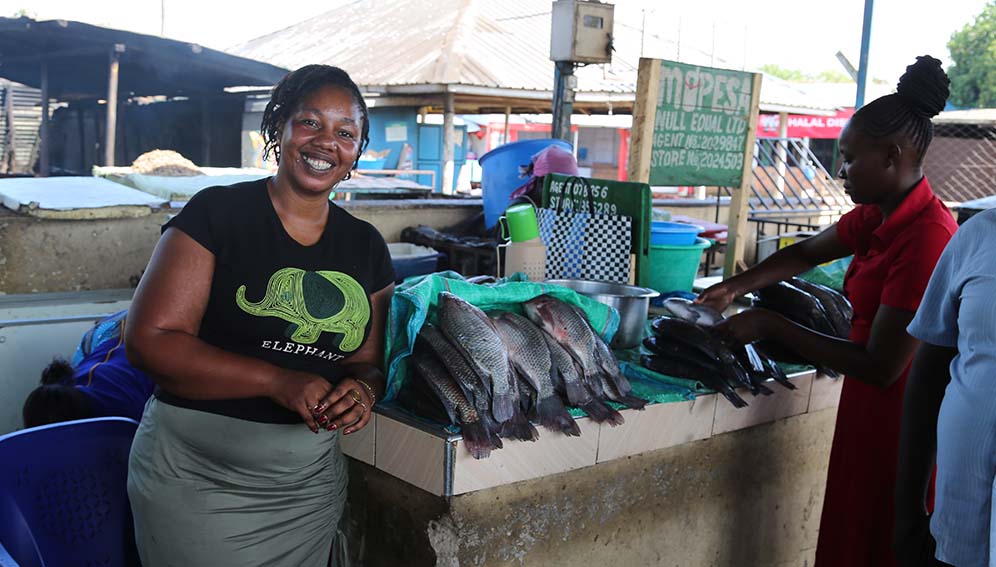
Fish monger Isabel Ogada at Dunga Beach fish market. She said her business suffered during mass fish kills on Lake Victoria, but this year it stopped after installation of the AI early warning system. Photo by Davis J. Weddi / SciDev.Net
For many farmers like Didi Victor, who also holds an environmental management degree, the speed with which information is relayed to them has changed everything. Instead of relying on rumour, instinct or late observation, they now receive a warning with enough time to act.
Across the lake, other farmers are paying attention. What was once dismissed as an unpredictable act of nature is starting to look like a problem that can be monitored, understood and, in some cases, prevented.
Angela Juliana Odero, CEO of Rio Fish Ltd, a social enterprise focused on aquaculture, located at a different part of the lake, tells SciDev.Net that, while she has not yet engaged with it, she believes it could be a valuable tool for preventing losses, if used correctly.
The success at Dunga has stirred fresh interest in expanding the system to other high-risk sites, with KMFRI saying 15 hotspots have been identified for possible rollout, and two additional locations are expected to go live in the second half of 2026.
That matters because the aquaculture economy on Lake Victoria has been growing fast and so have the risks.
A January 2026 joint report by Project INCATA, which aims to better improve understanding of agrifood value chains, and partners, found that Kenya’s cage-based aquaculture sector grew from just 24 metric tonnes of production in 2014 to 30,565 metric tonnes in 2024. Over the same period, the number of cage operators rose from 39 to 2,737.
As more farmers invest in commercial fish production, each episode of mass mortality threatens not just individual livelihoods, but confidence in the entire sector.
KMFRI has developed a Lake Victoria spatial plan to guide farmers on which areas are suitable for cage aquaculture. The plan and accompanying maps are being used to support licensing and reduce the likelihood that new cages are placed in high-risk zones.
On another front, several initiatives are producing detailed reports about the state of the lake. One of them is the environmental monitoring in the Lake Victoria region being done by KMFRI and the UK Centre for Ecology & Hydrology, who host a portal with a map showing suitable spots for cage fish farming.
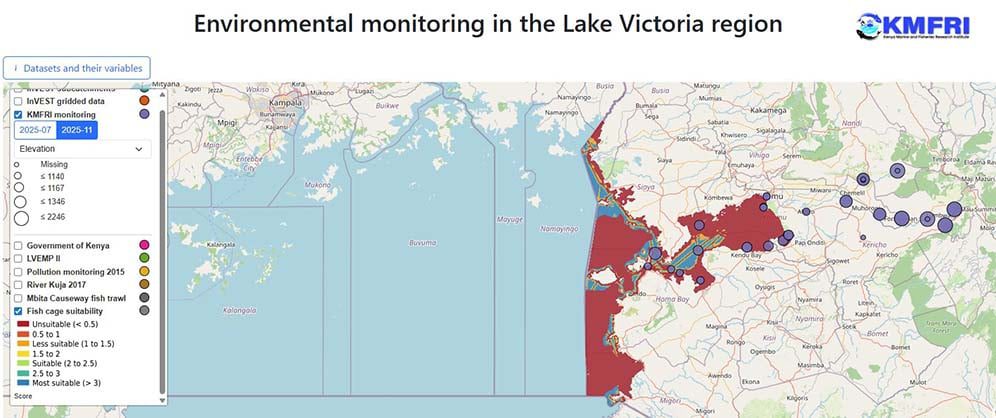
Screenshot of an app showing Environmental monitoring in Lake Victoria
“What we have seen is that the fish that die, die in places that we characterise as unsuitable for aquaculture,” Nyamweya says. “Anyone who is in the green zone has not suffered these fish kills.”
Still, the events at Dunga Beach suggest that mapping alone may not be enough in a lake system under pressure from runoff, waste, warming waters and intense commercial activity. Farmers need safer places to farm in addition to faster ways to see danger coming.
Local technology
For Obwoni, the success at Dunga is only the beginning. Behind the rescue of those fish cages lies a larger argument about what locally built technology can do in African food systems: not only to predict disaster, but to lower costs, widen access, and give communities tools they can use.
ShoShin says it built much of its AI early warning system’s architecture locally, from software and cloud infrastructure, right down to the circuit boards in the sensors.
Obwoni says this reduces the cost of deploying Internet of Things (IoT) technologies in places where they have often remained out of reach.
“Today, if somebody purchases a sensor in Africa or in Kenya, they can easily plug into our software, and start using that hardware,” he explains.
To Obwoni, the challenge is making sure the sensor can communicate, send data, and return useful information to the people who need it.
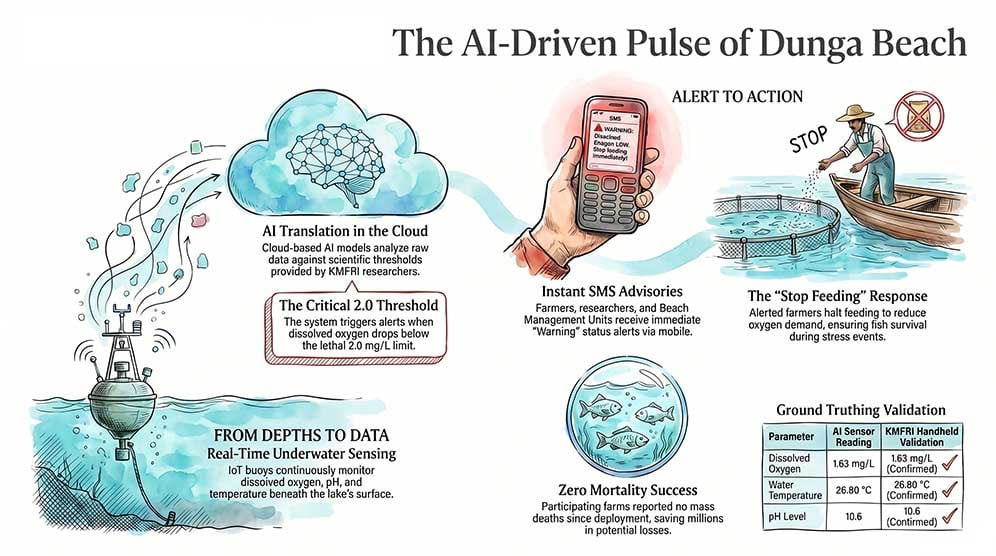
Infographic showing the pulse of the AI early warning system in operation at Dunga Beach, in Kisumu.
That practical challenge sits at the heart of why so many promising digital pilots stall. Rural communities may not have strong connectivity, farmers may be using feature phones, and imported systems can be expensive to maintain or difficult to adapt.
According to Obwoni, ShoShin tries to build technology around those constraints, keeping the hardware and software as local as possible, simplifying what farmers receive, and reserving the more technical dashboards for scientists and managers.
The approach is also beginning to reshape how risk is understood. Obwoni says the “blame game” over pollution and fish kills, whether caused by runoff, upstream waste, or other pressures, has dragged on for years, often without enough evidence to trigger action. Better environmental monitoring, he argues, could help change that. If river inflows and lake conditions can be tracked more consistently, it may become easier not only to warn farmers, but also to strengthen enforcement and policy.
Then there is the question of finance. For years, fish farmers have struggled to insure their cages because insurance companies could not confidently assess what had killed the fish, or how likely similar losses were to happen again.
Farmer Paul Ochieng lost 1 million Kenyan Shillings-worth (about US$7,730) of fish, which suffocated in eight cages. His cages were part of those near a river inlet and were affected by the effluent that led to one of the disasters in 2025.
“The insurance companies always come, but they are too expensive. They insist on insuring per cage,” he says, adding that it would be more cost-effective to insure a whole farm as a single package.
However, Obwoni says the perception is starting to change. As cage farmers ask to use the platform to monitor their own sites, insurers and financial institutions are beginning to show interest in the data trail it creates, not just to understand losses, but to price risk more accurately.
“The ripple effect on this is bigger,” says Obwoni. “It’s beyond just the death of fish.”
If that promise holds, the implications could stretch far beyond Lake Victoria. Sylvia Mosoti, ShoShin’s operations lead, says they are also piloting related tools in Kenya’s marine waters, where climate stress is taking a different, but no less dangerous, form.
From Lake Victoria to the Indian Ocean
Hundreds of kilometres from Dunga Beach, along Kenya’s coastline, another experiment is quietly testing if digital tools can help fish farmers adapt before environmental stress turns into loss.
Scientists at WorldFish in Mombasa are implementing an Integrated Multi-Trophic Aquaculture (IMTA) system that co-cultures marine tilapia, sea cucumbers, and gastropods. This innovative farming method promotes a circular ecosystem where waste and excess feed from one species serve as nutrients for another, significantly lowering costs while diversifying farmer income.

WorldFish scientist Douglas Okemwa using a tool supplied by ShoShin Hub to measure water conditions in an IMTA pond in Kilifi, Kenya. Photo by Davis J. Weddi / SciDev.Net
To manage this complex environment, these scientists use AI tools to continuously monitor critical water quality metrics such as pH, temperature, and salinity. Maintaining this precise balance is essential because different species have unique environmental tolerances, and fluctuations can lead to stock mortality.
WorldFish scientists say these digital data insights empower farmers to make informed decisions to ensure the sustainability and health of their aquatic crops.
Scientist Esther Wairimu, who is leading a team implementing WorldFish’s Asia-Africa BlueTech Superhighway project, now in its fourth year, told SciDev.Net says they are working with ShoShin Innovation Hub to pilot the E-Samaki platform, a farm-management and advisory tool now installed for farmers across multiple mariculture sites in Kilifi and Kwale counties on Kenya’s coast.
Wairimu explains that the varied sites include pond systems, cage systems and pen systems; marine-acclimatised tilapia in ponds; rabbit fish in open-sea systems; seaweed, oysters, sea cucumbers and gastropods forming part of IMTA. These are farming systems where different species are raised together so that the waste from one can help feed or support another.
“What ShoShin and KMFRI are demonstrating at Dunga Beach is the value of continuous sensing, rapid analysis, and timely alerts in a high-risk aquaculture environment,” says Wairimu.
“What we are building through E-Samaki on the coast is a complementary part of that picture.
“That means combining farm records, water quality monitoring, advisory logic, farmer-facing alerts and scientific validation into one system that works across different aquaculture contexts while still respecting local differences,” she adds.
That complexity makes decision-making harder, and data more valuable.
The platform works on two fronts. WorldFish uses one interface to onboard farmers and map the details of each site: county, subcounty, farm type, species, production system. Farmers use another interface to enter what is happening on the ground: how much they stocked, how much they are feeding, whether fish are dying, and what the water is doing.
That last part is becoming increasingly urgent. With a handheld device supplied through the platform, farmers can capture basic but critical indicators such as salinity, pH and temperature, then upload them into the system for review. The point is not simply to collect information; it is to catch trouble early enough to act. And on the Kenyan coast, trouble is arriving fast.
“Currently, we are experiencing climate change, and it is coming with many effects,” Wairimu says, adding that the most serious is ocean warming.
In one pond-based pilot site earlier this year, Wairimu says they recorded water temperatures that surged around 47 to 48 degrees Celsius, extreme levels for organisms more accustomed to temperatures closer to 25 to 30 degrees Celsius.
“Those organisms are already very, very much stressed,” she says.
The danger is not uniform across species. In IMTA systems, one shift in water quality can produce very different outcomes. Nutrient-rich water may support the growth of seaweed while stressing fish.
“Freshwater intrusion after heavy rain can lower salinity with consequences that marine species such as rabbit fish may struggle to tolerate. A temperature rise can worsen oxygen depletion, cut feed efficiency and slow growth,” Wairimu explains.
By flagging water-quality readings that fall outside the optimum range, she says, the system helps farmers and researchers identify corrective actions before losses spiral.
However, there is a question that often haunts aquaculture projects long after the pilot teams leave: who owns the data?
For Wairimu, the answer is clear. “We believe […] farmers are the ones who own the rights to have this data,” she says, adding that the reason is not just ethical; it is practical. Farmers are the ones managing the systems day-to-day, and the ones who need to track trends over time if they are to improve performance and survive future shocks.
“It also means using aggregated data responsibly and ensuring that any wider research or system learning does not come at the expense of farmer agency,” notes Wairimu.
There is another dimension too: gender. Along much of Kenya’s coast, Wairimu says, women are central to mariculture, especially in seaweed farming, harvesting, processing and value addition. Yet access to digital tools cannot be taken for granted. “They need to be equipped on digital confidence,” she says, adding that WorldFish is also looking closely at youth inclusion and livelihoods.
In that sense, what is unfolding on the Kenyan coast mirrors what is happening at Dunga Beach, but with a wider horizon.
From the oxygen-starved cages of Lake Victoria to the heat-stressed ponds and open-sea farms of Kilifi and Kwale, Kenya’s aquaculture sector is beginning to test a new proposition: that climate shocks do not always have to arrive as surprises, and that with the right mix of science, local innovation and farmer-centred design, technology can do more than diagnose crisis. It can buy time, improve decisions, and help make fish farming more survivable in a warming world.
Dave Okech, an aquaculture innovator and founder of Kisumu-based Aquarech Ltd, says: “This AI early warning system is a welcome development, so long as the AI models give timely, accurate and farmer-friendly alerts.” He, however, wonders about the cost of delivering the entire system.
When asked about any costs for the farmers, Nyamweya says all fish farmers across Kenya will access the early warning system alerts at no cost. He says the government is covering all the costs of managing data and disseminating critical information to the farmers until a subscription is introduced. “It will be a tiny fee,” he says, adding that the government will also cover the costs of expansion to other hotspots on the Kenyan side of Lake Victoria.
The development of the AI early warning system for aquaculture in Kisumu is in line with the goals of Kenya’s National Digital Masterplan (2022–2032), which, among other things, prioritises the AI-driven deployment of government services.
With AI now in use at Dunga Beach, researchers and farmers know what was killing the fish, have devised immediate responses, and are drawing interest from other sites.
While artificial intelligence alone may not stop mass fish deaths on Lake Victoria, it is becoming a critical tool in mitigating them. AI cannot reverse pollution or regulate weather, but early warning systems like the one deployed by KMFRI and ShoShin are helping fish farmers avoid catastrophic losses.
This piece was produced by SciDev.Net’s Sub-Saharan Africa English desk.