


Send to a friend
The details you provide on this page will not be used to send unsolicited email, and will not be sold to a 3rd party. See privacy policy.
Listen on Apple PodcastsListen on SpotifyListen on Google PodcastsListen on StitcherListen on OvercastListen on Amazon MusicListen on CastboxListen on Podcast AddictListen on Pocket CastsListen on iHeartRadioListen on PandoraRSS Feed
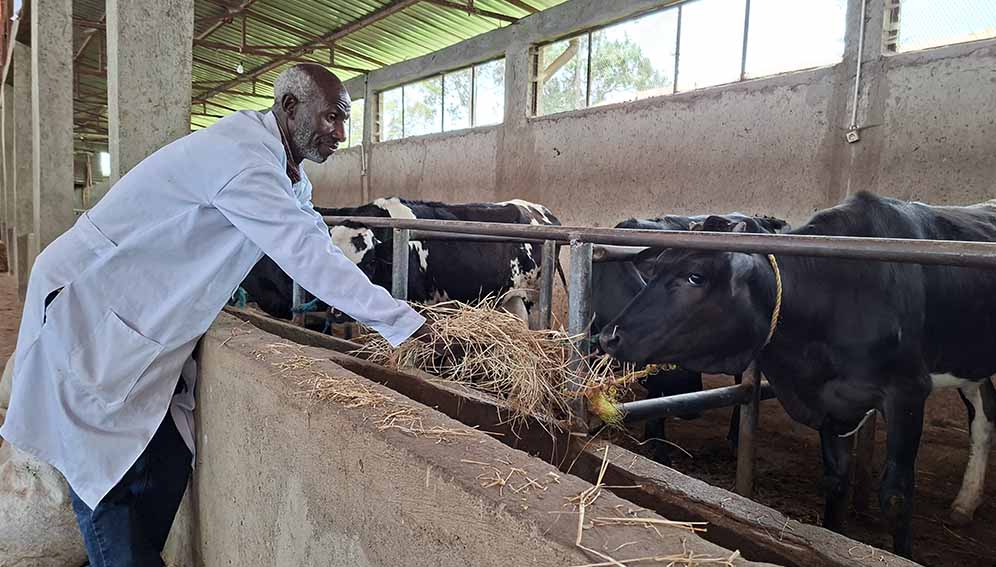
Across Sub-Saharan Africa, livestock is essential to livelihoods and food security. But cattle, goats, and sheep are also a major source of methane emissions, while farmers struggle with feed shortages and declining productivity.
Scientists are now exploring whether climate-smart feed can cut emissions and boost livestock production at the same time.
In this episode of Africa Science Focus, reporter Solomon Yimer examines the growing push for climate-smart livestock feed and asks whether efforts to reduce emissions can work for farmers under pressure.
Scientists from Scotland’s Rural College (SRUC), the International Livestock Research Institute (ILRI), and the Ethiopian Institute of Agricultural Research (EIAR) are screening hundreds of forage varieties to identify those that can reduce methane emissions while maintaining or improving milk and meat production. The project is funded by UK International Development through the UK-CGIAR Centre, which is hosted by the agricultural research organisation CABI (the parent organisation of SciDev.Net).
Aklilu Mekasha, a senior researcher at EIAR, explains why livestock productivity across much of Sub-Saharan Africa remains far below global averages and how feed shortages and climate stress are limiting farmers’ ability to meet growing demand.
Jamie Newbold, deputy principal of the SRUC and the project’s lead researcher, explains the science behind livestock methane emissions and why some forage varieties have the potential to significantly reduce them. He tells us how combining improved animal genetics with climate-smart feeds could help cut emissions while boosting productivity.
Bayissa Hatew, an animal nutrition scientist at ILRI, examines the role of research, policy, and private-sector partnerships in ensuring promising innovations reach farmers at scale.
But developing solutions is only part of the challenge. Adugna Tolera of Ethiopia’s Hawassa University argues that getting innovations out of research stations and into farmers’ hands remains one of the biggest obstacles to transforming livestock production across the region.
We also hear from Ethiopian farmers Yetmwork Tilahun and Berhanu Derese, who describe the realities of raising livestock in a changing climate and the difficulties of accessing improved forage seeds and other inputs.
Their experiences expose the gap between scientific advances and on-farm adoption, and why closing that gap will be critical if climate-smart livestock systems are to deliver on their promise.
————————————————————————————————————
Do you have any comments, questions or feedback about our podcast episodes? Let us know at podcast@scidev.net
Africa Science Focus is produced by SciDev.Net and distributed in association with your local radio station
This piece was produced by SciDev.Net’s Sub-Saharan Africa English desk.
This episode was supported by the UK-CGIAR Centre. The UK-CGIAR Centre, hosted at CABI (the parent organisation of SciDev.Net), aims to support global food security by bringing together scientists from the UK and CGIAR to form impact-focused research collaborations. This project is funded by UK International Development.