


By: Dann Okoth
Send to a friend
The details you provide on this page will not be used to send unsolicited email, and will not be sold to a 3rd party. See privacy policy.
An Artificial Intelligence (AI) sandbox gives innovators a safe space to try to tackle world hunger.
It’s one of a number of new approaches being tried to bring technology to bear on the increasing levels of hunger around the world, according to Bernhard Kowatsch, head of the Innovator Accelerator at the UN World Food Programme (WFP).
Following new analysis on the scale of global hunger, Kowatsch tells SciDev.Net how these projects can reinforce food systems and make communities more resilient to food insecurity.

Bernhard Kowatsch, head of the Innovator Accelerator at the UN World Food Programme (WFP).
What is your take on the Global Report on Food Crises?
The new Global Report on Food Crises 2024 is a stark reminder there are now an alarming number of people – 282 million – at acute food security level across 59 countries.
The report points out three main reasons behind these crises: conflict and insecurity, economic shocks, and extreme weather events due to climate change. These issues often go hand in hand, making the situation even more challenging to tackle.
Some of these topics need systematic solutions, some of these topics require a lot more funding, but there is also the role that innovation and technology can play to tackle some of those issues. This is exactly what the WFP Innovation Accelerator is working on together with WFP offices across the globe.
We need new solutions, innovations, smarter business models, and strong partnerships to make a long-term difference. We must reinforce our current food systems and enable communities to become more resilient against food insecurity at scale.
Why are the figures so stark, especially in the Horn of Africa?
The hunger figures are stark in a lot of countries, because of conflict, climate change and also high food and fuel prices. This is also particularly affecting the Horn of Africa, whether it’s drought that affects livelihoods, or conflict that displaces people.
The report highlights that the Horn of Africa experienced five seasons of below-average rainfall from late 2020 to early 2023, which created the worst drought conditions that the Horn of Africa has experienced in nearly 40 years.
How is WFP leveraging science and innovation to address world food crises?
WFP has a decades-long legacy on innovating in countries, whether it was first using air drops for emergency response, or cash-based transfers which now account for over 35 per cent of WFP’s food assistance across the globe.
We also now have a global WFP Innovation Accelerator, as well as a regional innovation hub in East Africa and several country innovation units in our operations that have more dedicated capacity to identify, support and scale high-potential innovations.
At the WFP Innovation Accelerator, we are right now identifying, supporting and scaling new startups, but also internal solutions that are locally grounded in the problems WFP colleagues see every day.
What are some of the interesting recent innovations from the Innovation Accelerator? Where are these being implemented and what impact are they making?
At the accelerator, we place a strong emphasis on locally led solutions, that we source through our innovation programmes. Here are a few examples:
Boomitra, an Earthshot prize-winning solution, is a WFP Innovation Accelerator portfolio innovation, currently being deployed with WFP Kenya and Farm to Market Alliance. Boomitra leverages Artificial Intelligence for climate adaptation. Using satellites and AI, it measures soil moisture, nutrients and carbon which aids farmers in reducing water and nutrient use by 30 per cent, while enhancing soil fertility. Combining insights with carbon credit payment schemes, Boomitra enables farmers to adopt regenerative land management practices.
Another example of a successful WFP-supported innovation is the Sankalp award-winning Toothpick Project. This Kenya-based project arms smallholder farmers with bio-herbicide technology to help them kill striga, a destructive parasitic weed attacking the roots of staple crops in Sub-Saharan Africa.
Optimus, a big data optimisation tool developed by the WFP’s Supply Chain Division, helps WFP identify the most efficient and cost-effective way to reach the people we serve. It is deployed in 44 country offices and has resulted in more than US$50 million in savings to date, with further growth expected.
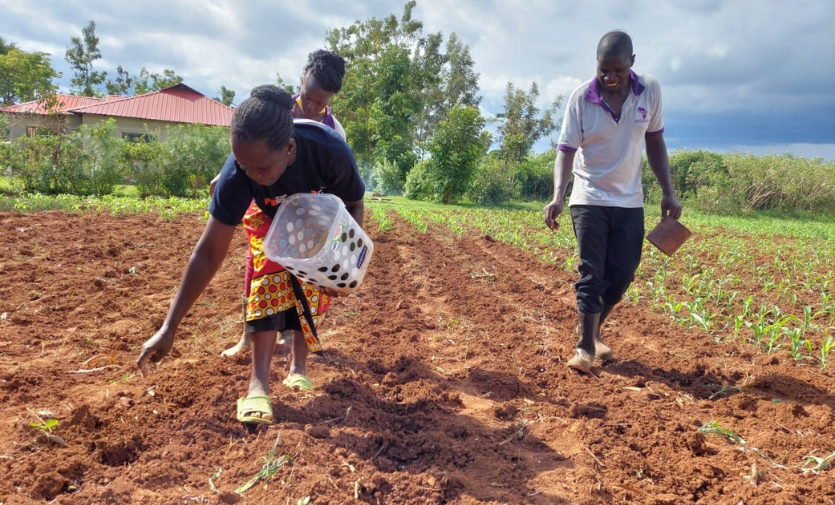
The Toothpick Company Ltd arms smallholder farmers with bio-herbicide technology to help them kill striga, a destructive parasitic weed attacking the roots of staple crops in Sub-Saharan Africa. Photo credit: Claire Baker
What new innovations are in the pipeline?
I’m happy to share that we are continuing to source, support, and scale several new innovations beyond this across the globe. In 2024, the WFP Innovation Accelerator is running 20 accelerator programmes to end global hunger and other global problems such as climate change, gender equality, primary healthcare and emergency response for WFP and other partners.
Within WFP we’ve launched Artificial Intelligence Sandbox – a collaborative and safe environment to experiment and pilot AI initiatives before their broader implementation. WFP aims to use responsible AI to modernize, streamline, and revolutionise our operations.
We invite applications from innovators working towards zero hunger all year round and would encourage you to visit innovation.wfp.org/apply.
This year, we launched the Kofi Annan Award for Innovation in Africa and the Stability-and-Peace Accelerator Programme specifically for innovators from African countries.
The WFP Regional Innovation Hub for Eastern Africa, based in Nairobi, also runs innovation challenges to source and support regional innovations such as the IGNITE Innovation Challenge.
Can these advances really make a difference in the face of such huge crises?
Yes, indeed I believe innovations, both high and low tech, hold tremendous potential to create positive change. Today, alongside innovation champions in WFP country offices and regional bureaus worldwide, we are committed to sourcing innovations and taking calculated risks to test new solutions and address longstanding challenges.
In 2023 alone, we reached 60.7 million people through our supported innovations and they have raised a total of US$295 million of grant funding already – not counting equity investments.
As we navigate this era of global food and climate crises, we need the best ideas, we need the committed partners and people that want to make a difference to fight global hunger.
WFP faces a major funding shortfall. How much more money is needed to tackle these crises?
As of today, hunger is rising, but funding isn’t keeping track.
In 2023, WFP was able to assist 152 million people worldwide. While this is 10 million less than 2022, a sharp drop in funding led WFP to cut the size and scope of operations, assisting fewer people and providing less assistance, less often. This trend continues into 2024.
WFP funding needs in 2024 to provide food assistance would be at US$18 billion. A lot more funding is required to help just the most vulnerable people.
This piece was produced by SciDev.Net’s Global desk.
Q&As are edited for length and clarity.