


18/05/26
Uganda, DRC race to contain rare Ebola outbreak
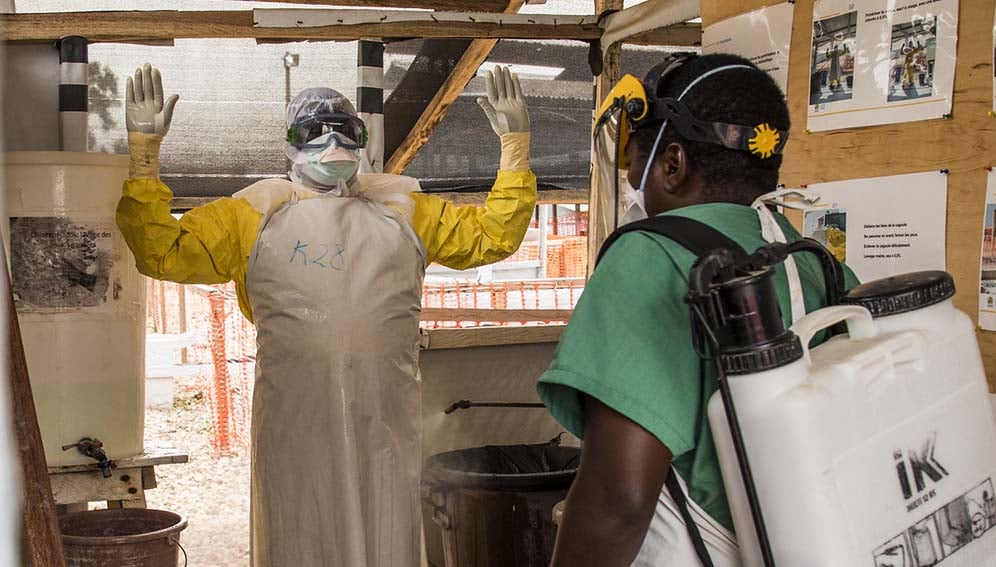
By: John Musenze
Send to a friend
The details you provide on this page will not be used to send unsolicited email, and will not be sold to a 3rd party. See privacy policy.
[KAMPALA, SciDev.Net] Uganda has activated its national emergency response and postponed a religious gathering expected to draw a million pilgrims following an outbreak of Ebola that has spread into the country from the Democratic Republic of Congo (DRC), raising international alarm.
The World Health Organization (WHO) declared a public health emergency of international concern (PHEIC) on Sunday (17 May) due to the high risk of the virus spreading across borders, after two cases were confirmed in Uganda’s capital, Kampala.
The outbreak involves the rare Bundibugyo species of the virus, which has no approved vaccine or treatment.
As of Saturday (16 May), there had been eight laboratory-confirmed cases, 246 suspected cases and 80 suspected deaths reported in DRC’s Ituri province, which borders South Sudan and Uganda, according to the WHO.
Two travellers from the DRC also tested positive in Kampala for the virus. One of the patients, a 59-year-old Congolese man, died on 14 May at a private hospital in the capital, while a second case, with no apparent link to the first, was also confirmed.
Henry Kyobe Bosa, the National Incident Commander for Public Health Emergencies at Uganda’s Ministry of Health, said contact tracing teams were mapping exposure networks across the city.
“The two cases we have as of now are imported cases from DRC,” he told SciDev.Net.
“We have identified 103 contacts so far, and all of them are being followed up daily for 21 days.”
The Ugandan ministry has deployed screening, surveillance and rapid response teams at official and unofficial entry points along its western border and major transit routes, Jane Ruth Aceng, Uganda’s Minister of Health, said on Friday (15 May).

“We have built up a very strong system of identification, detection and response to these outbreaks” Aceng said.
“At the grassroots level we have our community health extension workers and Village Health Teams who have been trained not only to offer services door to door but also to act as surveillance officers. We have also deployed a mobile laboratory.”
Aceng said suspected disease alerts are routed through the eCommunity health information system to national emergency operation centres in real time.
On Sunday (17 May), Uganda’s President Yoweri Museveni postponed the annual Martyrs Day celebrations, scheduled for 3 June at Namugongo, near Kampala, and typically drawing around a million Christian pilgrims, many from eastern DRC.
“To safeguard everyone’s lives, it is essential that this important event be postponed,” Museveni said in a statement posted on social media.
He added, however, that there was no need for alarm and told journalists that the border with DRC would remain open.
WHO has advised affected countries against closing borders, warning that doing so may push movement onto informal routes that are harder to monitor.
Undetected Ebola spread
Health experts are particularly concerned about the outbreak because it went undetected for weeks in DRC. The first known suspected case, a health worker in Bunia, developed symptoms on 24 April, while Ebola was not confirmed until 15 May.
In the intervening three weeks, four health workers died, the virus reached Kampala, and an infected woman travelled to the eastern Congolese city of Goma.
The lag raises concerns about gaps in infection prevention, WHO said in its 17 May statement.
Initial samples tested in Bunia using standard Ebola Xpert assays returned negative. Only genomic sequencing at the DRC’s National Institute of Biomedical Research identified the virus as Bundibugyo.
There is currently no licensed vaccine or therapeutic against the Bundibugyo species of the disease, which has been documented in only three outbreaks since first identified in western Uganda in 2007. Case fatality is estimated between 25 and 40 per cent, according to Médecins Sans Frontières (MSF).
WHO director-general Tedros Adhanom Ghebreyesus issued the PHEIC declaration without first convening an emergency committee, a procedural first, showing the urgency of the situation.
The agency has warned the outbreak is likely larger than reported, citing the high positivity rate of initial samples, rising syndromic reporting across Ituri, and clusters of community deaths.
‘Panic mode’
Jean Kaseya, director general of Africa CDC, told an online briefing on Saturday (16 May) that he was on “panic mode” because people are dying, with no medicines to save them.
“I don’t have vaccines to support countries, and what that means is that we are forced to rely entirely on public health measures like surveillance, infection prevention, contact tracing and those systems are being stretched in real time across multiple countries at once,” he said.
Kaseya said Africa CDC was in discussions with pharmaceutical companies in Egypt and India developing experimental Bundibugyo diagnostics, vaccines and treatments to assess whether any could be safely deployed during the outbreak.
He also called for US$2 million to establish a personal protective equipment manufacturing plant on the continent.
Helen Clark, co-chair of the Independent Panel for Pandemic Preparedness and Response, said the response requires urgent international support including diagnostic capacity for the Bundibugyo strain.
“The world must now respond with the speed and solidarity this emergency demands with resources, expertise, cross-border coordination, and critically, diagnostic capacity for this Bundibugyo strain deployed to where it is needed most,” she said.
This piece was produced by SciDev.Net’s Sub-Saharan Africa English desk.