



By: Mohammed El-Said
Send to a friend
The details you provide on this page will not be used to send unsolicited email, and will not be sold to a 3rd party. See privacy policy.
[CAIRO, SciDev.Net] The race for minerals needed for clean energy and digital technologies is polluting the environment, threatening access to safe water, and harming health in some of the world’s poorest communities, according to a report by the UN’s water think tank.
Lithium, cobalt, nickel, graphite and rare earth elements—essential for electric vehicles, batteries, solar panels, wind turbines, data centres and artificial intelligence (AI)—have become the “oil of the 21st Century”, essential to economic security, according to the report by the United Nations University Institute for Water, Environment and Health (UNU-INWEH).
But the environmental and human costs of extracting these resources fall largely on poorer mining regions such as Africa and South America, while the benefits flow mainly to industrialised countries, the report highlights.

Kaveh Madani, director of UNU-INWEH, who led the investigation team, told SciDev.Net that the world is repeating the mistakes of the fossil fuel era.
Extraction of critical minerals, he says, is framed as unavoidable for progress, while water depletion, pollution and health impacts are treated as “acceptable trade-offs”.
Demand for critical minerals tripled between 2010 and 2023 and could more than double by 2030 and quadruple by 2050, the report says.
Demand for lithium, graphite and cobalt could rise by nearly 500 per cent from 2020 levels by 2050 if the world acts to limit global warming to 1.5 or two degrees Celsius.
‘Sacrifice zones’
Abraham Nunbogu, a UNU-INWEH scientist and the report’s lead author, says sustainability-linked technologies have “quietly reproduced old patterns of exploitation”, creating new “sacrifice zones” in vulnerable regions.
“Technological advancement has outpaced ethical governance, shifting the burdens of progress onto those least equipped to absorb them,” he told SciDev.Net.
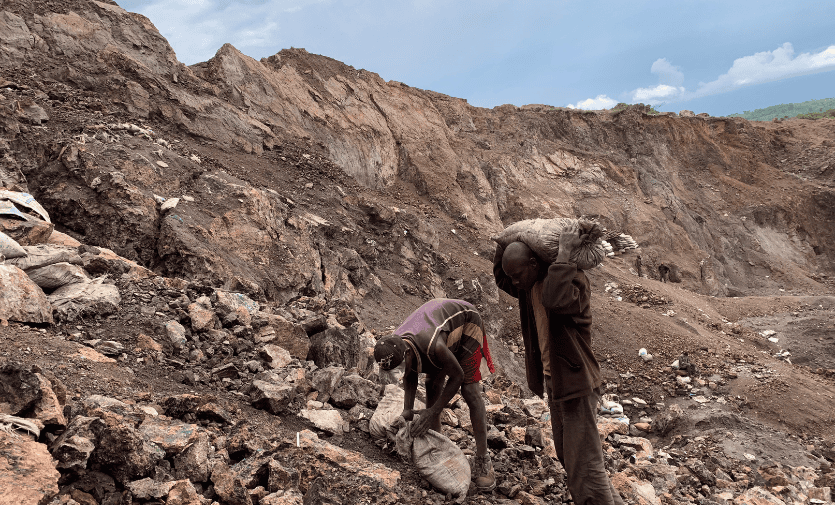
Workers in a cobalt mine in the DRC. Image credit: IIED/Flickr/Wikipedia Commons
Africa holds about 30 per cent of the world’s critical mineral reserves, according to the report. The Democratic Republic of Congo (DRC), Madagascar and Morocco together hold more than half of global cobalt deposits, with the DRC accounting for more than 60 per cent of global cobalt production.
In the DRC, where more than 80 per cent of mineral output comes from foreign-controlled industrial mines, almost three quarters of people live on less than US$2.15 a day, and about two thirds lack basic drinking water access, despite the country holding more than half of Africa’s freshwater reserves.
Nunbogu says mining severely impacts daily life “when people can no longer drink safely or practise basic hygiene without risks”, with compromised drinking water and sanitation becoming “a public-health emergency”.
Osama Sallam, a water expert at the Environment Agency–Abu Dhabi and Egypt’s National Water Research Center, says mining threatens water security through excessive depletion, as in lithium extraction, and chemical pollution, as in cobalt mining.
Producing one tonne of lithium requires about 1.9 million litres of water, the report says.
In South America’s largely arid “Lithium Triangle”, extraction is lowering groundwater levels used for drinking and livestock, putting communities at risk, says Sallam. The area, which includes Bolivia, Argentina, and Chile, holds over half of the world’s lithium reserves.
In 2024, global lithium production, excluding the United States, reached about 240,000 tonnes, requiring around 456 billion litres of water—enough to meet the annual domestic water needs of about 62 million people in Sub-Saharan Africa.
Mohamed Tawfik, professor of physical geography at Sohag University in Egypt, says many mines operate in arid or semi-arid regions, where evaporation is high and groundwater recharge is slow.
“In these environments, any large and continuous withdrawal of water is not a temporary use, but a change in the region’s water balance,” he says, adding that this disruption comes on top of the pressures caused by climate change.
Toxic waste
As well as water depletion, contamination is a critical issue.
The report says producing one tonne of rare earth minerals can generate about 2,000 tonnes of toxic waste. In 2024, global rare earth production generated an estimated 707 million metric tonnes of toxic waste—equivalent to nearly 59 million fully loaded garbage trucks.
In the DRC, the health impacts are clear to see. A survey of mining communities found that skin diseases, and gynaecological problems in women and girls, were widespread. About a third of mining sites in the DRC employ children.
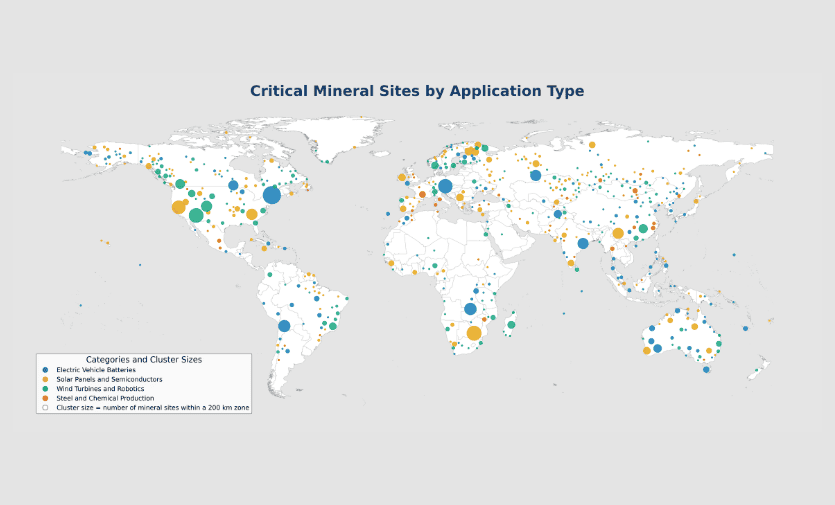
Global clusters of critical mineral deposits and sites, derived from USGS geospatial point data on mines, deposits, districts, and mineral regions (2017). Image credit: UNU-INWEH
Rates of abnormalities such as neural tube defects and lower limb defects were also higher in maternal wards near mining areas, according to a study cited in the report.
Sallam warns that heavy metal contamination threatens drinking water, agriculture and food security. Excessive groundwater withdrawal can dry irrigation wells, while heavy metals can destroy soil fertility and make crops unsafe to eat, threatening small farmers’ livelihoods.
Reform urged
Current water policies cannot absorb these pressures, Sallam says, because governments often prioritise mining licences for quick economic returns, while cumulative water impact assessments are largely absent. Without strict reforms, mining regions could reach “water bankruptcy” in surrounding surface and groundwater basins, he warns.
The report calls for restructuring mineral supply chains, not abandoning the green transition. It says governments must invest in recycling infrastructure and scientific research into material substitution to reduce the global demand for newly mined minerals.
Madani says climate goals will not be achieved sustainably unless material demand is reduced, environmental standards are enforced, water resources are protected and benefits are shared more fairly.
Nunbogu calls for mandatory due diligence, trade policies aligned with human rights and water protection, investment in recycling and material substitution, and support for environmental and health recovery in affected regions.
“Ethical consumption without structural reform is insufficient,” he says, warning that recycling alone will not be enough unless combined with demand reduction, alternative materials and enforceable extraction standards.
This piece was produced by SciDev.Net’s Global desk.