


Send to a friend
The details you provide on this page will not be used to send unsolicited email, and will not be sold to a 3rd party. See privacy policy.
[MONTEVIDEO, SciDev.Net] Countries in Latin America and the Caribbean are pooling expertise to promote ethical artificial intelligence (AI) policies as part of a new roadmap targeting sustainability and protection of vulnerable groups.
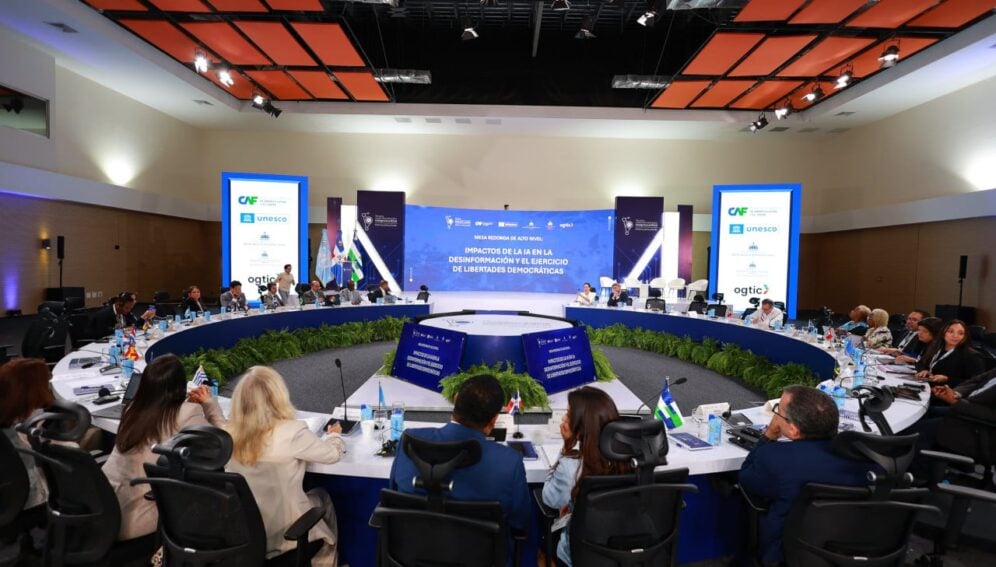
More than 20 countries agreed to set up a regional group of specialists in disinformation and AI as part of the Santo Domingo Declaration, approved at a ministerial summit on the ethics of AI in the Dominican Republic.
The Third Ministerial and High-Level Authorities Summit on the Ethics of Artificial Intelligence (25-26 June), supported by UNESCO and the Development Bank of Latin America and the Caribbean, sought to plan and implement concrete actions for ethical AI, focused on people, human rights and sustainable development.
“Latin America and the Caribbean is one of the most unequal regions in the world, and AI can both deepen and reduce those gaps depending on how it is governed.”
Gisselle Burbano, UNESCO, Montevideo
The declaration promotes a 2026-2027 roadmap with five strategic pillars: governance and regulation; talent and the future of work; protection of vulnerable groups; environment, sustainability and climate change, and infrastructure.
Gisselle Burbano, head of AI ethics for Latin America at the UNESCO regional office in Montevideo, says the roadmap needs to be “ambitious and operational”, considering the diversity of infrastructure, regulatory frameworks and institutional preparedness of participating countries.
“Latin America and the Caribbean is one of the most unequal regions in the world, and AI can both deepen and reduce those gaps depending on how it is governed,” she tells SciDev.Net.
The speed of technology adoption often exceeds the institutional capacity to regulate it, says Burbano. This particularly exposes women, Afro-Caribbean and indigenous communities, informal workers, and children to risks such as algorithmic biases, job displacement or environmental impacts from the energy demands of digital infrastructure, she explains.
For Burbano, responsible governance should not put a “brake on innovation”, but the benefits must be distributed fairly.
Federico Lecumberry, a professor in signal processing and machine learning at the University of the Republic, Uruguay, who did not attend the event, says regional agreements are fundamental because AI is a “geopolitical issue”, citing progress made by Europe, China, and Japan.
However, he notes that the word “sovereignty”, a key concept that implies leveraging knowledge generated by and for the region, is absent from the agreement. He also stresses that digital literacy must be improved to “prevent abuses and foster critical thinking”.

Actions set out in the roadmap include a playbook for disinformation incidents, an open course on AI skills, and training to incorporate gender perspectives into public policies.
The declaration also establishes an existing working group on AI ethics as a permanent body for coordinating and monitoring the roadmap and commits to annual ministerial summits to assess progress.
Disinformation in the crosshairs
The new Regional Group of Specialists in Disinformation and Artificial Intelligence will bring together technical specialists, academics, and representatives from international organisations to monitor disinformation, produce evidence, and develop practical tools for a coordinated response.
Lecumberry, who is also a steering committee member for the Latin American AI meeting Kiphu, welcomes the roadmap’s focus on disinformation.
“Without a doubt, fake news is one of the dangers to democracy, and having a group that generates tools and literacy on the subject is very valuable,” he says.
According to Burbano, Latin America and the Caribbean, with its frequent electoral processes and widespread use of social networks, faces increasing exposure to disinformation, amplified by AI.
“For UNESCO, which has been working for years on press freedom and media and information literacy, this phenomenon represents a direct threat to human rights and the quality of democratic processes,” she says.
Luciana Benotti, associate professor and specialist in multimodal AI and language models at the National University of Córdoba, Argentina, says misinformation is “a serious problem” as there is no mathematical way to distinguish between true and false information produced by generative AI models.
“For now, no one working in AI knows the solution to this problem, and that’s why it’s a real risk that occurs globally,” she tells SciDev.Net.
Benotti, who did not attend the summit, believes the problem is exacerbated by structural vulnerabilities in Latin America. If schools or media outlets adopt AI tools without careful consideration, they incorporate systems that can homogenise thinking, erase regional historical memory, and validate disinformation, she says.
She also warns that AI is exacerbating worker exploitation, making it harder for university graduates in the technology sector to access junior jobs and increasing pressure on more experienced workers, due to expectations of greater productivity.
“This is a specific issue related to human rights, and regional coordination would be very necessary,” she adds.
Looking forward, Burbano expects to see the 2026-2027 roadmap generate practical tools for governments to design and evaluate regulatory frameworks and other public policies on AI.
“For UNESCO, the most important indicator is not how many documents are produced, but how many countries manage to translate these commitments into concrete public policies that improve AI governance,” she adds.
This article was produced by SciDev.Net’s Latin America and Caribbean desk.