


09/09/25
Higgs boson scientists take on S. Africa air pollution
By: Rory Harris
Send to a friend
The details you provide on this page will not be used to send unsolicited email, and will not be sold to a 3rd party. See privacy policy.
[LONDON, SciDev.Net] An artificial intelligence-powered innovation developed with scientists behind the landmark Higgs boson discovery is being used to monitor air quality in real time in South Africa, one of the continent’s biggest polluters.
Scientists adapted methods from experimental particle physics to come up with “AI_r”, a system that combines a network of sensors located in pollution hotspots with low-cost Internet of Things technology and artificial intelligence (AI).
The South African researchers, working in partnership with the European Organization for Nuclear Research, CERN, say it removes the need for expensive air quality monitoring infrastructure.
“We have seen that it’s easy to create spikes [in air pollution], and those spikes move like monsters across the city.”
Bruce Mellado, lead researcher, South African Consortium of Air Quality Monitoring
The World Health Organization estimates that air pollution kills almost 7 million people every year and 89 per cent of these deaths are in low- and middle-income countries.
“Air quality now kills more people in Africa than the big three: HIV, malaria and tuberculosis,” says Bruce Mellado, lead researcher of the South African Consortium of Air Quality Monitoring and a member of the team at CERN that discovered the Higgs boson, a landmark discovery in particle physics.
|
Keep Science Journalism Alive
SciDev.Net provides award-winning science news coverage free of charge. We rely on donations from readers like you. Donate to SciDev.Net now. |
||
|---|---|---|
The researchers hope that effective monitoring in cities like Johannesburg and elsewhere will provide the evidence needed to support policymakers get to grips with the problem.
The first deployment of the system began over a year ago in a small pilot test. Several sensors were placed in schools in Soweto, an area of Johannesburg with high levels of air pollution due to vehicle emissions, open waste burning and nearby industry.
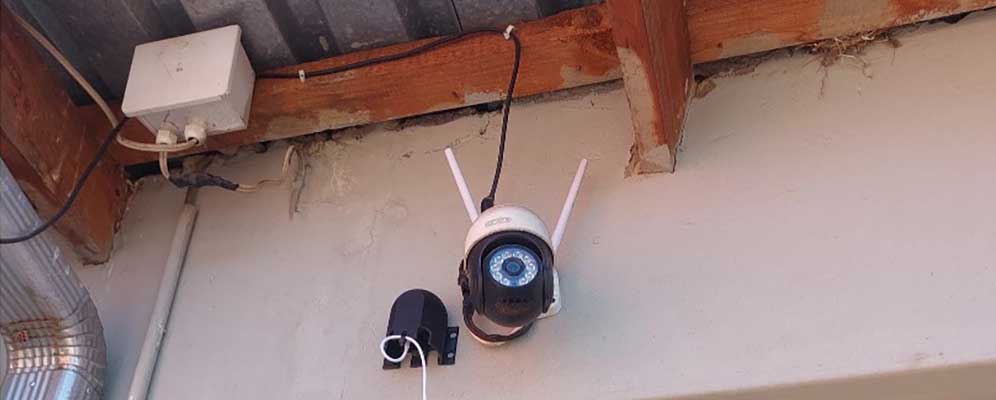
One of 500 devices being deployed by SACAQM.
“We have seen that it’s easy to create spikes [in air pollution], and those spikes move like monsters across the city,” said Mellado, who heads up the Institute for Collider Particle Physics at South Africa’s University of the Witwatersrand.
If someone burns something it can impact air quality as far as ten kilometres away, he explained.
“When you actually have the measurement that demonstrates that spikes move and then bring that pollution to hundreds of thousands of people, you have evidence to say that this is very serious,” he added.
Financial costs
The World Bank estimates that poor health due to outdoor air pollution costs up to US$6 trillion every year. Again, it is low- and middle-income countries that carry the greatest burden.
While air quality monitoring is being widely adopted globally, poorer countries often do not have the resources to install and maintain effective monitoring stations.
According to a 2024 report from OpenAQ, an international non-profit organisation, over a third of countries are not monitoring air pollution at all. Nearly 1 billion people live in a country without any programme to monitor air pollution.
Almost all of these countries are low- or middle-income countries, suggesting that the main barrier for monitoring air pollution is financial.
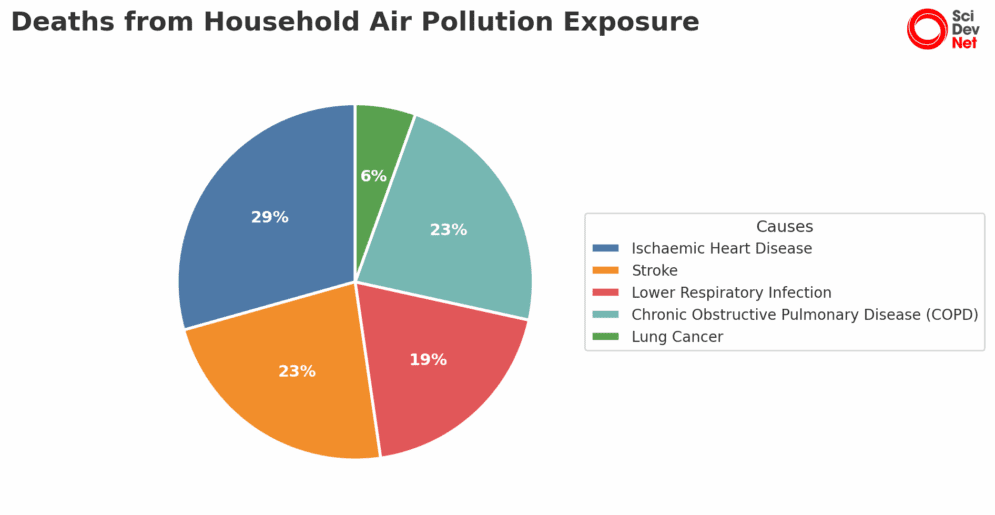
Breakdown of deaths from household air pollution around the world. Adapted from: sacaqm.org
Even in the countries where air quality is measured, the stations are often spread far apart, which means that some pollution hotspots might go unnoticed if they are far from the sensors.
South Africa is one of these countries that is underserved by current air quality monitoring facilities, says Vumile Senene, country lead for South Africa at the Clean Air Fund.
“Forty per cent of South Africans live more than 25 kilometres from the nearest monitoring station,” Senene told SciDev.Net.
“This technology makes it possible to measure air quality in more places, especially in underserved communities that often have no monitoring at all. This, in turn, can be used to better campaign for clean air initiatives, raise awareness about the pervasive effects of air pollution, and drive evidence-based policy.”
Network of sensors
In the next phase of the project, which began last month, Mellado and his team hope to deploy a dense network of sensors to produce a detailed real-time map of air pollution, with AI_r significantly reducing the cost of analysis.
Over the next year, 500 sensors will be placed across the Sedibeng district, south of Johannesburg, home to around 1 million people.
“It’s certainly the largest network in Africa, in one area,” explained Mellado.
“It’s real deployment in large numbers in a province. That’s needed as a showcase for other provinces and other countries to adopt this type of technology and enact policymaking.”
The project is being implemented with support from the governments of South Africa, the UK and Canada, as well as CERN and iThemba Labs, a South African research facility.
For their work applying physics-inspired technology to environmental and public health issues, the team have been awarded the Global South eHealth Observatory (ODESS) prize from the Pierre Fabre Foundation in France, which will be presented in October.
They now hope to deliver networks of air quality sensors to the rest of Africa and beyond.
Mellado said: “The idea is to develop more of a continental approach than just a purely national approach. It’s a process, because we need funding for that, but clearly, we are in the right direction.”
This piece was produced by SciDev.Net’s Global desk.