


15/06/26
Experts warn mistrust is fuelling DRC Ebola outbreak
By: Titilope Fadare
Send to a friend
The details you provide on this page will not be used to send unsolicited email, and will not be sold to a 3rd party. See privacy policy.
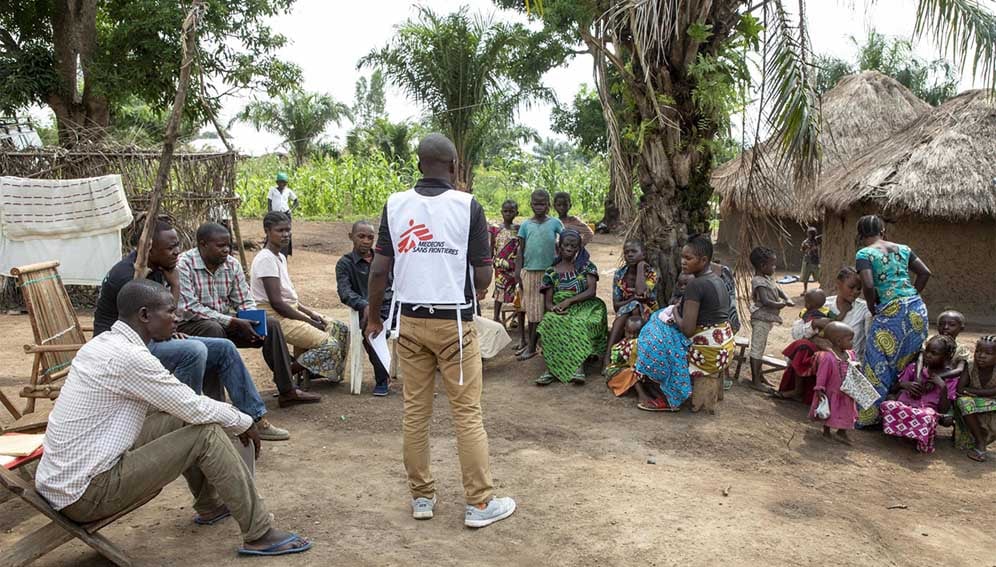
[LAGOS, SciDev.Net] Frontline healthworkers trying to prevent the spread of Ebola in the Democratic Republic of Congo (DRC) are facing anger from local communities after years of neglect through multiple health crises, health officials warn.
Speaking at an international media briefing organised by the Global Virus Network on Wednesday (10 June), experts described community anger and the breakdown of trust as among the biggest obstacles to containing the outbreak.
As of 11 June, the DRC had recorded 635 confirmed cases and 127 deaths, according to DRC’s Ministry of Health. Meanwhile, the country is still grappling with multiple other health threats, including malaria, HIV, cholera and malnutrition.
“Ebola is not the only health problem of the community,” said Marie Roseline Bélizaire, acting emergency director, WHO regional office for Africa.
“One of the things that the community are angry at is that we come only for Ebola.”
Bélizaire said the response must go beyond the virus itself.
“Our response should be a holistic response, taking into consideration the malaria problem, all the other problems of health that the community is also facing during the Ebola response,” she said.
“We shouldn’t also forget that Ebola is happening in humanitarian settings. The population is angry, they need peace, they also need a lot of other support.”

Maria Van Kerkhove, acting director of the Epidemic and Pandemic Threat Management Department at the WHO, told the briefing: “There is a lot of money that comes in for Ebola.
“But if we save someone from Ebola and their child dies from malaria, how will we actually help that family?”
Van Kerkhove said the response must take a wider view. “We are trying to make sure that the support we provide is more of a comprehensive approach, looking at WASH, looking at security issues, looking at malaria, looking at measles, looking at mpox, but also looking at Ebola,” she said.
‘Unprepared’
The DRC has battled 17 Ebola outbreaks, more than any country in the world. Yet experts at the briefing admitted that accumulated experience has not translated into readiness on the ground for this outbreak, which began just five months after the 16th ended.
Jean-Jacques Muyembe, director general of the DRC’s National Institute of Biomedical Research and co-discoverer of Ebola in 1976, said he was “disappointed” that previous experiences were not reflected in practices on the ground now.
“It seems that we have been surprised by these outbreaks and we have to learn again how to involve community in this outbreak.”
Yap Boum II, head of emergency preparedness and response division at the Africa Centres for Disease Control and Prevention (Africa CDC) said preparedness in the outbreak zone was effectively absent.
“There is no preparedness in the region where we are,” he said.
“We are starting a response from scratch—a surveillance system, infection prevention and control, clinical care, everything has to start from scratch.”
Field assessments found that infection prevention capacity at health facilities in Ituri province, where the outbreak is centred, averaged below 30 per cent, Boum said.
The WHO declared the outbreak a Public Health Emergency of International Concern on 17 May due to the risk of it spreading across borders. The outbreak is caused by the Bundibugyo species of Ebola, for which there is no approved vaccine or licensed treatment.
Building trust
Muyembe said responders were working to recover community confidence by engaging religious and traditional leaders.
“What we are doing now is to contact, to speak with leaders of opinions, like pastors, priests in the churches, speaking with traditional chiefs, and also local people in the response team,” he said.
“If they speak the local language, our population will [see them as] their relatives, and this will increase their trust in the response.”
Salim Abdool Karim, director of the Centre for the AIDS Programme of Research in South Africa, who is working on the response in Kinshasa with Muyembe, said the issue runs deeper than communication, stressing the need to strengthen health systems.
“The community needs to really have confidence in the healthcare service. If they’re sick, we need them to go into a healthcare service so that they can be diagnosed,” he said.
He added that while laboratory testing was going well, a rapid, onsite diagnostic test was urgently needed.
Conflict threatens containment
Armed conflict is another factor hindering the response effort. Boum said the governor of North Kivu acknowledged that government forces control only around a third of the province due to the presence of armed groups.
“There is no health without peace,” Boum said.
“If the borders are closed, accessing some of the population becomes very difficult.”
He said the complexity of the humanitarian situation demands a response that goes beyond medical intervention.
“It is important to have that comprehensive and holistic perspective of the challenge, which includes decentralisation, community engagement, but also the complexity of the humanitarian environment,” he said.
Van Kerkhove warned that without community trust, even the best-funded response will fail. “We can have the best plan in place. We can have the best interventions in place. But if we don’t have the trust and support of communities, we actually won’t be able to implement them,” she said.
This piece was produced by SciDev.Net’s Sub-Saharan Africa English desk.