


Send to a friend
The details you provide on this page will not be used to send unsolicited email, and will not be sold to a 3rd party. See privacy policy.
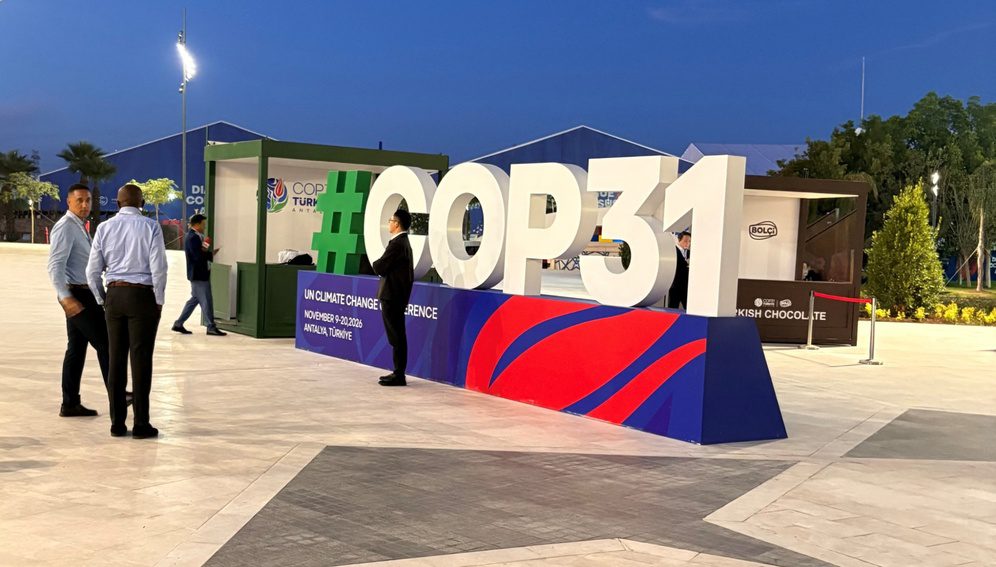
[ANTALYA, TURKEY, SciDev.Net] The 31st UN climate change conference COP31 ended in Antalya on Sunday without a final political deal after running more than 44 hours into overtime—the longest in UN climate summit history—as delegates failed to reach consensus on fossil fuels.
Frustration among climate-vulnerable nations had mounted after references to phasing out fossil fuels were dropped from the draft agreement, which offered little progress on climate finance.
“This has been the worst ever COP and its collapse needs to be a wake-up call for the world,” said Mohamed Adow, director of the Nairobi-based think tank Power Shift Africa.
Yet beneath the diplomatic wreckage of the failed “Antalya Pact,” there was a more hopeful outcome: a sweeping global push toward electrification backed by governments, multilateral initiatives, and major corporations.
The contrast underscores the reality of international climate politics, where real-economy energy transitions—driven by energy security and falling renewable costs—are advancing even as multilateral consensus breaks down.
The electrification bright spot
Despite failing to agree on an overarching political text, governments in Antalya adopted several technical decisions—including those relating to the Just Transition Mechanism, the Adaptation Fund, the Green Climate Fund, and the Fund for Responding to Loss and Damage.
Meanwhile, host nation Turkey made electrification a centrepiece of its COP31 agenda, delivering a suite of announcements under the banner of the Electrify Now movement. Around 80 national governments endorsed the flagship 35-by-35 Global Electrification Pledge, which aims to raise electricity’s share of global total final energy consumption from roughly 20 per cent today to 35 per cent by 2035.
More than a dozen countries published new or updated electrification or energy access plans, while 185 private companies signed a statement urging governments to prioritise clean electrification, according to the Energy Efficiency Council (EEC).
Luke Menzel, chief executive officer of the EEC, said: “In a year marked by wars, energy crises, extreme heat and climate disasters, consensus has been out of reach on new collective actions to accelerate the energy transition. However, the momentum for electrification coming out of COP31 is unstoppable.”
The announcements reflect a broader shift in global energy policy. According to the International Energy Agency’s (IEA) 2026 World Energy Outlook, launched on 19 November, 25 countries alongside the European Commission have introduced new electrification policies since the onset of the 2026 Hormuz energy crises—half of them in the Asia-Pacific region, followed by Europe.
A separate IEA analysis requested by Turkey and co-host Australia to inform COP31 discussions found that faster, broader electrification could cut fuel-importing countries’ energy import bills by a quarter—around US$400 billion a year—by 2035 compared with 2025 levels.
“The task now is delivery: a lot more renewable capacity, plus the grids and interconnectors to get clean power to homes and industry,” said Richard Smith, senior policy advisor at the climate think tank E3G, who welcomed the broad backing for the electrification target.
Clean power or fossil-fuelled grids?
However, the electrification pledge raised questions over whether expanding electricity use automatically equates to climate action, particularly given its failure to specify how much of the 35 per cent target must come from renewable sources.
Adow, while welcoming the initiative, warned it was being used to “cover the cracks in this summit,” arguing that a new electricity target “cannot substitute for rich countries honouring their finance obligations, or for accelerating the move away from fossil fuels”.
Karim Elgendy, executive director of the Carboun Institute, a climate and energy think tank focused on the Middle East and North Africa, played down fears that the pledge could inadvertently boost gas- or coal-fired power. He argued that additional power to meet the 2035 target “will almost inevitably come from renewable energy sources because the vast majority of demand for new electricity is satisfied most economically using renewables.”
“Electrification of some sectors, such as transportation, is an energy efficiency measure regardless of whether the countries that implement it have significant funding to develop renewable energy projects or not,” Elgendy told SciDev.Net.
Financing bottleneck
For many lower-income countries, however, the gap between electrification ambition and on-the-ground reality remains stark. According to the IEA, around 720 million people globally still lack access to electricity—90 per cent of them in Sub-Saharan Africa. While annual access gains are projected to rise from 24 million in 2025 to 40 million before 2030, Africa still holds just 1 per cent of global installed solar capacity despite possessing 60 per cent of the world’s best solar resources.
Bridging that divide requires unlocking capital—precisely where COP31’s broader negotiations fell short.
Hesham El-Sayed Eissa, former head of Egypt’s technical climate negotiation delegation, argued that governments must focus on fulfilling existing finance promises rather than launching new pledges at successive summits. He pointed to sluggish capitalisation of the Fund for Responding to Loss and Damage, which had received just US$485.77 million of the US$822.71 million pledged to it by 31 July 2026. Funding requests in its first funding round reached US$2.8 billion—more than eight times the US$342 million available for allocation under the initial funding arrangements.
Even where capital is available, structural barriers stand in the way, noted Jauad El Kharraz, senior adviser at the coordination unit for the TeraMed Initiative, a regional effort aiming to install 1 terawatt of renewable capacity across the Mediterranean by 2030.
“In the Southern and Eastern Mediterranean […] high borrowing costs, currency risks, and fragmented grids stall projects before they become bankable,” El Kharraz told SciDev.Net.
He urged multilateral development banks and climate funds to deploy first-loss guarantees, foreign exchange hedging, and blended finance to de-risk investments—a model E3G’s Smith highlighted as essential for turning pledges into concrete projects.
To help address those hurdles, COP31 also saw the launch of the Electrify Now Finance Coalition, an initiative running through to COP33 in 2028 that will work directly with governments in lower-income countries to build investable project pipelines, reduce financial risks, tackle regulatory barriers, and improve access to finance.
All eyes on Ethiopia
In Antalya, E3G criticised the rejected draft deal as “not yet the package this moment demands”, denouncing the removal of roadmaps to transition away from fossil fuels and halt deforestation alongside an overreliance on carbon capture technologies.
With COP31 ending in acrimony, the task of salvaging multilateral climate diplomacy—and ensuring that new initiatives like the Electrify Now Finance Coalition translate into tangible power access for energy-poor regions—now shifts to next year’s summit in Addis Ababa, Ethiopia.
In a statement titled “GHOST COP, WORST EVER”, Adow directed his hopes toward the incoming presidency: “It’s a crying shame that the mess left over by Türkiye and Australia is left to Africa to sort out. Hopefully, a COP held on the front line of the climate crisis will focus minds.”