


By: Abdallah Taha
Send to a friend
The details you provide on this page will not be used to send unsolicited email, and will not be sold to a 3rd party. See privacy policy.
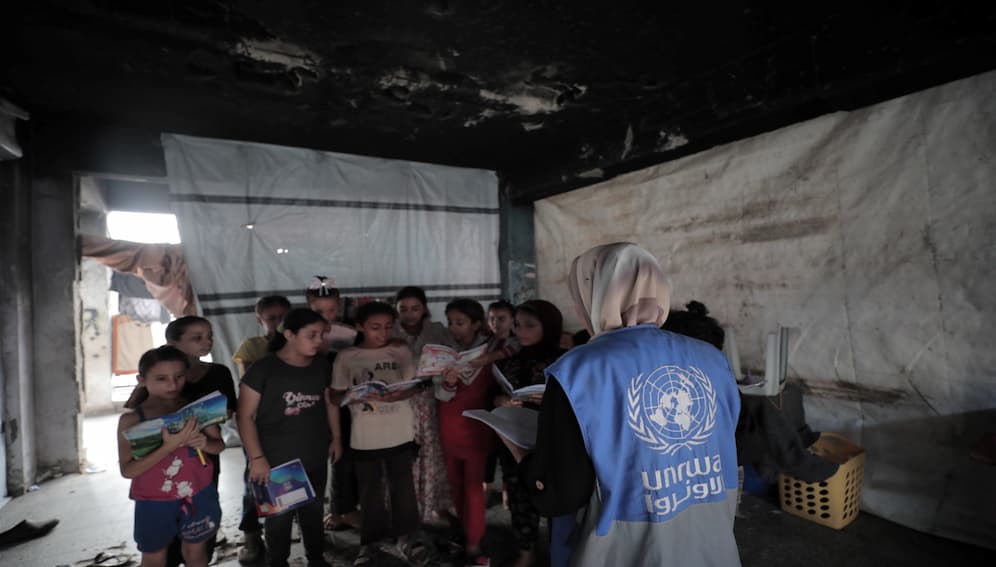
[CAIRO] Gaza’s education system will need to be completely rebuilt, taking into account the physical and psychological trauma suffered by children in the besieged enclave, an educator told SciDev.Net.
The year-long war in Gaza has led to the near-total collapse of its education system, with educational facilities destroyed and human resources lost, according to a recent UN report.
Ashraf Kahil, a senior English teacher at the East Gaza Education Directorate, described the situation as “catastrophic”.
“We need an entirely new education system that can deal with children with disabilities, including those who have lost limbs or lost their families.”
Ashraf Kahil, English teacher, East Gaza Education Directorate
“Many students have lost their families … others have lost limbs or are suffering psychological trauma as a result of repeated displacement and loss of security,” Kahil told SciDev.Net.
“The majority of schools in northern Gaza have been partially or completely destroyed,” under bombardment by Israeli forces, he said.
“Education is not possible in an unfit environment, where we are forced to use school tents, which do not meet the most basic standards necessary for an educational environment.”
He said some children had acquired violent behaviours due to their experiences, adding: “It has become normal to see one child carrying a knife and another stealing.”
A report published September by the University of Cambridge and the Centre for Lebanese Studies, in cooperation with the United Nations Relief and Works Agency for Palestine Refugees in the Near East (UNRWA), said the trauma faced by children was “ongoing and continuous”.
“It is not overstating to say everyone is traumatised,” stated the report, titled Palestinian Education: under attack in Gaza.
10,000 children
Up to August this year, the conflict had led to the deaths of more than 40,000 Palestinians, including more than 10,000 children and over 400 teachers, according to the paper.
Thousands more have been injured and around 1.9 million people were displaced, many of them seeking refuge in UNRWA installations, including schools.
More than 90 per cent of schools have been damaged in some way, and around 85 per cent need to be completely rebuilt to become usable, according to the report.
“The current war in Gaza is unlike any other war in recent times,” said Pauline Rose, professor of international education and director of the Research for Equitable Access and Learning Centre at the University of Cambridge.
“Nearly all schools have been destroyed, [resulting in] at least two years’ education loss — and probably up to at least five,” Rose told SciDev.Net.
The current conflict has severely disrupted the education of 625,000 students and affected the lives and livelihoods of more than 22,000 teachers, according to the analysis.
For many, their education had already been impacted by COVID-19-related closures and an escalation of violence in May 2021, as well as longer-term shortages of basic resources and educational supplies.
The scale of the damage shows a need to plan for the rebuilding of the education system “as soon as there is a permanent ceasefire”, the report says.
Kahil says eventual efforts to rebuild the educational process must take into account the psychological experiences of children, youth and teachers, as well as physical impairments caused by the war.
Lost limbs
“We need an entirely new education system that can deal with children with disabilities, including those who have lost limbs or lost their families,” he said.
More immediately, there is an urgent need for intervention to provide psychological support to affected children, said Rose.
“Education is interconnected with mental health,” she explained.
“Currently, educational recreational spaces are being provided to try and ameliorate trauma and provide … support.
“Teachers and counsellors have a big role to play. Education is about building social resilience, so you don’t leave a generation lost.”
According to the report, the education crisis in Gaza has been exacerbated by a lack of dedicated international funding, with education initiatives receiving only 3.5 per cent of total emergency funding in the occupied Palestinian territory in 2024.
It calls on the international community to fulfil its obligations when it comes to rebuilding, referring to the Sustainable Development Goal Four for equitable, inclusive and quality education.
Under the 1989 Convention on the Rights of the Child, education is a fundamental right in times of peace as in times of emergency and war, the report adds.
It recommends that teacher training programmes should include support activities with a focus on dealing with children exposed to long-term trauma.
“Enabling Palestinians to exercise their rights … and make meaningful contributions to their society and the global community is an urgent task … Anything less makes all actors complicit in undermining the belief in the power of education to make this world a better, safer, just and more peaceful place,” concluded Rose.
This piece was produced by SciDev.Net’s Middle East and North Africa desk.