


By: Sahana Ghosh
Send to a friend
The details you provide on this page will not be used to send unsolicited email, and will not be sold to a 3rd party. See privacy policy.
[NEW DELHI] Overestimating the potential of so-called “coastal blue carbon” ecosystems to remove carbon dioxide (CO2) from the atmosphere undermines the credibility of carbon offset schemes and could amount to “greenwashing”, according to new analysis.
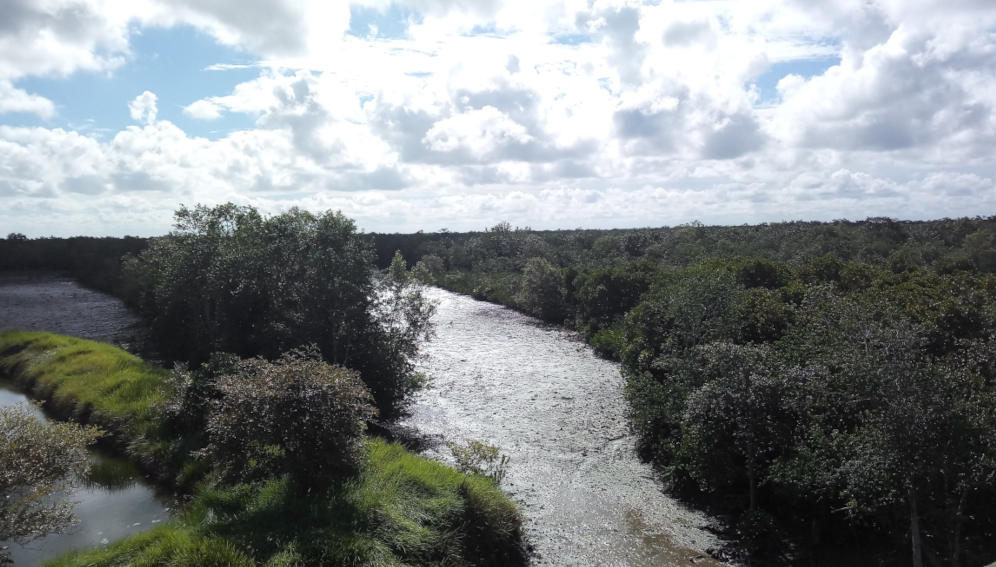
Coastal blue carbon refers to the carbon captured by coastal and marine organisms and stored in coastal ecosystems such as estuaries and saltmarshes, where land meets sea.
Covering 70 per cent of the earth’s surface, scientists consider the ocean – and the coastal ecosystems that feed into them – as a natural carbon sink that absorbs and stores carbon from the atmosphere.
But in a study published this month in Environmental Research Letters, researchers say that the carbon dioxide removal potential of coastal blue carbon ecosystems, using seagrass restoration, saltmarsh and mangrove forests, may not effectively contribute to meaningful climate mitigation.
Such approaches, which are being used by companies looking to offset carbon emissions, could actually be “dead-ends” that are counterproductive in efforts to reduce global warming, they argue.
“These nature-based approaches may represent greenwashing rather than being effective climate solutions,” says study co-author Phillip Williamson at the University of East Anglia’s School of Environmental Sciences, in the United Kingdom.
According to the researchers, many scientists and private sector organisations advocate for ocean-based carbon dioxide removal methods without due diligence on the science behind them.
“A better assessment would require forensic carbon accounting – carbon budgets and life cycle analysis of the blue carbon,” says the study’s first author Philip Boyd at the University of Tasmania’s Institute for Marine and Antarctic Studies.
Benefits ‘oversold’
The researchers emphasise the importance of restoring coastal blue carbon ecosystems for coastal protection, pollution control, biodiversity, livelihood and food security. However, their overall contribution to carbon removal is minimal and often oversold, says Boyd.
He suggests that resources could be better spent on emission reductions and other carbon dioxide removal methods such as ocean alkalinity enhancement to improve CO2 uptake.
According to previous estimates, coastal blue carbon ecosystems naturally remove just 0.4 per cent of current CO2 emissions.
Even with extensive restoration of such ecosystems to sequester and store more carbon, the climate impact would still be minimal, Boyd and his team claim. Moreover, in most parts of the world, coastal restoration would conflict with human settlement, agriculture, aquaculture or other economically significant coastal land uses, they argue.
In Southeast Asia, touted as a hotspot for restoring mangroves, financial, land-use, and operational challenges significantly restrict reforestation efforts.
Coastal wetlands can also be sources of two powerful greenhouse gases, methane and nitrous oxide, countering and complicating the monitoring of blue carbon benefits, researchers say.
“With climate mitigation taking centre stage in global dialogues, many proposals for marine carbon dioxide removal are constantly discussed,” says microbial ecologist Anwesha Ghosh of the Centre for Climate and Environmental Studies at the Indian Institute of Science Education and Research, in Kolkata, India.
“The paper reminds us of the need to probe deeper, to understand the ecosystem fine-prints before applying any such techniques on the ground.”
This piece was produced by SciDev.Net’s Asia & Pacific desk.