


13/01/26
Burning plastic waste ‘widespread’ in poor communities

By: Mohammed El-Said
Send to a friend
The details you provide on this page will not be used to send unsolicited email, and will not be sold to a 3rd party. See privacy policy.
[CAIRO, SciDev.Net] Burning of toxic plastic waste as a fuel for cooking, heating, or lighting fires has become common practice in low- and middle-income countries, driven by the absence of basic services in the poorest communities, a study suggests.
The survey of more than 1,000 participants in 26 countries, published in the journal Nature Communications, indicates that burning plastic as household fuel is prevalent in cities across Africa, Asia, and Latin America.
More than a third of respondents said they were aware of the practice, while 16 per cent reported that they had personally burned plastic as a fuel in their own homes, despite a high awareness of the risks. More than half of participants described the practice as widespread to varying degrees.
Lead author Bishal Bharadwaj, a research associate in economic geography at the University of Calgary, Canada, says these figures reflect “a daily reality in low-income neighborhoods,” where waste management services are lacking.
“Plastic waste is difficult to manage,” he told SciDev.Net. “It does not decompose, scrap collectors accept only limited types of it, and waste collection facilities are inadequate in many poor neighborhoods.
“Burning may become the last resort for getting rid of accumulated plastic.”

Often this takes place inside homes or in informal areas, making it almost invisible in official statistics, Bharadwaj added.
He says many public policies treat plastic burning as a general environmental problem, rather than a household practice linked to meeting basic needs such as energy access and waste disposal.
Waste and energy crisis
In many low-income urban communities, waste collection services are irregular or absent, leaving households to self-manage the accumulation of non-biodegradable waste, the study highlights.
At the same time, these households suffer from energy poverty, as gas and electricity are either unavailable or prohibitively expensive, while firewood and charcoal have become scarce or costly. In this context, plastic becomes an accessible and cheap option, despite the health risks.
Bharadwaj says that “the first step for local policymakers is to establish whether plastic waste burning is actually happening on the ground, and at what scale.” Households burn plastic for multiple purposes and for different reasons, he says, meaning there is no one-size-fits-all solution.
Hidden health risks
The study found that the most commonly burned types of plastic were everyday items such as water and juice bottles, plastic bags, and food packaging, as well as chemical containers, plastic pipes, and parts from broken household appliances.
Noha El-Halawany, head of the polymers and pigments department at Egypt’s National Research Centre who was not involved in the study, explains that the danger of burning plastic lies in its chemical composition.
“When these materials are exposed to uncontrolled temperatures, as happens in household stoves, they do not burn completely, but instead break down into highly toxic by-products,” she told SciDev.Net.
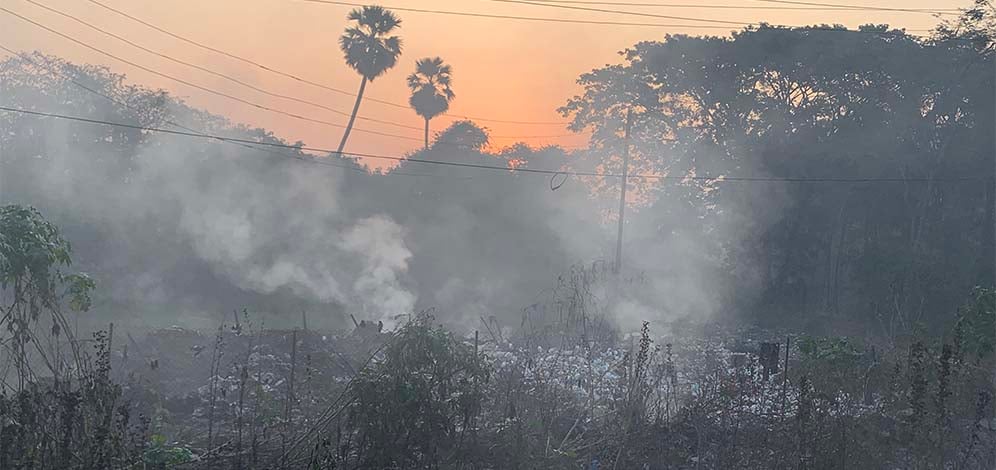
Fumes and smoke from burning plastic at a rubbish dump in Panvel Naka, near Mumbai city in India. Waste collection services are often lacking in informal settlements, leaving households to handle the accumulation themselves, researchers say. Credit: Sumaira Abdulali / Wikimedia (CC BY-SA 4.0)

El-Halawany adds that this breakdown can release fine particulate matter and hazardous organic compounds, and in the case of some plastics such as PVC, dioxins and furans—substances known for their carcinogenic effects and their ability to disrupt the respiratory and immune systems.
The problem does not end at the moment of burning, as these substances can settle on surfaces or contaminate food and water, she adds.
The study cites previous research that found toxins in chicken egg samples from an electronic waste site in Ghana, where plastic and cables were burnt in an open fire.
Practical alternatives
When asked about the most important solutions to curb plastic burning, study participants ranked improving waste management in informal settlements as the top priority. Second came increased access to clean energy technologies, followed by awareness raising around the negative health and environmental impacts.
Implementing such measures will only become more urgent as rapid urbanisation outpaces provision of services, the study warns.
“People do not burn plastic simply because they are unaware of its risks, but because they lack practical alternatives,” stressed Bharadwaj. He warned that banning burning or plastic outright, without providing substitutes, could push households toward even more dangerous practices inside their homes.
Aziza Mohamed, a professor of human geography at the Faculty of African Graduate Studies at Cairo University who was not involved in the research, sees the phenomenon as reflecting spatial and social inequality in cities.
“Plastic burning typically spreads on the urban margins, where service gaps intersect with energy poverty and informal housing,” she told SciDev.Net.
She believes that the practice represents a form of environmental injustice, as the poorest groups bear the health and environmental burden of pollution while remaining excluded from decision-making.
Addressing the problem, she says, requires urban policies that specifically target marginalised neighborhoods and link urban planning with energy and waste management.
Mohamed noted that the peer-reviewed study had a broad enough sample size to lend weight to the findings. But she added that the results were not disaggregated by country or city, limiting their usefulness for shaping precise national-level policies.
Bharadwaj added: “What we need now is evidence of solutions that are appropriate to local contexts, solutions that actually work on the ground, not just general recommendations.”
This piece was produced by SciDev.Net’s Global desk.