


Send to a friend
The details you provide on this page will not be used to send unsolicited email, and will not be sold to a 3rd party. See privacy policy.
[GOIÂNIA, BRAZIL, SciDev.Net] A massive area of protected land in the Brazilian Amazon could be at risk from expansion of mining driven by the demand for materials used in clean energy technologies, according to new analysis.
The study published in the journal Resources Policy indicates that nearly 363,000 square kilometres of the Brazilian Legal Amazon are threatened by current and potential future mining for critical minerals such as copper, bauxite, manganese and iron.
The Legal Amazon encompasses nine Brazilian states and spans more than five million square kilometres—around 60 per cent of Brazil’s territory.
The area found to be at risk from mining comprises mostly forest and is home to about 178,000 indigenous people and more than 17,000 quilombolas (descendants of African slaves).
The study’s lead author, environmental engineer Beatriz Carneiro, told SciDev.Net: “Although we are talking about an area potentially impacted in a scenario where all the minerals are exploited—ie, the worst-case scenario—this figure is worrying, as it demonstrates the economic pressure of mining projects in the licensing process near these territories.”

Researchers analysed the location of critical mineral deposits as well as applications and approved permits for mining. They found that a third of the protected areas of the Brazilian Amazon suffer some level of potential mining pressure.
According to the study, 73 per cent—around 267,000 square kilometres—of the threatened conservation area is forest cover.
‘Green colonialism’
A report by the International Energy Agency predicts that, under current trends, demand for minerals for clean technologies could double by 2030. In a carbon emissions elimination, or net zero, scenario it would be up to four times greater by 2040, according to the report.
Another report, from the UK-based charity Oxfam, shows that 70 per cent of the mineral reserves crucial for the energy transition are located in the global South.
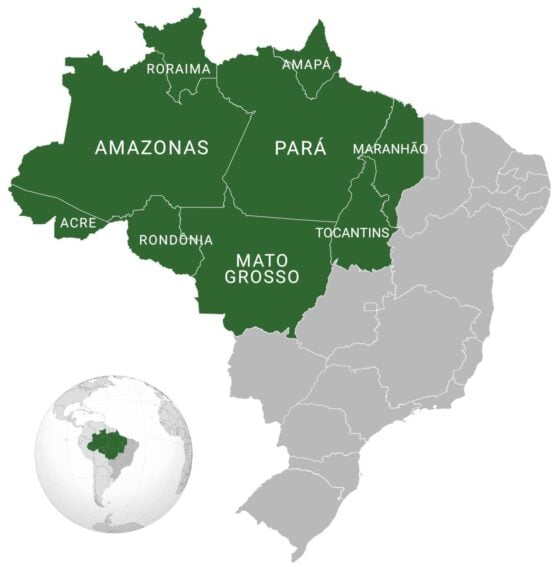
Map showing the Amazon in Brazil. Credit: Williamferreiraam/Wikimedia Commons (Creative Commons CC BY-SA 3.0 Deed).
Rhuan Sartore, a geographer at the Federal University of Rio de Janeiro who was not involved in any of these studies, describes this paradox of the energy transition as “green colonialism”.
“It is a corporate colonial model that proposes to achieve the decarbonisation of the global North by treating the ecosystems of the global South as ‘sacrifice zones’,” he told SciDev.Net.
To reduce the impacts, Carneiro and her team recommend prioritising projects in already degraded areas, avoiding mining expansion near protected areas, and stopping the granting of licenses in isolation, without considering cumulative regional impacts.
They also point to the need for policies to strengthen the territorial rights of traditional peoples, including the creation of new conservation units and formal recognition of indigenous and quilombola lands.
However, experts warn that the effort must be global. According to Carneiro, it is essential that countries trace the origin of imported minerals and are stricter about the environmental and societal impacts of their extraction.
Reducing energy consumption is also a key part of the solution. According to Carneiro, many countries, instead of replacing fossil fuels with renewable energy, are simply increasing capacity with new so-called “clean” energy sources.
Sartore agrees, adding: “The relentless search for new resource frontiers in the Amazon to maintain unsustainable consumption patterns in the global North only perpetuates a colonial logic under a new ecological guise.”
This article was produced by the Latin America and Caribbean edition of SciDev.Net.