


By: Neena Bhandari
Send to a friend
The details you provide on this page will not be used to send unsolicited email, and will not be sold to a 3rd party. See privacy policy.
Prosthetic supplies and ongoing care are urgently needed for Gaza’s child amputees, writes Neena Bhandari.
[SYDNEY, SciDev.Net] Thousands of children in Gaza, who have undergone amputations during the war, need their prostheses modified, repaired or replaced every six to 12 months or sooner, as they grow.
But with healthcare services severely strained and rehabilitation resources scarce to non-existent, specialists and aid organisations warn that young amputees face an uncertain future without sustained access to the care they need.
Eight-year-old Mohammed Akram Abu Aker’s right leg was severed in June 2025 by shrapnel from an artillery shell, just as he and his family were attempting to flee following an Israeli airstrike on a neighbour’s house in Gaza. The shrapnel penetrated multiple parts of his body, causing extensive wounds.
“The scale of injuries in Gaza requires a long-term international commitment and investment in advanced prosthetic and reconstructive care, not only emergency intervention.”
Fady Al Madhoun, Gaza City medical activity manager, MSF
About 10,000 children have sustained life-changing injuries in Gaza since October 2023, according to the World Health Organization (WHO). One in five out of more than 5,000, who have undergone limb amputations, is a child.
Mohammed was one of a number of injured children medically evacuated from Gaza to Jordan for treatment and rehabilitation. There, he was fitted with an above-the-knee prosthesis in November 2025.
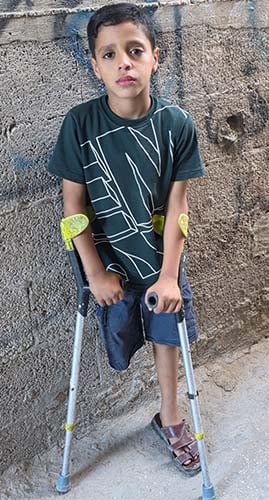
Mohammed Akram Abu Aker longs for a functional prosthesis that will allow him to run and play football without crutches. Photo courtesy of Mohammed’s parents.
“He was attending rehabilitation and gait-training sessions to learn how to use the prosthesis safely and effectively,” Mohammed’s father, Akram Abu Aker, told SciDev.Net by email through his son’s prosthetist in Gaza.
“But before he could complete the recommended rehabilitation programme and follow-up care, a decision was made for him to return to Gaza last December,” he added.
Growing problem
The prosthesis no longer fits properly due to his growth over the past seven months, his parents say. The poor fit causes severe pain in his residual limb, limiting his ability to wear the prosthesis to less than an hour at a time.
He now relies on crutches and a wheelchair for mobility. His parents say this has caused him to lose self-confidence and spend most of his time at home.
Mohammed urgently needs a new custom-made socket to ensure a proper fit and comfortable use of the prosthesis. But due to severe shortage of prosthetic materials and components in Gaza, resulting from the ongoing Israeli blockade, local prosthetists cannot make a new one that would fit properly and restore his mobility.
The importation of rehabilitation equipment, supplies and assistive products continues to face significant constraints despite the fragile ceasefire. According to WHO, 18 shipments of rehabilitation-related supplies are pending clearance, with a waiting time of 130 to 520 days, as of mid-April 2026.
Mohammed’s father says his son is reluctant to attend school as he fears being teased or bullied because of his disability. At times, he carries his son because navigating Gaza’s conflict-ravaged infrastructure on crutches can be too exhausting and painful.
For children with amputations, it is essential to have ongoing access to prosthetic services for follow up care, adjustments and replacement of their prosthetic limb throughout their growing years.
Having timely access to a functional prosthesis would enable Mohammed to walk independently and try to rebuild his life.
The boy’s only wish, his father told SciDev.Net, is for the war to end and one day to be fitted with a sports prosthesis so that he can run and play football without crutches like other children of his age.
“Mohammed is particularly devastated that he can no longer play football with his friends as he did before his injury.” his father said.

Critical resource shortage
Currently, all rehabilitation facilities in Gaza are operating with severe constraints in staffing, equipment or supplies. According to WHO, out of the 2,300 people with amputated limbs assessed between September 2024 and May 2026 in Gaza, fewer than 25 per cent have been fitted with permanent prosthetics due to this severe shortage.
A prosthesis is an artificial device to replace the missing body part whereas an orthosis is an externally applied device, such as a brace or splint, used to support and improve the function of an existing body part.
Aid organisations and rehabilitation professionals estimate the overall number of people requiring prosthetic and orthotic services to be significantly higher and growing. The WHO report only reflects conflict-related injuries, and not people with chronic conditions, pre-existing and age-related disabilities, who also need rehabilitation services.
The Artificial Limbs and Polio Centre (ALPC) is one of the main physical rehabilitation centres in Gaza providing prosthetics, orthotics, physiotherapy, wheelchairs, assistive devices, and mental health services.
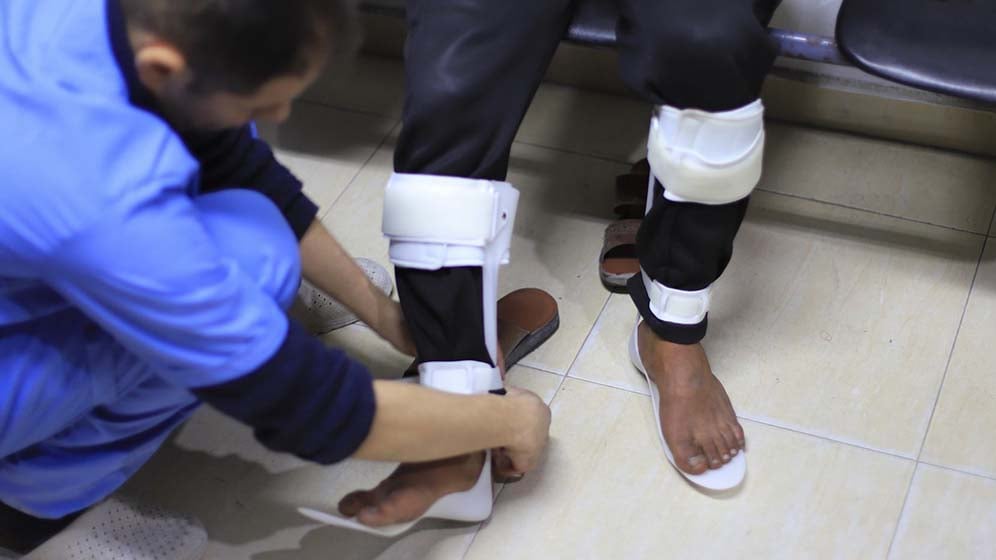
A rehabilitation professional fits an orthosis at the Artificial Limbs and Polio Centre (ALPC), Gaza. Photo courtesy of ALPC.
“We see approximately 40 to 50 patients, 40 per cent of them children, requiring prosthesis or orthosis per day,” ALPC’s acting director, Nevein Al-Ghussain, told SciDev.Net.
“Each month, we are fabricating and fitting around 35 patients with a permanent prosthesis, and about 100 patients with an orthosis,” she added.
Among the several challenges and constraints to care, Al-Ghussain highlights “the critical need for timely, continuous and reliable supply of prosthetic and orthotic raw materials, especially plaster of Paris, components, rehabilitation equipment, specialised tools, and machinery for manufacturing and fitting prosthetic and orthotic devices”.
The Gaza City clinic run by Médecins Sans Frontières (Doctors Without Borders/MSF) currently has eight active amputee patients. “But we do not have prosthetists onsite to provide fabrication services,” Fady Al Madhoun, MSF’s medical activity manager in Gaza City, told SciDev.Net.
“This significantly delays patient assessment, prosthetic fitting, orthotic support and follow-up rehabilitation services,” he said.
Patrick Griffiths, a spokesman for the International Committee of the Red Cross (ICRC) in Jerusalem, told SciDev.Net: “Currently, Gaza only has nine prosthetic and orthotic professionals.”
“Global standards estimate a need of approximately one prosthetist per 250 to 300 amputees and one physiotherapist per 100 to 150 rehabilitation patients. This indicates a major workforce gap.”
According to WHO, nearly 14,000 patients registered for limb reconstruction services between July 2025 and May 2026, and of those assessed so far, almost half require further surgery, including 105 children.
Burn injuries
Besides amputees, WHO has recorded 3,400 people with major burn injuries, who also require long-term rehabilitation. Al Madhoun’s team treats patients with burn injuries, using 3D technology for Transparent Facial Orthosis (TFO) at the MSF Gaza City clinic.
“Currently, we have around 90 active burn patients in need of TFO,” said Al Madhoun.
“The number of burn patients, especially children, requiring TFO is increasing with daily attacks continuing despite the so-called ceasefire.”
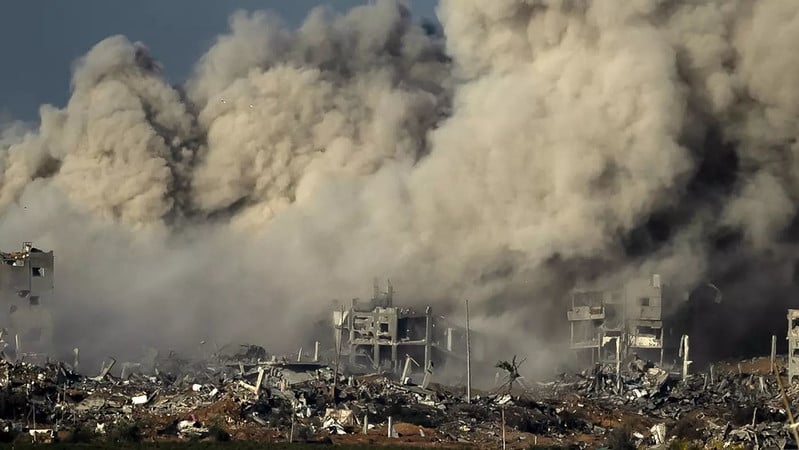
Destruction and smoke over Gaza in 2023. Photo by: Fellton Davis (CC BY 2.0)
He said more people were also sustaining burns in domestic incidents due to precarious living conditions in the makeshift tents in Gaza.
Meanwhile, the resources doctors have at hand to deal with these cases are dwindling.
“We are running out of filament, for example, which is an essential thermoplastic material needed for printing 3D masks, and spare parts for the 3D printer itself,” Al Madhoun said.
“If we run out of material or the printer breaks down, I don’t know what I can do as a doctor.”
The clinic also lacks basic items, such as antibiotics, painkillers, and skin-regenerating ointments, he noted.
Besides medical supplies and materials, health professionals are calling for technical support and training opportunities for rehabilitation professionals. Prostheses and orthoses have to be custom-made to fit an individual patient’s anatomy, requiring specialist expertise.
“The scale of injuries in Gaza requires a long-term international commitment and investment in advanced prosthetic and reconstructive care, not only emergency intervention,” Al Madhoun added.
This piece was produced by SciDev.Net’s Global desk.