


By: Edith Magak
Send to a friend
The details you provide on this page will not be used to send unsolicited email, and will not be sold to a 3rd party. See privacy policy.
Greater diagnostic testing for cryptococcal meningitis could help avert 135,000 deaths a year in Africa, writes Edith Magak.
[LILONGWE, Malawi] A persistent headache nearly killed Elube. It took Patricia’s sight. Both women had cryptococcal meningitis, a fungal infection that mostly affects people with HIV and kills around 135,000 people each year in Sub-Saharan Africa.
Effective treatments exist, but in the places where the disease kills most people, they are often unaffordable, unavailable or impossible to administer.
In 2014, in Lilongwe, Malawi, Elube and Patricia did not know each other. Elube, a wife and mother-of-two, ran a garage shop and tended a small farm. Both women asked that their surnames be withheld because of HIV-related stigma. Across the city, Patricia, a mother-of-one, ran a salon and was saving for a plot of land. Around the same time, both began to feel the same symptom: a headache that would not go away.
“I suffered from these headaches for a long time,” Elube tells SciDev.Net, adding that despite taking painkillers, the headaches grew worse.
“I also felt a lot of neck pain, especially when I carried something on my head. I lost my appetite and vomited frequently. It went on for a long time.”

Patricia had a similar experience.
“I remember the headaches started around July 2014, and over the next few months my head was still aching,” she recalls.
In both cases, the women eventually lost consciousness.
HIV positive
Patricia collapsed in her sister’s bathroom and woke up hours later at Kamuzu Central Hospital in Lilongwe. Elube opened her eyes in a bed at the same hospital three days later, with no memory of how she had arrived.
Both women received the same news: they had tested positive for HIV and had cryptococcal meningitis. For Patricia’s sister, who had accompanied her, the second diagnosis was entirely unfamiliar. “We know HIV,” she says, “but this one, we had never heard about it.”
“Cryptococcal meningitis is a fungal infection,” explains Cecilia Kanyama, an internal medicine physician and researcher at Kamuzu Central Hospital.
“The fungus is ubiquitous in the environment. It gets into a person through the respiratory system and stays dormant. But once there is immune suppression, either through HIV or other causes, it can disseminate and cause problems. When it spreads to the central nervous system, it causes meningitis.”
Symptoms, she says, start with a headache, which becomes increasingly severe. Patients might also experience fever and neck pain or stiffness.
“Later, they may present with seizures, loss of consciousness, or neurological complications like problems with their sight or vision,” she adds.
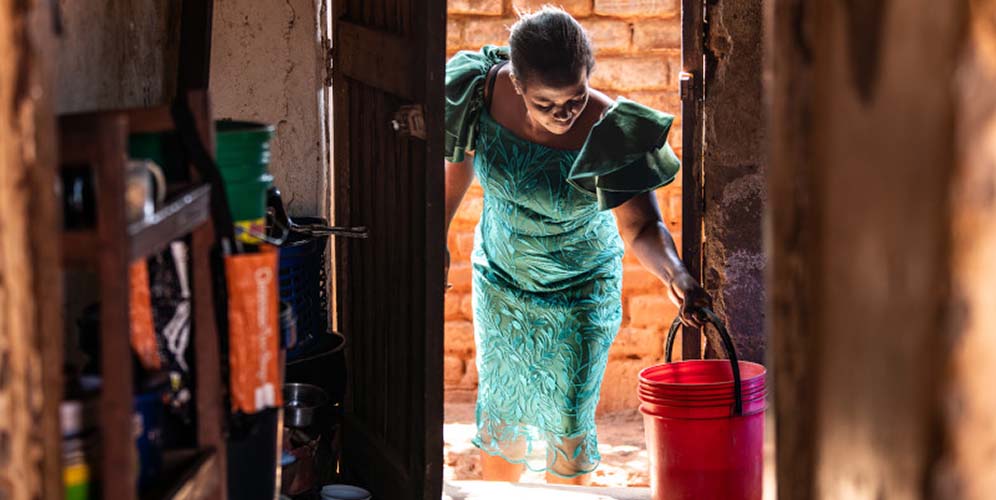
Elube, a mother-of-two from Lilongwe who survived cryptococcal meningitis. The disease remains under-diagnosed, under-treated and overlooked by research funders and global health donors. Photo courtesy of DNDi.
To relieve the pain, both Elube and Patricia were given a lumbar puncture, a needle inserted into the lower back to draw out cerebrospinal fluid. The procedure releases the pressure that the fungal infection builds inside the skull, which is what drives the devastating headache.
But relief from pressure is not the same as recovery. The damage the disease leaves behind can be permanent. For Patricia, it was her vision.
“I told the doctors, why is it that I cannot see now? When I asked why all this was happening, they said meningitis can disable other organs. If you are lucky, you will have your sight back. But if not, you will be like that.”
That was over ten years ago. Her sight has not returned.
Four times a day
Both women received the World Health Organization-recommended regimen at the time: a week of amphotericin B deoxycholate, then the only formulation available, by intravenous drip, followed by oral flucytosine four times a day for 14 days and then at least eight weeks of fluconazole. WHO updated its guidance in 2022, and now recommends a single high dose of liposomal amphotericin B with 14 days of flucytosine and fluconazole.
Emily Kumwenda, a research nurse at Kamuzu Central Hospital, describes the difficulty of keeping patients on oral flucytosine. Four doses a day is hard for anyone, she says, but especially for patients who are weak and nauseous.
“The challenge that most patients complain about is nausea and vomiting,” she says. “When they vomit, they are afraid to take the next dose. You have to reassure them, explain that while they are taking the drug, they will get better, and that the nausea and vomiting will stop at some point.
“But most complain because of how many times a day they have to take it. Six in the morning, 12 noon, six in the evening, and midnight.”
The challenge is greater for patients who arrive unconscious. “We insert a nasogastric tube for feeding and drugs,” says Kanyama. “But when you crush the tablet to administer it that way, we cannot be certain the bioavailability [proportion of the drug that enters the body] of the medication is the same as in its original form.”
This routine may soon change. The Drugs for Neglected Diseases initiative (DNDi) is leading a Phase II trial at Kamuzu of a simplified regimen that reduces flucytosine from four daily doses to two. Other partners include Tanzania’s National Institute for Medical Research, the University of North Carolina Project in Lilongwe, the Luxembourg Institute of Health, South African clinical research organisation FARMOVS and St George’s, University of London.
The 5FC HIV-Crypto trial uses a sustained-release pellet formulation, made by global healthcare company Viatris, which is mixed with water before being swallowed or administered through a nasogastric tube. The trial has enrolled half its participants, with results expected in 2027.
Long-term effects
While Elube has recovered and her headaches are gone, Patricia’s life was reshaped by the disease. She closed the salon and was unable to buy the land she had been saving for, turning instead to selling charcoal for a living.
Because of her vision loss, she cannot go to the market alone and needs accompanying when she collects her HIV medication and fluconazole from the hospital.
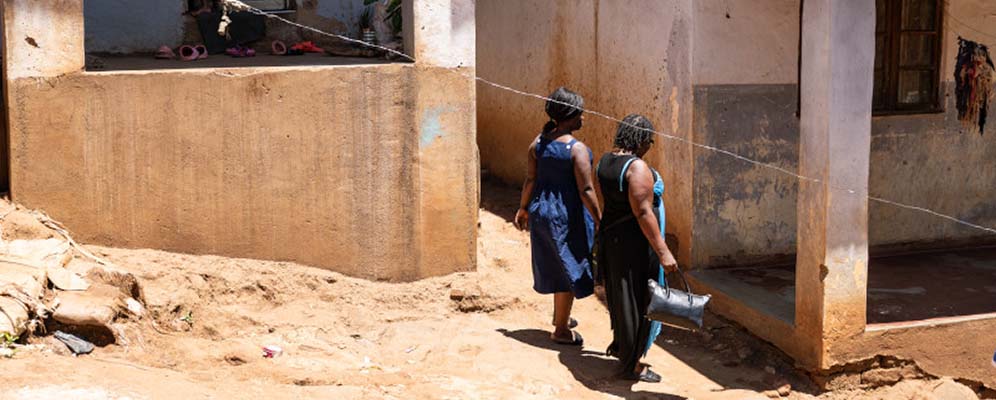
Patricia, pictured left walking with her sister, lost her vision due to cryptococcal meningitis. Scientists say that if people know the signs and symptoms of the disease, they will rush to the hospital for treatment. Photo courtesy of DNDi.
“Before I got cryptococcal meningitis, I could do everything for myself. Money was not the problem,” she recalls.
“But now things are hard, and if there is no one to give me something, I have absolutely nothing.”
Neglected disease
For many people with cryptococcal meningitis, the outcomes are worse. The disease remains under-diagnosed, under-treated and overlooked by research funders and global health donors.
Effective treatments exist, but they are often too expensive, unavailable or too difficult to administer in the resource-limited settings where the disease hits hardest.
“If left untreated, there is 100 per cent mortality,” Kanyama says. “There is no chance of surviving this disease without treatment.”
Caught early, patients can survive. Kanyama is clear about what needs to change: “What I would also want to see is more diagnostic testing on the ground, so that we can pick up the disease earlier, because it is the late presentation that carries high mortality.
“Community awareness matters just as much. If people know the signs and symptoms, they will rush to the hospital. They will receive treatment. They won’t die.”
This article was supported by a reporting grant from DNDi.
This piece was produced by SciDev.Net’s Sub-Saharan Africa English desk.