


26/11/26
Nigeria’s Ebola scare exposes gaps in preparedness

By: Titilope Fadare
Send to a friend
The details you provide on this page will not be used to send unsolicited email, and will not be sold to a 3rd party. See privacy policy.
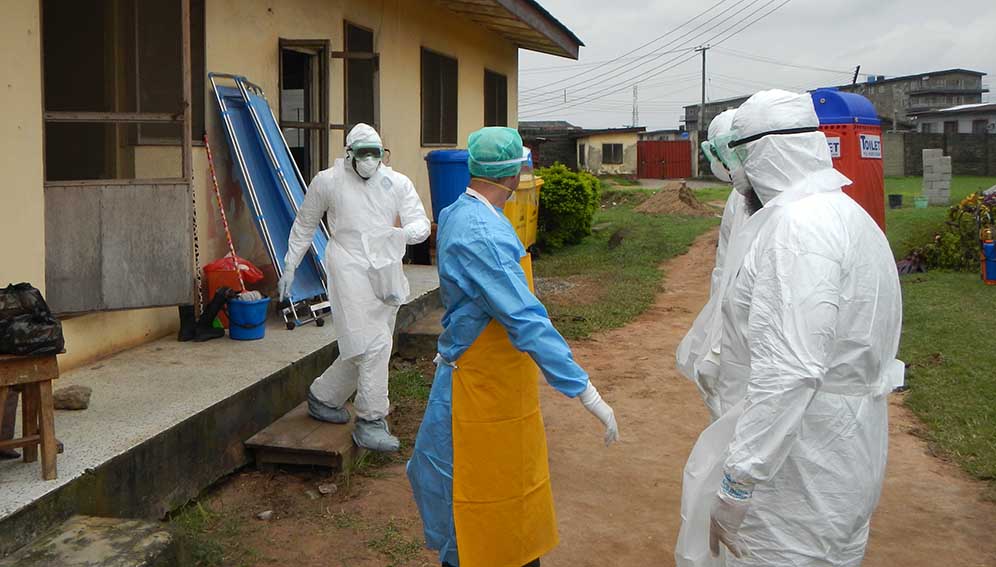
[ABUJA, SciDev.Net] Nigeria contained its first imported case of Bundibugyo Ebola without recording a secondary infection. But the 12-day gap between symptom onset and disease reporting raises urgent questions about hospital preparedness for future outbreaks.
What happened in Nigeria’s first Bundibugyo Ebola case?
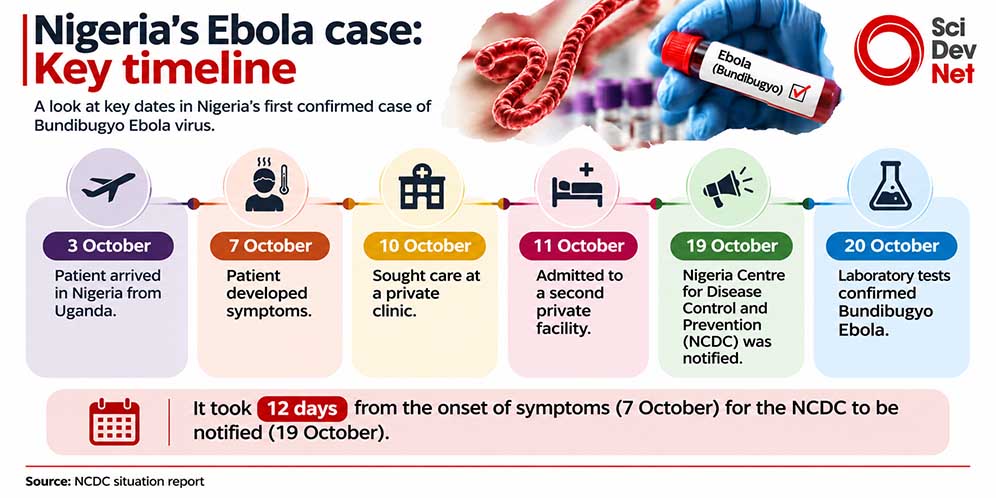
Nigeria confirmed its first case of Bundibugyo Ebola disease on 20 October 2026, in a woman who had travelled from Uganda.
The 42-year-old arrived in Abuja on 3 October and developed symptoms on 7 October, according to the Nigeria Centre for Disease Control and Prevention (NCDC). She sought treatment at a private health facility on 10 October before being admitted to another private facility a day later.
However, the NCDC said it was only notified on 19 October—12 days after symptoms began—with laboratory tests confirming the infection the following day.
This fell well short of the global 7-1-7 benchmark, which calls for outbreaks to be detected within seven days, reported within one day, and responded to within seven days.
The patient was isolated and received supportive care before being medically evacuated to her home country, Switzerland on 26 October. She was discharged from hospital on 11 November.
The NCDC identified 62 contacts, all of whom completed their 21-day monitoring by 13 November, with no secondary infections recorded. Nigeria has now begun the standard 42-day countdown to declare the outbreak over.
“We have built a system around preparedness for a virus that may come, but it stops at the hospital door. ”
Testimony Olumade, immunology researcher, University of Manitoba, Canada
While the immediate threat was contained, the delay raises a pressing question: why did a country that spent months preparing for Ebola take so long to recognise it?
What is Bundibugyo Ebola and how does it spread?
First identified in Uganda in 2007, Bundibugyo virus is one of several viruses that cause Ebola disease. There is currently no approved vaccine or specific treatment for this rare species of the disease.
Suspected to originate in fruit bats, the Ebola virus jumps from wildlife to humans before spreading through direct contact with the blood, organs, or bodily fluids of infected people, contaminated surfaces, or unsafe burial practices.
The incubation period lasts two to 21 days, and patients only become infectious once symptoms appear.
Early signs—fever, fatigue, muscle pain, headache, and sore throat—resemble common illnesses such as malaria and typhoid. As the disease progresses, patients may experience gastrointestinal distress, organ dysfunction, and internal or external bleeding.
Why was the Nigerian case not detected earlier?
Experts say the delay exposed a gap between national outbreak readiness and frontline clinical recognition.
Testimony Olumade, a doctoral researcher in immunology at the University of Manitoba, Canada, who led a 2020 review of Nigeria’s outbreak preparedness, said the country had strengthened laboratory and genomic surveillance but had lagged at the point of care.
“We have built a system around preparedness for a virus that may come, but it stops at the hospital door,” he told SciDev.Net.
One missed opportunity in this case, he said, was establishing the patient’s travel history during her first consultations, which can help identify possible Ebola infections earlier.
Oyewale Tomori, a professor of virology and former president of the Nigerian Academy of Science, stressed that private hospitals must be included in preparedness programmes because many patients seek care there first. He also highlighted shortages of personal protective equipment (PPE) among health workers.
He told SciDev.Net: “Everybody thinks of malaria for any fever. If someone comes to the clinic with fever, the question should be: have you travelled in the last three weeks? Where have you been?”
The NCDC acknowledged the diagnostic overlap with malaria and typhoid and said the private facility received on-site support after alerting them.
The agency said it had circulated revised case definitions, advised clinicians not to wait for bleeding before considering Ebola, and was establishing screening and triage stations in public secondary hospitals across Abuja.
Can patients survive Bundibugyo Ebola without a vaccine?
In the absence of a specific authorised treatment, early diagnosis and supportive care can improve patients’ chances of survival, helping the body withstand the infection and manage complications.
Omosivie Maduka, a professor of epidemiology at the University of Port Harcourt who has helped treat Ebola patients, said treatment includes maintaining hydration, managing symptoms and supporting the body’s immune response.
“It’s not everybody that gets this Ebola that dies,” said Tomori. “If the patient comes in on time and you treat him symptomatically, many of them will survive.”
Patients need to be isolated and managed in designated infectious disease treatment centres rather than ordinary healthcare facilities or at home.
The NCDC said the Nigerian patient received fluids and electrolytes to prevent dehydration, treatment for other infections, fever and pain management, nutritional and psychosocial support, and monitoring for complications affecting organs such as the kidneys and liver.
The lack of a licensed vaccine specifically for Bundibugyo is nevertheless a concern as vaccines developed for the Zaire strain cannot be assumed to work against other Ebola viruses.
To address this gap, researchers launched the Tumaini Phase 2/3 clinical trial in the Democratic Republic of Congo (DRC) in October to evaluate candidate vaccines against Bundibugyo virus. WHO has also recommended two additional candidates, ChAdOx1 and Moderna’s mRNA-1469, for inclusion in the trial.
Was Nigeria prepared for the outbreak?
The NCDC said it began preparing for a possible imported case five months before this infection was confirmed.
Measures included monitoring travellers from affected countries, sharing case definitions and laboratory procedures with states, activating emergency coordination structures and assessing the importation risks.
More than 5,200 travellers from Uganda, the DRC and Kenya were referred to states for a 21-day follow-up, according to the agency.
In June, Nigeria’s President Bola Tinubu established a presidential task force on Ebola preparedness and approved the release of 10 billion Naira (about US$7.4 million) to strengthen emergency readiness.
However, Tomori questioned whether that funding reached health facilities in the form of PPE, trained personnel and isolation facilities.
NCDC director-general Jide Idris later clarified that the funding was to address wider health security needs—including Lassa fever, lab supplies, and facility repairs—while acknowledging gaps in refresher training, triage, and testing capacity outside Abuja.
Attahir Abubakar, a public health researcher at Ahmadu Bello University in Zaria, who led a 2026 review of Nigeria’s outbreak responses between 2010 and 2023, says fragmented coordination, inadequate laboratory infrastructure and shortages of testing materials hampered previous responses. He considers the response this time to be improved, pointing to the rapid mobilisation of resources after confirmation, isolation of the patient, and contact tracing.
Olumade highlighted progress in laboratory capacity, with Nigeria’s score in a WHO-led evaluation of health security capacities rising from 39 per cent in 2017 to 54 per cent in 2023. But he warned that the country’s detection capacity is outpacing its ability to respond.
What needs to change?
The continuing transmission in the DRC means Nigeria cannot afford to treat the absence of secondary infections as proof that its preparedness gaps have been resolved.
WHO reported 11,613 confirmed cases and 5,678 deaths in the DRC as of 17 November, with transmission continuing across eight provinces.
Nine cases and two deaths were also recorded in Kenya in October. The last patient was discharged on 11 November, and all contacts have completed monitoring, according to the WHO.
Experts say preparedness must extend beyond emergency operations centres, national surveillance systems and border screening, into clinical practice, including in private facilities. They say hospitals need regular training to recognise the disease, establish travel histories and report suspected cases promptly, as well as PPE, reliable diagnostics, functional isolation facilities and clear referral pathways.
The NCDC says it is working to preposition supplies in high-risk states, extend testing, strengthen triage in private facilities, and establish treatment centres in states with international airports.
Maduka says these investments must be sustained beyond the outbreak, while Tomori called for the revival of isolation wards abandoned after the COVID-19 pandemic as a further step.
For Olumade, the central lesson is that Nigeria must close the gap between detecting an outbreak and responding to it, if it is to successfully fend off future threats.
This piece was produced by SciDev.Net’s Sub-Saharan Africa English desk.