


14/09/26
Ebola outbreak is DRC’s worst. Where is the vaccine?
Send to a friend
The details you provide on this page will not be used to send unsolicited email, and will not be sold to a 3rd party. See privacy policy.
[LAGOS, SciDev.Net] As the Ebola outbreak spreads unabated in the Democratic Republic of the Congo (DRC), vaccine developers are scrambling to develop and test a vaccine candidate that will target the species at its centre.
The outbreak, which has become the largest ever recorded in the country, is caused by the Bundibugyo species of the virus, for which there is no approved vaccine.
On 30 July, the vaccine alliance CEPI announced it was providing funding of up to US$8.5 million for Hilleman Laboratories to advance the development of a Bundibugyo Ebola vaccine and produce doses for human testing.
Hilleman Laboratories is a Singapore-based vaccine manufacturer established by US biopharmaceutical company MSD and the health-focused charitable foundation Wellcome.
The vaccine candidate under development originated from the International AIDS Vaccine Initiative, IAVI and WHO scientists identified it in May as the most promising so far. The first doses are expected to be ready for clinical trials by the end of the year.
Meanwhile, however, the outbreak is moving with “unprecedented speed”, according to WHO director-general Tedros Adhanom Ghebreyesus.
How bad is the outbreak?
As of 7 September, WHO reported 6,757 confirmed cases and 3,267 deaths, giving the outbreak a case-fatality rate of 48.3 per cent.
The outbreak has spread across six provinces. Ituri remains the main focus, while substantial transmission continues in North Kivu and Haut-Uélé. Cases have also been reported in South Kivu, Tshopo and Bas-Uélé.
As well as being the largest Ebola outbreak of any species recorded in the DRC, it is the second-largest globally, after the 2014-16 West Africa epidemic, which killed more than 11,300 people.
The current outbreak has grown unusually quickly. The WHO’s 14 August update said is was “expanding faster than any previous Ebola outbreak”. Tedros told an emergency committee on 18 August that the epidemic was “far from being under control”.
Children make up roughly a quarter of cases but nearly a third of deaths, according to the UN children’s agency UNICEF. Meanwhile, 155 health workers have been infected, 45 of whom have died, according to the WHO.
A WHO investigation suggests the outbreak began in mid-January, about four months before it was declared, after early cases were mistaken for malaria and typhoid.
Why is there no approved vaccine yet?
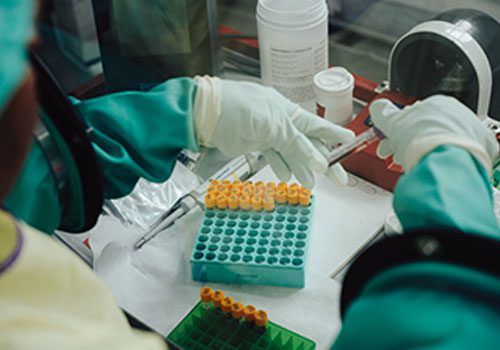
An MSF staff member analyses blood samples at the Elikya Ebola Treatment Centre in Bunia, DRC. Copyright: Julien Dewarichet/MSF.
Every licensed Ebola vaccine, including MSD’s single-dose Ervebo, targets the Zaire species—not Bundibugyo, which was first identified during an outbreak in Uganda in 2007.
Although thousands of Ervebo doses are being sent to the DRC, WHO says the evidence on cross-protection of Erbebo to other Ebola virus species remains “limited and inconclusive”.
Mandeep Dhingra, director of research and development programmes at CEPI, said the gap reflects the limited number of previous Bundibugyo outbreaks. Before this year, the virus had caused only two known outbreaks, so “the world had not prioritised it for dedicated investment”. Funding instead focused largely on the Zaire strain.
CEPI announced its first Bundibugyo investments two weeks after the current outbreak was declared in mid-May, drawing on a filovirus programme already under way.
What is Hilleman’s candidate?
Hilleman’s candidate uses the recombinant vesicular stomatitis virus (rVSV) platform behind Ervebo—a modified livestock virus that trains the immune system to recognise the target pathogen and is designed to be given as a single dose.
Erlyani Hamid, Hilleman’s head of portfolio, said WHO experts identified it as the most promising candidate because the platform has an established safety record, the candidate has shown protective efficacy against Bundibugyo in published primate studies, and Hilleman can reuse manufacturing upgrades from a separate US$30 million CEPI investment in Ervebo production.
The upgrades are intended to increase the amount of vaccine produced from the same inputs, cut costs and allow the vaccine to be stored under ordinary refrigeration for several months instead of requiring ultra-cold storage.
That could make deployment easier in parts of eastern DRC where electricity and cold-chain infrastructure are limited.
Work is further along than the July announcement suggested. Hilleman received the candidate’s starting material from IAVI, which carried out the foundational research, on 12 August. Manufacturing is now imminent.
“By the end of the year, we expect to have manufactured our first batch of vaccine candidate doses, ready to provide supply for potential clinical trials,” Hamid said.
If trials are successful, Hilleman says it will transfer the technology to a large-scale manufacturer for further trials.
Is anything being tested in people now?
Yes. CEPI now backs a range of Bundibugyo candidates, two of which are in early human trials.
One is a Moderna mRNA-1469 candidate, with up to US$50 million in CEPI funding. Its Phase 1 trial began in Canada in early August.
The other is the University of Oxford’s ChAdOx1 BDBV candidate, manufactured by the Serum Institute of India’s and supported by CEPI. Its Phase 1 trials were launched in July.
CEPI also included another Bundibugyo candidate from Egypt-based Minapharm Group. Developed by German biotech company ProBioGen, it uses an MVA-CR19 platform and is expected to enter Phase 1 trials in Africa. CEPI is providing up to US$16.5 million for its development.
While this research is progressing, WHO and Africa CDC announced on 20 August that 70,000 doses of Ervebo would go to the DRC. Of those, 50,000 doses are for health workers and 20,000 for a trial testing whether Ervebo offers any cross-protection against Bundibugyo.
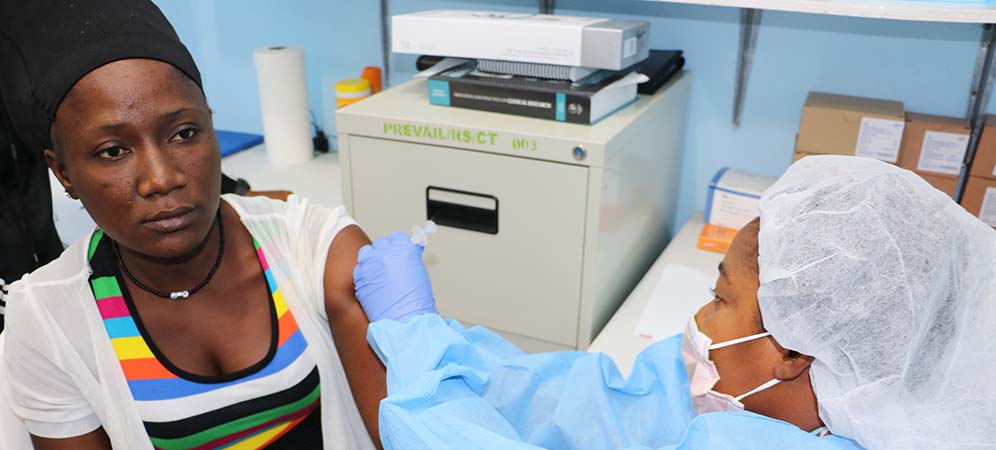
A study volunteer is vaccinated against Ebola at Redemption Hospital, Monrovia in 2017 as part of the Phase 2 PREVAC trial. The.2014-16 West Africa outbreak was the largest in history, with more than 11,300 deaths. Copyright: NIAID
WHO has said the evidence is insufficient to establish clinically meaningful protection, and the use of Ervebo against Bundibugyo should remain within research protocols.
CEPI says its goal is to get at least two Bundibugyo candidates to Emergency Use Authorisation and WHO Prequalification.
MSD, which has already supplied hundreds of thousands of Ervebo doses through the global stockpile, is providing technical support to Hilleman Laboratories as it develops the Bundibugyo vaccine. The company is sharing manufacturing expertise from Ervebo, including experience that could help Hilleman scale production.
MSD said its involvement reflects the need for collaboration in responding to outbreaks.
“No single organization can address complex health challenges like the current Bundibugyo outbreak alone,” a company spokesman said.
‘Panic and neglect’
By Hilleman’s own timeline, trial-ready doses will not exist before the end of the year.
The candidate would then need to enter clinical trials, generate safety and efficacy data and progress through later-stage testing before it could potentially be used more widely.
Dhingra says this race for a vaccine under the pressure of an escalating crisis is all too familiar. She says the world has been “trapped in a costly cycle of panic and neglect, scrambling to respond when outbreaks strike, only to ease investment once the immediate threat has passed.”
CEPI is now pressing for US$2.5 billion in new funding for its 100 Days Mission, which aims to have vaccines ready within 100 days of identifying a future pathogen.
The DRC outbreak is nowhere close to that target for the strain driving it.
This piece was produced by SciDev.Net’s Sub-Saharan Africa English desk.