

By: Catherine Brahic
Send to a friend
The details you provide on this page will not be used to send unsolicited email, and will not be sold to a 3rd party. See privacy policy.
The sleeping sickness parasite cannot reproduce if its whip-like tail stops working, say scientists in Nature this week (9 March).
They say their finding opens the door to new ways of fighting the disease. Current drugs are decades old and can have unpleasant side effects.
Sleeping sickness kills about 50,000 people in Africa every year. It is caused by Trypanosoma brucei, a parasite that is transmitted to humans by the tsetse fly.
The parasite has a long tail — or ‘flagellum’ — a structure that many such cells use to move about or sense things in their environment. The human sperm, for instance, uses its flagellum to ‘swim’ towards an egg and fertilise it.
So far, however, it has not been clear why the sleeping sickness parasite has a flagellum.
Now researchers led by Keith Gull of Oxford University, suggest that the structure helps the parasite split in two when it is multiplying in the human bloodstream.
 |
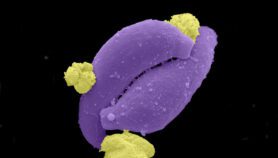
| The photo on the left is a normal Trypanosoma brucei parasite. Without a well-functioning flagellum, the parasite cannot divide properly. The photo on the right shows how it becomes monstrously contorted. |
Having identified the 330 proteins that make up the flagellum, including more than 100 that are unique to the parasite — a mammoth task in itself — Gull’s team selected five proteins and inactivated them. The effect was surprising.
“When we inhibit a range of these flagella proteins, then the cells cannot pull apart as they divide,” explains Gull.
The result is “grotesque, monstrous cells”, which soon die.
Gull says the finding make the parasite’s tail a very interesting target for future drugs.
“If you could design a small molecule that blocked the function of the flagellum, it would be likely to have an effect on the parasite,” he explains.
Moreover, inactivating one or more proteins in the parasite’s flagellum, but not in human cells, would leave patients’ cells unaffected.
Reference: Nature 440, 225 (2006)
More on Disease