

Send to a friend
The details you provide on this page will not be used to send unsolicited email, and will not be sold to a 3rd party. See privacy policy.
[HANOI] Rising sea levels linked to global warming threaten economically, ecologically and culturally important mangrove forests in Pacific island states.
The warning comes in a study published today (18 July) by the UN Environment Programme (UNEP), which says some of the region’s islands could lose half of their mangroves by 2100.
The report predicts that American Samoa, the Federated States of Micronesia, Fiji and Tuvalu will be worst hit.
Mangroves grow along coasts throughout the tropics and subtropics. They occupy the boundary between land and sea and are semi-submerged during high tides.
Many species of commercially important fish breed and raise their young among mangrove roots, and studies have shown that when mangroves are cut down local fish catches decline.
Mangroves also provide a range of ‘ecological goods and services’ for coastal communities. They are sources of timber and medicines, and they protect shorelines from storms and tidal surges.
The UNEP study shows that up to 13 per cent of the Pacific region’s mangroves could disappear as sea levels rise because the forests’ natural response — to retreat further inland — is blocked by natural features and man-made obstructions, such as sea walls and settlements.
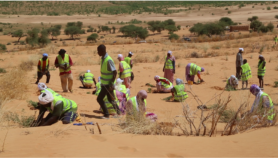
The report recommends limiting coastal development and allowing mangrove forests to spread inland. It urges policymakers to rehabilitate former mangrove areas by planting young trees, and to create new mangrove habitat.
Phan Nguyen Hong, head of the Mangrove Ecosystem Research Division of the Vietnam National University, agrees that rising sea levels and mangrove loss are a concern. But he points out that direct human action — such as conversion of mangroves to shrimp farms — has already had a massive impact.
He points to recent figures from Vietnam’s Ministry of Agriculture and Rural Development that show the country has just 165,000 hectares of mangroves compared to 408,500 hectares before 1945.
"But now the government has considered the problem seriously and decided to restore the mangroves," Hong told SciDev.Net. "It is because recent storms caused much more severe damage for people in areas where the mangroves have disappeared."
He says replanting mangrove forests could help to limit the effects of rising sea levels and increase local catches of marine products.
The UNEP report says the annual economic value of products and services that mangroves provide is between US$200,000 and US$900,000 per hectare.
Achim Steiner, UNEP’s executive director, said that there is "an urgent need to help vulnerable communities adapt to the sea level rise which is already underway."
"This report provides sensible and sound advice on management regimes needed to boost the health and resilience of coastal zones and coastal ecosystems — like mangroves — in the face of current and future threats," he said.
Link to full UNEP report  [2454KB]
More on Biodiversity