
Skip Navigation

News

  • Print
  • Comment
  • | Share

Cactus purifies water on the cheap, finds study

Lucina Melesio Friedman

6 May 2010 | EN | ES | 中文

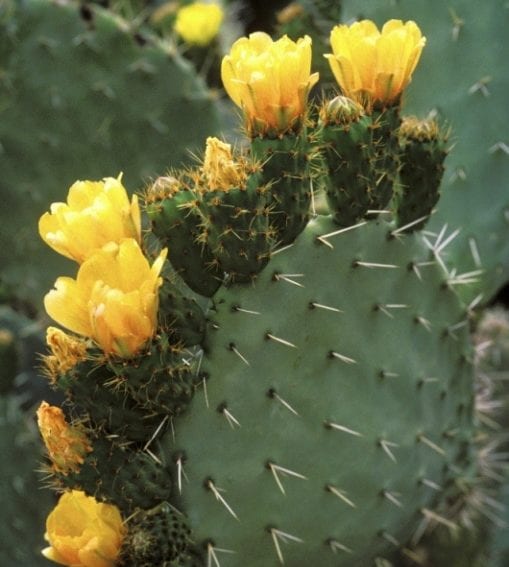
Prickly pear catus

The prickly pear cactus removed 98% of sediment and bacteria from water.

Flickr/ ah zut

[MEXICO CITY] Scientists have worked out how a common, edible cactus purifies water, paving the way for its use in developing countries.

The nopal (or prickly pear) cactus, Opuntia ficus-indica, is native to the United States and grown widely on the African continent, Mexico and other developing countries. It could now become a sustainable and affordable water purification method in the rural communities of developing countries, say the scientists.

Scientists have known that prickly pear cleans water but their understanding of the mechanism was poor.

They tested two types of mucilage — a gelatinous substance produced by the cactus — in contaminated water. The cactus removed 98 per cent of bacteria within 15 minutes by clumping sediment and bacteria into small 'flocs' — clumps of particles floating in water — that could easily be filtered out.

These findings pave the way for guidelines on how much cactus is needed to purify water, say the researchers. Guidelines already exist for the moringa seed, another natural water purifier (see Poor missing out on moringa seeds' water-purifying powers).

"We envision that communities would be able to use the cactus to feed themselves, and at the same time to clean their water," Norma Alcantar, lead author of the study, from the University of Florida, United States, told SciDev.Net.

When she tested the cactus in a Mexican rural community "people were all open to the idea of using the cactus," she said.

But Alejandra Martín, head of the Water Potabilization Program at The Mexican Institute of Water Technology (IMTA), believes the greatest challenge is educating people about importance of purifying water.

"It's a necessity from our point of view, but not from theirs," she told SciDev.Net.

"Some indigenous communities don't purify water," Daniel Murillo, head of the Social Participation Program, at IMTA, told SciDev.Net. "Stomach and intestinal infections are considered a way of cleansing the body, and are not conceived as diseases."

Alcantar's team is now working on educational programmes with non-profit organisations and universities in Mexico. She is expecting to start a similar project in June to help with water problems caused by the recent earthquake in Haiti (see Geologists survey Haiti quake aftermath).

Adrian Rennie, a materials physicist at Uppsala University, Sweden, whose research includes water purification by moringa seeds, said it was good to see more detailed studies on natural polymers for water purification as different settings suit different bio-polymers.

Link to paper abstract in Environmental Science & Technology

References

Environmental Science & Technology doi: 10.1021/es9030744 (2010)

Comments (7)

John Allen ( South Africa )

10 May 2010

Cultivation of prickly pear outside of its natural distribution is extremely risky as it can become an invader weed with serious conservation, biodiversity & agricultural problems. Eradication is difficult to impossible in a severely infested area.

collery ( United Kingdom )

10 May 2010

Very interesting, I'm in an area where these cacti are common. But as the article says, the challenge is to get people to use them. I believe someone taught people near here (Kenyan Rift Valley) to use these cacti as cattle feed in emergencies but I've never seen or heard of anyone here doing so. SODIS has been trialled in several areas too but few people use it. But I hope work will also go into the problem of adoption of technology because it's a very general one and very important.

Fouad Oodian ( Mauritius )

11 May 2010

I think that this experiment will work as in certain cactus
plants they can store water and the water are pure. Bamboo plants also store water in so let check out if they do contains somethings which can purify water.

Dickens Ochiel ( Kenya )

19 May 2010

Am promotting Household Water Treatment in rural Kenya and the issue of prickly pear cactus is frequently asked with many people wanting to plant this type of cactus and they don't have it. How can I get it since there are so many different types of cactus but they are wild ones. Please I need this plant can someone contact me and tell me how I can get it.

Mico Tatalovic ( United Kingdom )

24 May 2010

Dear Dickens, the author of the report told me that the plant is sold from nurseries in Mexico and Arizona, it is readily available in Australia.

Jason Tolosa ( Universidad del Tolima | Colombia )

1 July 2010

HELLO, Great work, Norma Alcantar Does anyone have the article by Alcantar and his collaborators which is called,Removal of Sediment and Bacteria from Water Using Green Chemistry. I thank the people who send me the article. THANKS, THIS IS VERY IMPORTANT FOR MY COMMUNITY. My EMAILs are : yortegont@ut.edu.co, ganimedes01@hotmail.es, yeisonleo123@hotmail.com

char ( chico state university | United States of America )

29 March 2012

Check out Milpa, Mexico and see how huge amounts of the plant is grown for human consumption.The fruit of the cactus is bottled in juice form and is a very costly, upscale product. This plant is a major carbon-sequestering vehicle.

Add your comment

This is your network: share your views on any of our articles by adding your comments.

You need to be signed in to post a comment or to email a consenting comment author. Please sign in or sign up.

All comments are subject to approval and we reserve the right to edit comments containing inappropriate/unsuitable language. SciDev.Net holds copyright for all material posted on the website. Please see terms of use for further details.

All SciDev.Net material is free to reproduce providing that the source and author are appropriately credited. For further details see Creative Commons.

Back to News
To the top