

Science and Development Network
News, views and information about science, technology and the developing world
27 July 2010 | EN
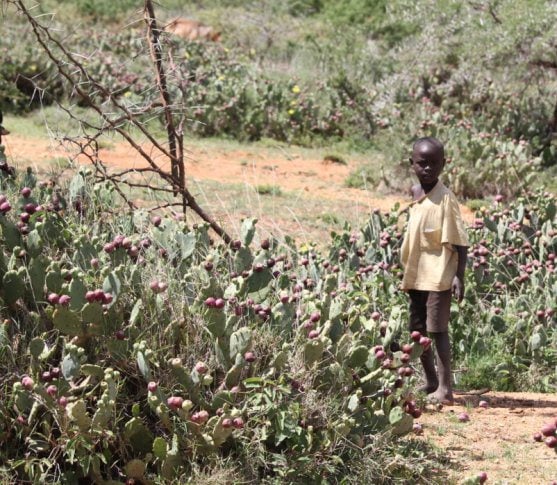
Opuntia cactus: Rich in water and vitamins but poor in protein
Flickr/tegg
[NAIROBI] A succulent, wild-growing cactus that has been widely dismissed as a noxious weed could sustain African livestock during drought, according to scientists at the Kenya Agricultural Research Institute (KARI).
A paper by John Kang'ara and Josiah Gitari, animal nutritionists at KARI, concludes that Opuntia species — the prickly pear or paddle cacti — have extreme tolerance to drought and remain succulent and easily digestible even in times of extreme water shortages, which makes them an excellent source of water and nutrition in harsh conditions.
They found that during a severe drought in 2008–2009, farmers who fed their cattle the cactus paddles (the large, leaf-like parts) lost none of their cattle to drought.
Meanwhile, some farmers, such as the Masai pastoralists in Laikipia North refused to use the cactus as feed and even pleaded with the government to eradicate what they consider to be an invading weed.
Farmers in East Africa lack information on the cactus's nutritive value said Kang'ara, who presented the paper at the Pastoralism and Climate Change Adaptation in Africa conference, in Njoro, Kenya (24-28 May).
Opuntia is used for human food during famine and one species can be used in water purification.
Kang'ara, said there is a need for intensive education of more farmers on the importance of the cactus in arid districts in Kenya. He added that farmer groups and agricultural extension officers — intermediaries who liaise among farmers and the research and policy communities — were being trained about the benefits of the cactus as fodder under programmes funded by the government and KARI.
The next stage, said Kang'ara, will involve research on the best agronomic practices for wide-scale planting of the cactus and characterisation of the spiny and spineless varieties growing wild in Kenya to determine which are most suited for farming in the country.
The researchers are now asking regional governments to encourage cactus plantations to help livestock survive drought.
But Ben Lukuyu, an animal nutritionist at the International Livestock Research Institute in Nairobi, said the cactus's low protein and dry matter content limit its importance as a source of forage to periods of extreme drought.
Glenn Althor ( Australia )
28 July 2010
Christian F. ( Germany )
2 August 2010
willem van cotthem ( Belgium )
4 August 2010
Kang'ara ( Kenya )
12 August 2010
MERINYI ( University of Nairobi | Kenya )
16 November 2010
Peter Wamboga-Mugirya, UGANDA ( Science Foundation for Livelihoods and Development (Scifode) | Uganda )
8 August 2011
Dear All--Especially Kangara and Merinyi: Both of you may be right. What bothers me is if Cactus is edible by cattle, then the animals would be going for them automatically on their own volition.
May I know from Kangara whether the livestock eat them,when prompted or on their own? The Spiny type's thorn is lethal, hence causing blindness to any animal that dares nib at them. But if cattle can eat them ONLY when it is introduced to them, then the scientists should say this. And if its the spineless that should be introduced, then Kangara should state this very clearly, other than generalizing or sounding that a blanket use of all of them is okay. The perception given is that all cactus plant types--spiny & non-spiny--all are applicable gives a wrong impression, please. However, its ability to grow and survive in harsh hot, dry climatic conditions and rough landscape-mostly stony, sandy desert and semi-desert rocky soils, also goes a long way to illustrate how this plant can be very useful with genes may that could confer drought-tolerance to our crops that are vulnerable to drought- impacts. Biotech scientists should explore this. Also medicinal properties may be found in the cactus too. These could be opportunities worth confirming. Thank you. Let the debate continue. Peter Wamboga-Mugirya (Scifode--UGANDA) Freelance journalist, SciDev.Net, Kampala, Uganda and Events Manager, Open Forum on Agro-Biotechnology in Africa (OFAB)--Uganda Chapter. Email: pwamboga@gmail.com
Ann Waters-Bayer ( Netherlands )
8 August 2011
Agropastoralist livestock-keepers in semiarid northern Tigray, e.g. the Irob, have been using Opuntia (locally known as "beles") for well over 100 years; the plant had been introduced by missionaries. The Irob regard beles as a saver of lives of both livestock and people in times of shortage of pasture and food. They now deliberately plant beles for feed and food. In less dry parts of Tigray, beles can easily become a weed if it is not used intensively. There can be no blanket recommendations about the use of this plant; it depends on the specific local conditions. But my main point is that, once again, some scientists are “discovering” what many farmers and pastoralists have known and have been practising for a very long time. Several scientists in Tigray have also done research on beles, starting already in the 1990s. I hope that the Kenyan scientists are aware of this earlier work.
LENACHURU C.I. ( Ilchamus Development and Human Right Organization | Kenya )
9 September 2011
It is true that Opuntia can be fed to livestock. Those animals use to it really relish it and tend to come home early to eat as opposed to feeding in natural pasture. Herders in Mariagat district, former Baringo fed it to their livestock in the 1999/2000 drought and lost no livestock to drought, although I should say few of them used it. There must also be a trained animal since livestock are not used to this herb.
NatAlex ( Australia )
2 February 2012
I would like to add that many Opuntia species are considered weeds in Australia EXCEPT for the Opuntia ficus indica. This is a cactus that should be looked at for its potential innovative uses and not put into the same category as the other cactuses that have caused problems in the past.
All comments are subject to approval and we reserve the right to edit comments containing inappropriate/unsuitable language. SciDev.Net holds copyright for all material posted on the website. Please see terms of use for further details.
All SciDev.Net material is free to reproduce providing that the source and author are appropriately credited. For further details see Creative Commons.
11 February 2012