
Skip Navigation

News

  • Print
  • Comment
  • | Share

Africa's Green Revolution 'needs indigenous tech approach'

Yojana Sharma

9 July 2010 | EN | FR

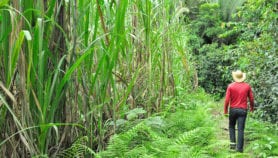
Africa's Green Revolution should be built around the needs of its people, says report

Flickr\CIAT\Neil Palmer

Seeding a Green Revolution for Africa will require developing innovation systems that match each country and science and technology approaches that are relevant to local agriculture, according to a UN report.

"There has been a tendency to focus on applying international models of agricultural development without questioning their applicability to local circumstances," says the 'Technology and Innovation Report 2010: Enhancing Food Security in Africa through Science, Technology and Innovation' released by the UN Conference on Trade and Development (UNCTAD).

"When the new African Agricultural Revolution is eventually implemented, it is likely to be built on Africa's own indigenous technology and knowledge requirements and the nutrition and food security needs of its people," says the report.

Asia's Green Revolution swept across the continent in the 1960s, leading to high-yielding grain varieties, but Africa is yet to see the same and all eyes are focused on how to bring about a similar advance in Africa.

Some agricultural research and technology can be imported and adapted, some developed from scratch, and still some brought in by cooperation between developing countries with assistance from third-country donors.

But the challenge is to find, promote and disseminate innovation relevant to African agriculture.

"Our understanding of how new ideas, knowledge and technologies are introduced into agricultural practice remains incomplete," the report said.

"You can take different types of technology — medium, low and high tech — and different mixes of technology but adapted to Africa's different conditions, different ecology zones and crops," said Michael Lim, an economist in UNCTAD's technology and logistics division, but added that this is "quite challenging".

UNCTAD recommends strengthening the 'innovation systems' — a wide range of interconnecting issues, from providing financial incentives and ensuring technology transfer to promoting education — for agriculture in each country in Africa. "This means enhancing links between knowledge research institutes to make sure any innovation they come up with is diffused to the farmer," said Lim.

"Farmers need to be able to absorb knowledge to use technologies effectively, and they often come up with their own solutions."

UNCTAD cites the example of the Framework for African Agricultural Productivity developed by the Forum for Agricultural Research in Africa which advocates involving farmers as active players in improving agricultural productivity by increasing yields but also by having a say in shaping policy.

Apart from outlining the challenges, the report also mentions success stories. These include biological control of the cassava mealy bug, which was supported in Zambia by the improvement of agricultural supply chains and the development of markets. The result was that cassava production grew rapidly — at times overtaking maize, the country's other staple crop.

The report was released on 19 May.

Link to full report [1.18MB]

Comments (3)

ironjustice ( Canada )

10 July 2010

This seems to be the PERFECT 'scenario' for a computer program developed to accept 'input' and 'kick out' the effective PROVEN 'inovations' CURRENTLY proven to work .. ? It would ELIMINATE completely those people who would try to INFLUENCE the 'findings' in order to benefit THEMSELVES .. ? It would be very simple if one thought it through .. ?

erich ( United States of America )

12 July 2010

a group of anthropologists, historians and soil scientists have received a grant to study "anthropogenic dark earth" traditions in Africa. I'm privileged to be part of this, as I will be researching the living tradition known as "ankara" in and around Batibo (Cameroon), as well as in the Equateur Province of Congo, where, perhaps, we will find historic sites as well. To me this is a most important line of current research for the biochar community, as it will, perhaps, demonstrate that the use of charcoal in agriculture is practiced far more universally and has been for a much longer time than we think, or than we reference by merely looking at Brazil's Terra Preta.This research might put our efforts in a much needed longitudinal and cross-cultural perspective. It might allow us to blend biochar projects into local knowledge - a stronger guarantee that such projects might happen. Here's a short outline of the project: http://www.esrcsocietytoday.ac.uk/ESRCInfoCentre/ViewAwardPage.aspx?data=%2FFrXHTl993pZAl%2F5l3eMwc0TrRLrnTpDdTZ1%2BB7UmtqnbYgdS9mezi%2BW0B%2F%2FhkP1sqoCprJF%2FA73r1qC98VTr63eyfAfQuqfrDHcVJPZt36uKpsWmpG6MgM46Ny2b6US3FE0IpndAgpOgbBvCv%2FxyE8webM4HBPR&xu=0&isAwardHolder=&isProfiled=&AwardHolderID=&Sector= Let's broaden our perspectives, and build a social and cultural context around biochar, instead of sticking to technocratic visions only. It will help us all! Laurens Rademakers Managing director Biochar Fund http://www.biocharfund.org

Allan Savory ( Savory Institute & Africa Centre for Holistic Management | Zimbabwe )

12 July 2010

I hope that all concerned will take note of the recent Buckminster Fuller Institute challenge award to the Africa Centre for Holistic Management selected from over 250 projects world wide as the one most ably dealing with some of humanity's most pressing problems. This is African technology being increasingly recognized and practiced in the US, Canada, Mexico and Australia because of it's crucial role in any hope of a new green revolution providing sustained success. Information is available on the BFI site, ACHM site www.achmonline.org or on www.savoryinstitute.com

Add your comment

This is your network: share your views on any of our articles by adding your comments.

You need to be signed in to post a comment or to email a consenting comment author. Please sign in or sign up.

All comments are subject to approval and we reserve the right to edit comments containing inappropriate/unsuitable language. SciDev.Net holds copyright for all material posted on the website. Please see terms of use for further details.

All SciDev.Net material is free to reproduce providing that the source and author are appropriately credited. For further details see Creative Commons.

Back to News
To the top

Information Services