

By: Sophie Hebden
Send to a friend
The details you provide on this page will not be used to send unsolicited email, and will not be sold to a 3rd party. See privacy policy.
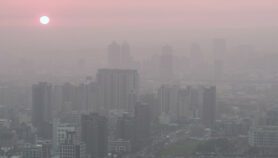
Indonesia’s president apologised today for the thick smoke covering parts of neighbouring Malaysia and Singapore — just days after the World Health Organization warned that air pollution must be cut to protect human health.
Politicians in Malaysia and Singapore had been calling on Indonesia to tackle the forest fires that are causing the haze.
Over the past two weeks there were up to 500 fires a day in West Kalimantan, Indonesia, says a report released yesterday (10 October) by the UN Office for the Coordination of Humanitarian Affairs.
In the provincial capital Pontianak the air pollution index reached 913. An index of 101-200 is considered ‘unhealthy’ while 300-550 is ‘dangerous’.
On 5 October the World Health Organization (WHO) tightened its guidelines on safe levels of air pollution, setting new standards that many developing countries — particularly in Asia — will struggle to meet.
The recommended maximum level for particles suspended in the air, which are mainly produced by burning fossil fuels, is now 20 micrograms per cubic metre.
This is one-tenth the amount measured in Beijing, Cairo, Karachi, Kathmandu, Lima and New Delhi, and considerably less than the previous guideline of 70 micrograms.
But the WHO says that achieving this level could reduce the number of premature deaths due to respiratory infections, heart disease and lung cancer by 15 per cent.
Malaysia’s health minister warned this week that the Indonesian fires were threatening human health and the economy in Malaysia.
According to the Associated Foreign Press, Malaysia’s foreign minister urged South-East Asian nations to formulate a plan of action rather than merely sign agreements that achieve little.
Indonesia is the only member of the Association of South East Asian Nations not to have signed the association’s agreement on haze pollution that crosses borders.
Its president Susilo Bambang Yudhoyono has now offered to host a regional meeting to tackle forest fires in the country, reports Bloomberg.com.
The WHO air pollution guidelines also substantially lower the recommended limits for ozone and sulphur dioxide.
According the WHO, more than two million premature deaths each year can be attributed to the effects of urban outdoor air pollution and indoor air pollution. More than half of this disease burden is borne by the populations of developing countries.
Link to executive summary of the WHO Air Quality Guidelines  [1.8 MB]
The full edition of the guidelines is due for publication later in 2006
More on Pollution