


By: Dann Okoth
Send to a friend
The details you provide on this page will not be used to send unsolicited email, and will not be sold to a 3rd party. See privacy policy.
This article was supported by Global Burden of Crop Loss (GBCL)
Women farmers face deeper losses from crop failure, driven by unequal access to land, credit, data and decision-making, writes Dann Okoth.
[NAIROBI, SciDev.Net] In late November and early December, a lush green cover usually blankets the rolling hills, plains and valleys of Kimilili, a rural settlement in Bungoma County in western Kenya.
For residents who depend on subsistence farming, the stunning seasonal greenery signals the promise of maize, beans and cassava harvests.
This year, that promise has faded. Short rains that normally arrive between late October and early December were erratic and insufficient, leaving maize and bean crops stranded at the flowering stage, when they are most vulnerable to pests and diseases.
Instead of green fields, a brownish hue now dominates the landscape, with the withering vegetation signalling a poor harvest to come.
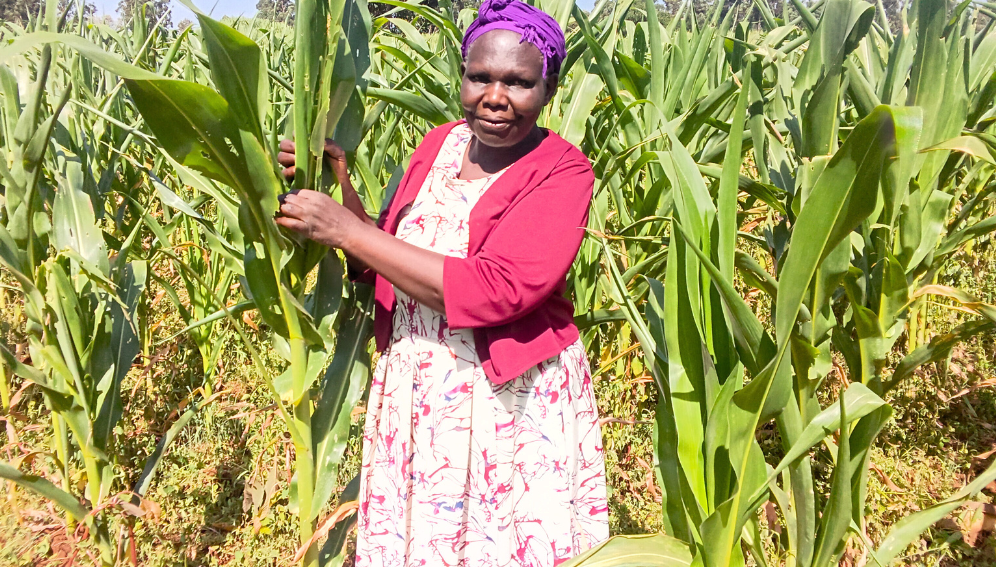
For women farmers like Dinah Fwamba, a mother-of-four from Kanduyi village, Kimilili, the failure of crops goes far beyond agriculture. It threatens household stability, education, health and food security.
“When my crops fail, it hits at the very core of my family,” Fwamba says. It means the children will not go to school, have clothes, or receive healthcare, she explains.
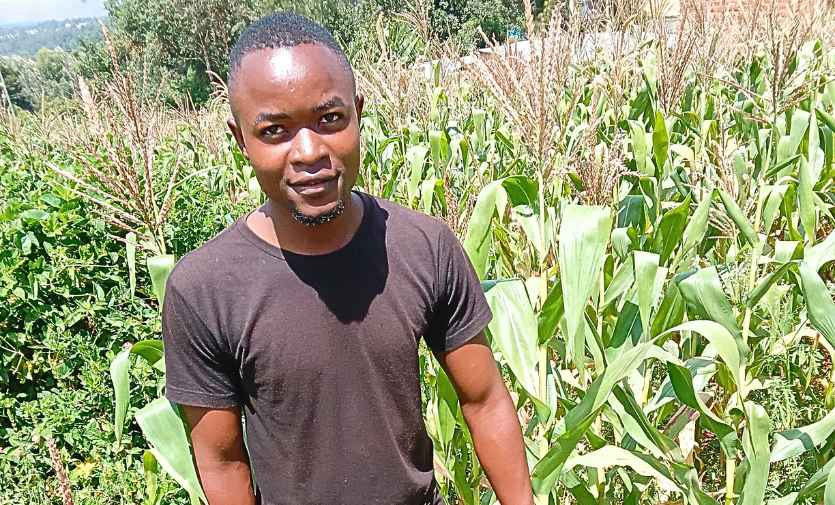
Sospeter Kiberenge, a young farmer from Bungoma ventured into farming after high school, but he encounters challenges such as high cost of labour, lack of inputs and weather unpredictability. Copyright: Dann Okoth
“At times it could mean the difference whether my family stays together or not because there is a lot of tension in the family whenever there is no food,” she tells SciDev.Net.
Fwamba’s experience reflects a wider pattern. Across many parts of Africa and Asia, crop loss affects women farmers differently—and often more severely—because of entrenched gender inequalities in access to land, finance, decision-making and agricultural support.
This is not the first time Fwamba has faced pre-harvest losses. In 2022, she planted maize two months late, as she didn’t receive the money for seeds from her husband in time. The delayed crop was cut short by the rains and, as a late season crop, became more exposed to pests and diseases.

“The result was that I got only eight bags from the one-acre farm, instead of the usual 17,” she recalls.
Yet despite doing most of the farm work with her children, Fwamba has little control over key farming decisions. In her household, as in many patriarchal settings, decisions on when to prepare land, plant, harvest or adopt new technologies rest with her husband.
Gender resource gap
Research shows that pests and diseases cause up to 40 per cent more pre-harvest crop loss than climate-related factors, compounding food insecurity.
These losses interact with gender inequality to magnify their impact on women farmers, according to experts.
Kavita Mishra, gender and inclusion expert at the agricultural research organisation CABI (the parent organisation of SciDev.Net), says women are disproportionately affected by crop loss because they have limited access to land, credit, technology and advisory services, particularly in patriarchal societies.
Women make up about 43 per cent of the agricultural labour force in low- and middle-income countries countries, according to UN Women.
But if women had the same access to productive resources as male farmers, they could increase their yields by up to 30 per cent, the UN agency says, raising total agricultural output by up to four per cent and reducing global hunger by as much as 17 per cent.
Mishra tells SciDev.Net that single women and women-headed households face even greater risks. Without land registered in their names and confronted by complex land entitlement processes, they often fail to access government schemes or benefits during crop loss events.
Marital barriers
Gender disparities also shape access to mitigation tools such as crop insurance, irrigation technology and extension services.
Farmer Salome Hamala says she wanted to use family land as collateral to borrow money for irrigation equipment after the rains failed, but her husband opposed the idea.
“There is this fear that, somehow, the loan will not be repaid and the bank will confiscate the land,” she tells SciDev.Net.
Hamala adds that she cannot sell farm produce to raise money for agricultural inputs without her husband’s consent. “It seems the harvest belongs to him first before it can belong to the family,” she laments.
Fwamba encountered similar resistance when she proposed ripping cultivation, a land preparation technique designed to improve soil structure and water infiltration, after learning about it through a women’s group. She says her husband insisted on continuing with oxen ploughing.
Lack of land ownership, limited credit access, restricted mobility and lower literacy levels collectively reduce women’s eligibility for government support, Mishra explains.
Agricultural benefits are often tied to land titles held by men, leaving women, particularly those heading households, highly vulnerable when crops fail.
Building independence
These barriers are not unique to African nations. In Odisha, eastern India, women’s groups have turned to alternative livelihoods such as fish farming, goat rearing, tailoring and savings schemes in attempts to overcome these barriers, Mishra tells SciDev,Net.
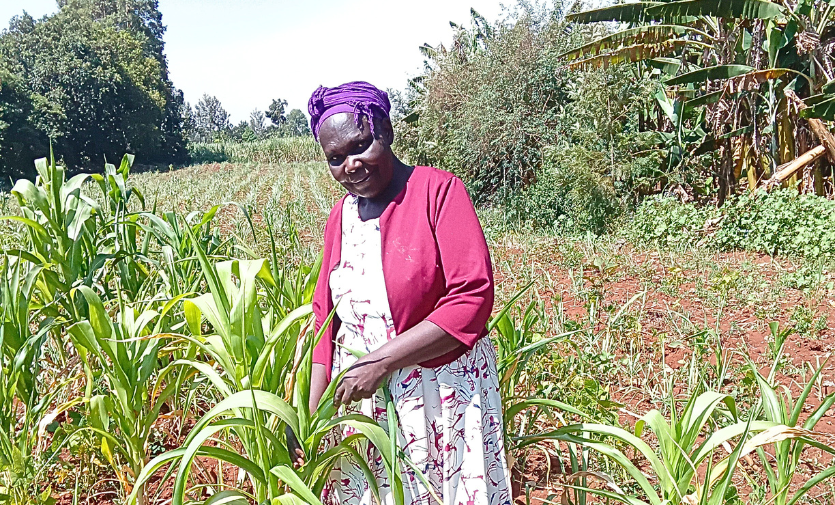
Salome’s pre-harvest crop losses are compounded by her inability as a woman to make certain decision regarding farming activities. Copyright: Dann Okoth
Meanwhile, in Kenya, households rely on informal income sources including casual farm labour, domestic work, small kiosks, grocery stalls, salons and the sale of vegetables, milk, eggs, charcoal and clothes.
“These strategies not only cushion the impact of crop loss but also enhance women’s economic independence,” Mishra says.
Yet despite its scale and impact, pre-harvest crop loss often remains poorly quantified, limiting effective policy responses, according to a report by CABI’s Global Burden of Crop Loss (GBCL) project.
Data gaps
Experts say one of the biggest challenges in tackling this loss is that it is not well measured.
Researchers involved in the GBCL project say gaps in consistent, disaggregated data make it difficult for governments and investors to design effective responses, particularly for women farmers who are often invisible in official statistics. To address this gap, they are working to produce clearer, comparable estimates of crop losses across regions and farming systems, with the aim of informing policy and investment decisions.
At the heart of this work is a concept known as “attainable yield in context”. Rather than measuring yields against ideal or laboratory conditions, GBCL estimates what farmers should be able to harvest under real-world conditions, considering local climate, water availability, inputs, and farming practices.
The project assesses the impact of pests and diseases using data from field trials and scientific and grey literature, while CABI is also exploring automated text mining, Earth observation and machine learning to improve monitoring of pest outbreaks, diseases and climate-related shocks.
Such data, the GBCL project finds, is critical for understanding how crop loss affects women differently and for designing gender-responsive interventions.
Gender-based policies
Some policies are beginning to address these gaps.
In Odisha, women farmers receive 50 per cent input subsidies compared to 40 per cent for men, says Mishra, who works closely with farmers. A state-run women’s welfare scheme, called Subhadra Yojana, provides direct financial support during crop failure and climate stress.
In Kenya, county and national programmes supply seeds and inputs to farmers. Bungoma County has also introduced trade loans for women’s self-help groups.
Benson Masinde, assistant director of agriculture in charge of crop protection in Bungoma County, says women can access these loans for agricultural enterprises.
The county also partners with organisations such as CABI to promote pest alert tools and biopesticides and works with financial institutions to develop products targeting women farmers.
Jeremiah Owiti, director at the Centre for Independent Research in Nairobi, says improving agricultural productivity is central to tackling both poverty and gender inequality.
“The gender question in most Sub-Saharan African countries is also a poverty question,” he says. “A rising tide lifts all boats.”
This article is supported by CABI’s Global Burden of Crop Loss (GBCL) project. GBCL is funded by UK International Development of the UK government and the Gates Foundation.
The piece was produced by SciDev.Net’s Sub-Saharan Africa English desk.