


By: Paul Adepoju
Send to a friend
The details you provide on this page will not be used to send unsolicited email, and will not be sold to a 3rd party. See privacy policy.
This article was supported by One Health Hub.
One Health surveillance must cut across all sectors and cover hard-to-reach places, writes Paul Adepoju.
[SciDev.Net] Health experts and researchers are calling for better cross-sectoral integration of surveillance systems across Africa, arguing that fragmented data collection continues to delay outbreak detection and response despite growing awareness of the problem.
The challenge is no longer a lack of data on potential health threats but the persistence of silos that prevent information from moving between sectors, according to findings from the One Health Horizon Scanning exercise.
The study, led by the agricultural research organisation CABI (the parent organisation of SciDev.Net), gathered insights from more than 400 stakeholders across governments, research institutions, NGOs and international organisations.
“We need to ensure surveillance at all levels of the health system, including the peripheral level.”
Yahaya Ali Ahmed, team leader, WHO Africa Antimicrobial Resistance Unit
When asked to identify priorities for the future of One Health in Africa, respondents placed integrated surveillance systems—mechanisms that unite human, livestock, agricultural and ecosystem expertise—above all else.
“Surveillance should not be done only at a central level,” Yahaya Ali Ahmed, team leader of the Antimicrobial Resistance Unit at the World Health Organization (WHO) Regional Office for Africa, told SciDev.Net.
“We need to ensure surveillance at all levels of the health system, including the peripheral level.”
Ahmed explained that WHO’s work with the Food and Agriculture Organization, UN Environment Programme and World Organisation for Animal Health through the regional Quadripartite focuses on helping countries develop national action plans grounded in the One Health approach, with regular monitoring to identify major gaps.

The foundation of effective surveillance, he said, is “a functional, multisectoral collaboration” at country level, with joint plans, shared terms of reference, and transparency between sectors.
Raji Tajudeen, Africa CDC’s acting deputy director general, put it more bluntly: “Every outbreak begins and ends in the community.”
Community health workers, he argued, must be adequately trained, sufficiently numerous and properly integrated into health systems, not treated as temporary volunteers attached to short-term interventions.
Reflecting on COVID-19, Tajudeen described how Africa CDC invested in understanding which variants were circulating so countries could make informed decisions about vaccines.
That work required deploying epidemiologists, data scientists, behavioural scientists and communication experts to support member states. Surveillance, in this framing, is inseparable from capacity to interpret and act.
Detection delays
But even the strongest regional coordination faces the same constraint: surveillance systems still struggle to reach the places where outbreaks begin.
In Nigeria’s Lassa fever belt, the consequences of delayed detection play out regularly.
Médecins Sans Frontières (Doctors Without Borders/MSF) has repeatedly documented how patients arrive at treatment centres late, often when disease severity limits options.
“Patients come quite late,” said Temmy Sunyoto, MSF’s senior operational research advisor, pointing to the combined effect of delayed detection and limited access to diagnostics.
Sunyoto says health workers face heightened risk because patients often present with non-specific symptoms and are initially treated for common illnesses without appropriate protective equipment.
For Sunyoto, the lesson is practical. Diagnostic tools must be usable where patients are seen.
“User friendliness matters,” she told SciDev.Net.
“Otherwise, the tool will not work at the periphery.”
If a test requires long waiting times or cumbersome procedures, it will not function at overstretched, remote facilities, she explained.
Progress and friction
Nigeria’s surveillance architecture shows both progress and persistent friction. The Nigeria Centre for Disease Control and Prevention (NCDC) has built extensive capacity to detect and respond to infectious threats. During outbreaks, technical working groups bring together multiple government agencies.
Jide Idris, NCDC director general, described monitoring how data on mpox is tracked, analysed and discussed through multisectoral platforms, with regular meetings aimed at preparedness and coordination.
This machinery works best once an outbreak is already visible. NCDC officials describe constant emergency operations meetings and multiple technical working groups managing overlapping outbreaks. “We are geared towards multiple responses,” Idris said.
However, the delays in diagnosis present a deeper challenge: surveillance does not fail only when data is missing. It fails when information cannot travel quickly enough to change what happens next. Environmental drivers compound the problem.
The One Health Horizon Scanning brief identifies climate change and environmental degradation as central drivers of future outbreaks. Yet environmental data remains weakly integrated into systems designed primarily around human and animal health.
“We know the role of climate change,” Tajudeen said. “We know the role of human beings encroaching spaces where we were not known to find ourselves before, bringing us very close to the animal ecospace.”
Blind spots
Despite this awareness, blind spots persist.
A separate One Health Hub evidence brief on plant health states plainly that plant-related issues are “critically neglected in research, policy, and funding”, even though they shape food security, livelihoods and health resilience across Africa. The brief notes that within the Quadripartite Joint Plan of Action, agriculture appears only marginally, reinforcing silos rather than dismantling them.
The research landscape mirrors this neglect. A bibliometric bibliometric analysis conducted by CABI shows that while One Health research output has grown rapidly, it remains dominated by zoonoses and antimicrobial resistance.
Topics such as pesticides, mycotoxins, land use change and ecosystem health are vastly underrepresented.
For African countries, where food systems and environmental pressures directly affect health risk, this imbalance has real consequences.
The experience of Kenya, cited by WHO officials as one of the countries actively promoting cross-sectoral surveillance, reflects both the difficulty of integration and the effort required to overcome it.
The country is working to educate communities and policymakers and to promote information sharing across human, animal and environmental sectors.
Initiatives focus on building coordination platforms and training a workforce capable of operating across disciplines, recognising that One Health cannot be switched on during emergencies alone.
However, financing remains a persistent constraint. Ahmed acknowledged that funding for antimicrobial resistance (AMR) is still low, reporting is inconsistent, and basic infection prevention measures remain absent in some facilities.
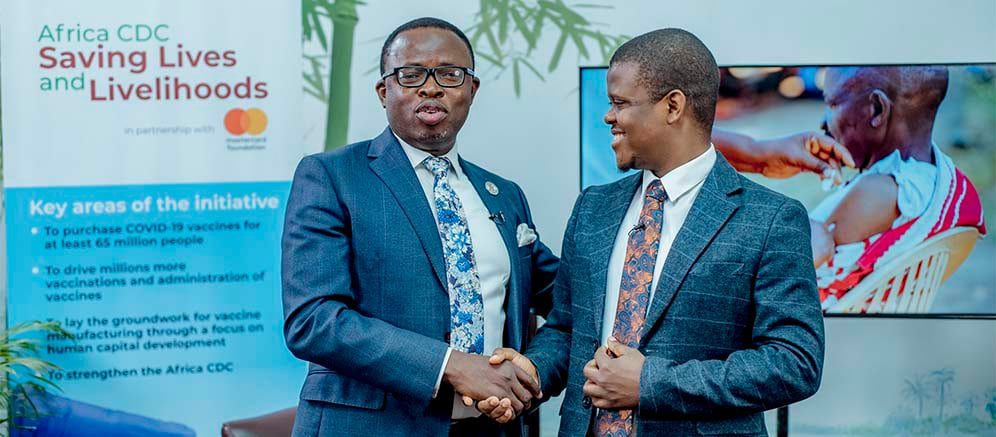
Africa CDC’s Tajudeen and Paul exchange pleasantries after the interview.
In such contexts, he says, AMR and integrated surveillance risk being sidelined when acute outbreaks demand immediate attention. This tension between urgency and continuity sits at the core of the One Health challenge.
The One Health Horizon Scanning brief does not argue for ideal systems but for workable ones.
Its recommendations focus on anchoring investment in shared priorities such as surveillance and governance, enabling regional customisation, promoting inclusive participation, bridging sectoral silos, and investing in intergenerational capacity building.
Community-based surveillance
The International Federation of Red Cross and Red Crescent Societies describes community-based surveillance as “a key step to improving the early detection and assessment of disease outbreaks”, framing it as a bridge between communities and formal systems rather than a substitute for them.
At the International Livestock Research Institute, scientists working within the CGIAR AMR Hub stress that healthy animals and safe food systems depend on acknowledging how antimicrobial use, environment and livelihoods intersect, rather than treating them as separate domains.
Africa CDC has argued that surveillance must be embedded within broader health security and system strengthening agendas. Before Africa CDC, Tajudeen reflected, decisions affecting local communities were often taken far from where impacts were felt.
Public health researchers and policy analyses say COVID-19 demonstrated what regional coordination could achieve, from pooled procurement to cross-border workforce deployment, and from engaging transport and finance to bringing environmental considerations into response planning.
On the ground, progress is visible but uneven. Reflecting on the Lassa fever response, Sunyoto acknowledged improvements in coordination and leadership but stressed that translating scientific advances into routine practice is slow.
“The progress is slower than we would like,” she said.
For the community health worker who notices an unusual pattern, integration determines whether that observation becomes shared intelligence or remains a footnote, Ahmed tells Scidev.Net.
For the livestock officer who reports animal deaths, it determines whether action follows before livelihoods are lost. For the environmental health officer watching floodwaters rise, it determines whether climate signals are treated as health warnings or background noise.
Ahmed argues that “without good surveillance systems and strong laboratories, detection is difficult”. But for Tajudeen, integration determines whether those early signals become shared intelligence or remain isolated observations.
This article was produced by SciDev.Net’s Sub-Saharan Africa English desk.
The article was supported by the One Health Hub is managed by CABI with funding from UK International Development; however, the views expressed do not necessarily reflect the UK government’s official policies.