


27/03/26
Q&A: Why climate adaptation funds miss Africa’s frontlines
Send to a friend
The details you provide on this page will not be used to send unsolicited email, and will not be sold to a 3rd party. See privacy policy.
This article was supported by Global Health Strategies
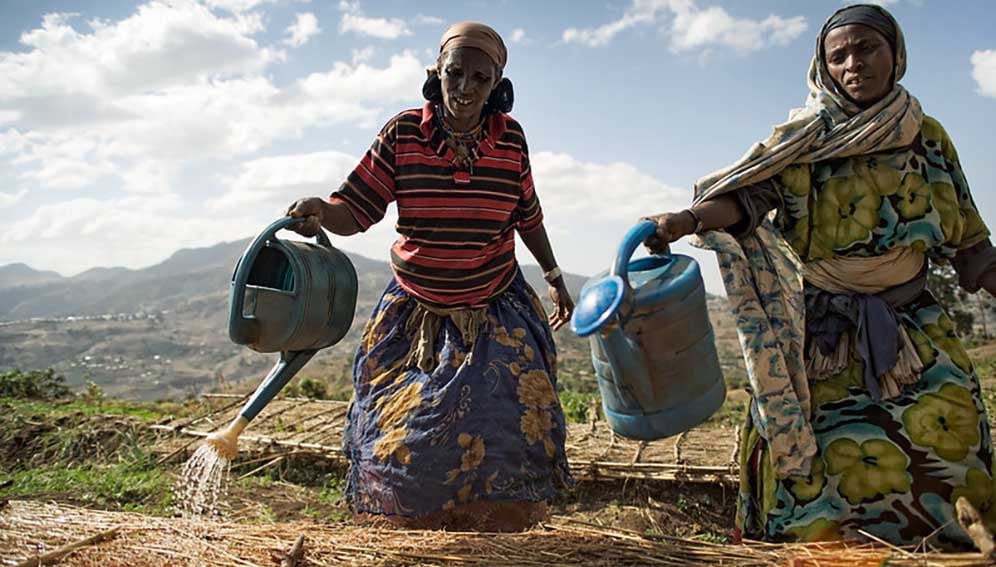
[LAGOS, SciDev.Net] Across Africa, communities are already adapting to climate shocks, from shifting rainfall patterns to intensifying floods. But the money meant to support them rarely reaches the frontlines.
In parts of Africa, farmers are adjusting planting seasons, coastal communities are reinforcing shorelines, and local innovators are developing low-cost resilience solutions. Yet despite these efforts, financing for climate adaptation continues to flow largely through top-down systems that struggle to reach those most affected.
A new report titled “A comprehensive study on climate adaptation intervention in Africa”, published in February by Global Health Strategies (GHS) in partnership with the Directorate for Sustainable Environment and Blue Economy of the African Union Commission (AU Commission), finds that adaptation finance remains heavily dependent on multilateral and bilateral sources, with private sector contributions accounting for just 12–15 per cent.
It also highlights a deeper problem: local actors, often best placed to design and implement adaptation solutions, face systemic barriers to accessing funds, including complex financing structures, heavy reliance on intermediaries, and risk perceptions that sideline community-led initiatives.
In this Q&A, Emmanuel Siakiloe, senior advisor on climate change adaptation and resilience at the AU Commission, explains why adaptation finance is not reaching where it is needed most and what it will take to fix it.
Why does private capital remain limited in Africa’s adaptation financing landscape?
Private investors are deterred by low and uncertain financial returns, long payback periods, weak revenue models, and high perceived risk—climate, political, and currency. Adaptation benefits are often public goods, such as resilience and avoided losses, which makes them hard to monetise. Limited project pipelines and the lack of standardised metrics also reduce investor confidence. On top of that, there is still a limited pipeline of well-prepared, investable projects, and the lack of standardised metrics for measuring returns further reduces investor confidence.
What is the biggest barrier preventing local actors from accessing climate finance?
Risk perception is the most restrictive barrier.
Even where funding structures are complex, what really drives exclusion is the perception of high fiduciary, operational, and climate risk—particularly when it comes to local actors. That perception leads to stringent requirements, heavy intermediation, and multiple layers of due diligence, which ultimately make it very difficult for local organisations to access funding directly.

What realistic options do African governments have for increasing domestic financing for locally led adaptation?
The most pragmatic way is for governments to expand budget allocations for adaptation, integrate climate into sectoral planning, issue green or resilience bonds, reform subsidies, improve tax collection, and establish national climate funds. Leveraging public finance to crowd in private capital through guarantees and co-financing is also key.
The report notes that private investment continues to favour mitigation—particularly energy transitions—rather than adaptation. What would make climate resilience projects bankable enough to attract private investors?
More broadly, the rationale lies in returns on investments. The analysis indicates that projects need clearer revenue streams or cost-saving models (for example insurance-linked products, user fees, resilience dividends), better risk-sharing instruments (guarantees, blended finance), and standardised metrics to quantify returns. Strong policy frameworks and aggregation of small projects into investable portfolios can also help.
Many locally led innovations are developed by communities or small organisations. What mechanisms do you think could help integrate these solutions into formal investment and scaling pipelines?
I think mechanisms such as incubators and accelerators, dedicated small-grants windows, community-driven funds, and partnerships with NGOs or intermediaries can structure and scale projects. Digital platforms and aggregation models can connect local solutions to larger financing channels.
What indicators should policymakers track to assess whether adaptation is truly locally led?
The most important indicators include the proportion of funds reaching local actors, level of community decision-making authority, inclusion of marginalised groups, alignment with local priorities, transparency in fund allocation, and evidence of sustained local capacity.
How can governments and donors ensure that “locally led adaptation” genuinely transfers power to communities?
Governments and donors need to devolve financial control, simplify access requirements, and fund local institutions more directly and embed accountability mechanisms that are led by communities themselves. Participatory planning and monitoring should be mandatory, not treated as symbolic or tokenistic.
What single policy shift could best accelerate locally led climate adaptation across Africa?
The greatest impact would be realised from direct, flexible funding to local actors, paired with simplified access criteria, as it addresses both power imbalances and the bottlenecks that prevent locally led solutions from scaling.
This piece was produced by SciDev.Net’s Sub-Saharan Africa English desk and was supported by Global Health Strategies (GHS).