


24/12/25
Crop loss deepens food insecurity across Africa
By: Ijeoma Ukazu
Send to a friend
The details you provide on this page will not be used to send unsolicited email, and will not be sold to a 3rd party. See privacy policy.
This article was supported by Global Burden of Crop Loss (GBCL)
[SciDev.Net] Crop losses linked to climate shocks, pests and diseases are placing growing pressure on food production systems across Africa, say researchers from the Global Burden of Crop Loss (GBCL).
According to their analysis, erratic rainfall, flooding and biological threats are reducing yields and farmer incomes across multiple regions, with implications for national food supplies and global commodity markets.
From smallholder farms in East Africa to flood-prone fields in Nigeria and drought-stressed zones of West Africa, farmers are reporting losses at both planting and harvest.
“Many farmers remain in agriculture not because it is viable, but because they have no alternative means of livelihood.”
Yunusa Halidu, secretary of the All Farmers Association of Nigeria
Ongoing modelling by the GBCL, led by the agricultural research organisation CABI (the parent organisation of SciDev.Net), aims to quantify where these losses are concentrated, what is driving them, and how targeted interventions could reduce their impact.
Climate volatility
In Kimilili, western Kenya, subsistence farmer Salome Kibunde is living with the consequences of increasingly unpredictable weather. Supporting a household of nine, she farms five hectares of maize and other crops, relying almost entirely on rainfall.
The long rains, traditionally expected between March and July, no longer follow a predictable pattern, according to a report by Kenya’s National Drought Management Authority (NDMA).

In 2025, rainfall in March allowed planting, only to disappear for nearly two weeks in April, disrupting germination. While some farmers near the Kuywa River can irrigate during dry spells, many in Kibunde’s community do not have that option.
Short rains, usually falling between September and December, have become equally unreliable. Forecasts suggested rainfall would continue through the end of the year, encouraging planting. Instead, drought returned during early crop growth, says Kibunde.
“When rains eventually resume, they are often prolonged and intense. We face drought at planting and too much rain at harvest,” she tells SciDev.Net.
These conditions have had direct impact on Kibunde’s yields. Excess rainfall during harvest has prevented proper drying, leading to rotting maize both in the field and after harvest. She says losses on her five hectares increased from two bags of rotten maize last year to about six bags in 2025, sharply reducing usable yield and income.
These losses have forced Kibunde to adapt as risks intensify. Women farmers in her area, she adds, often pool small harvests, hoping to generate enough resources over time to invest in improvements such as irrigation.
She says training from CABI has also helped her better understand how to manage crop loss, even though it cannot eliminate the risks she faces.
Flooding risks increase
In Nigeria, flooding has become a major driver of crop loss. Yunusa Halidu, secretary of the All Farmers Association of Nigeria (AFAN) and a medium-scale farmer with more than 50 hectares across Abuja and Nasarawa State, says risks have increased markedly over the past 30 years.
“Flooding was not previously a major concern,” Halidu says. “But in the past two years, it has become one of the biggest challenges farmers face.”
Halidu tells SciDev.Net that rising input costs have compounded the problem, leaving only a small proportion of farmers able to break even.
“Many farmers remain in agriculture not because it is viable, but because they have no alternative means of livelihood,” Halidu says.
He says market prices, climate change and shifting weather patterns have worsened losses year after year. The result is shrinking margins and rising vulnerability, increasing pressure on rural livelihoods and pushing farmers to the edge.
Regional shocks, global consequences
At a regional scale, these farm-level losses are already affecting food security beyond national borders, says Komlavi Akpoti, a researcher in remote sensing and hydrological modelling at the International Water Management Institute (IWMI), part of the agricultural research network CGIAR.
Akpoti says in Africa, climate shocks already reduce national crop production by nearly a third in bad years. He adds that around one-third of smallholders experience losses during extreme dry or wet seasons. When losses occur, Akpoti says domestic food supplies tighten, import dependence rises and food prices increase.
He tells SciDev.Net that Africa’s role as a producer of globally traded crops such as coffee, cocoa and cashew amplify these impacts. Production shocks in West Africa, Akpoti says, can influence international commodity markets and impact global supply.
“Staple crops including maize, rice, sorghum, millet and groundnut are highly vulnerable to climatic shocks, with yield declines commonly ranging from five to 15 per cent during major dry spells,” he said.
Cocoa yields in Ghana, for example, have shown reductions of about five to seven per cent during drought years, he explains.
Akpoti says exposure varies by region. The semi-arid Sudano-Sahelian belt—spanning northern Ghana, Côte d’Ivoire, Togo, Benin, Nigeria, Burkina Faso, Niger, Mali and Senegal—remains highly exposed due to recurrent drought and rising temperatures. Southern West Africa increasingly faces moisture-related stress, where excessive rainfall or waterlogging causes additional losses.
Even the Sahel, long associated with drought, is now increasingly affected by flooding.
Understanding how these different risks accumulate is central to designing effective responses, Akpoti explains.
Measuring crop loss
Understanding where and why losses occur is also essential. Data-driven projects such as GBCL are trying to fill this gap by quantifying crop loss and linking it to underlying climate drivers.
Akpoti says the modelling enables governments and development organisations to identify where losses are concentrated and which crops or communities are most affected. This supports targeted investment, early-season responses and improved planning for shocks, as well as the design of insurance schemes and disaster-relief programmes.
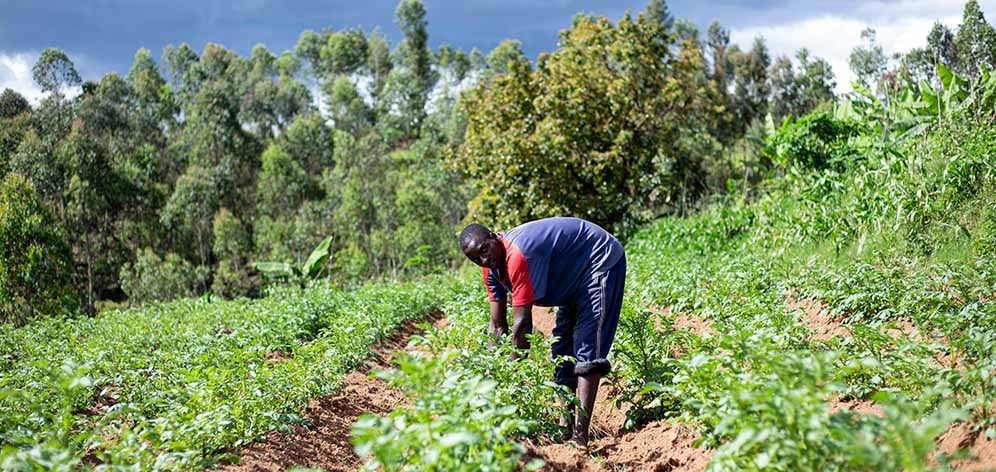
A farmer tending a vegetable garden. According to analysis by the Global Burden of Crop Loss project, erratic rainfall, floods, and droughts are disrupting African planting and harvest seasons. Copyright: Safari Consoler (Pexels license).
However, he points to the need for faster seasonal updates to capture emerging dry spells or flood conditions.
He says higher spatial resolution is also needed to accurately represent smallholder farms, many of which are less than one hectare, while broader crop coverage, including maize, rice, cassava, yam, millet, sorghum and plantain, would increase relevance for West Africa.
Pests and diseases
Climate is not the only driver of crop loss. Edward Onkendi, a researcher with CABI, identifies pests, diseases and limited access to quality seed and fertiliser as major contributors in East and Southern Africa.
Recent studies under the STDF 809 project across 12 countries in East and Southern Africa show that invasive pests such as potato cyst nematodes and soft rot Pectobacteriaceae cause annual losses of up to US$208 million and US$35 million respectively, Onkendi told SciDev.Neti.
With the potato sector valued at about US$500 million in the sub-region, these two pests alone account for nearly half of total losses, Onkendi said.
Environmental stress is intensifying their impact. Droughts now occur more frequently, often within shorter cycles than in the past. The prolonged drought between 2020 and 2023, followed by widespread flooding in early 2024, led to significant crop losses across East Africa, worsening food insecurity.
Economic and social cost
Beyond aggregate figures, crop loss has direct and lasting socio-economic impacts.
Onkendi explains that reduced production limits food availability for both purchase and own consumption, while income losses restrict households’ ability to buy nutritious food. He said production shortages drive up market prices, often placing basic food beyond the reach of farming communities themselves.
Reduced food access leads to lower calorie intake, undermining productivity and wellbeing, he added. Repeated losses also contribute to declining biodiversity and weaken long-term agricultural sustainability.
Tom Kirk, a breeding and economics consultant at AbacusBio, collaborating with CABI on the GBCL, explains that the modelling framework produces country-specific estimates of crop loss using data from multiple sources, including FAO databases.
Kirk points out that losses are calculated as lost profit per hectare and total lost profit at national level. Crop loss reduces revenue while increasing labour, capital and material costs. Initial GBCL results suggest that lost revenue is the largest component of the economic burden.
When valued at current market prices, maize crop losses alone were estimated at nearly US$200 billion in 2022, driven largely by biotic causes and equivalent to about 40 per cent of maize production, Kirk said.
He says the GBCL data is still being finalised and that the figures may therefore change.
Building resilience
Farmers across Africa are responding through a mix of traditional and emerging approaches. Climate-smart agriculture, including drought-resilient crops, has the potential to reduce losses, while land-restoration efforts aim to minimise flood impacts. Awareness campaigns promote the use of certified seed and quality inputs, CABI researcher Onkendi said.
At the policy level, researchers like Akpoti point to persistent gaps. He said farmers rely on index-based insurance, emergency input support and social-protection programmes, but coverage remains limited. Many countries lack affordable insurance options for smallholders, and compensation rarely reflects the full scale of losses.
Akpoti tells SciDev.Net that there is potential for expanding access to credit for climate-resilient seeds, promoting water-saving technologies and investing in small-scale irrigation. Even modest supplementary irrigation during dry spells, he says, can stabilise yields and prevent the five to 15 per cent declines seen during severe rainfall deficits.
As climate variability intensifies and pest pressures grow, the margin for error in African agriculture is shrinking. For Akpoti, the most impactful action over the next three to five years would be a large-scale expansion of small-scale irrigation and farmer-managed water storage, particularly across West Africa.
Such investments, he says, would stabilise yields, strengthen resilience and protect millions of livelihoods.
This article is supported by CABI’s Global Burden of Crop Loss (GBCL) project. GBCL is funded by UK International Development of the UK government and the Gates Foundation.
The piece was produced by SciDev.Net’s Sub-Saharan Africa English desk.