


09/01/26
Climate, pests and pollution fuel crop losses across India

By: Ranjit Devraj
Send to a friend
The details you provide on this page will not be used to send unsolicited email, and will not be sold to a 3rd party. See privacy policy.
This article was supported by Global Burden of Crop Loss (GBCL)
[NEW DELHI, SciDev.Net] When unseasonal rains hit Kerala during last year’s paddy harvest, farmers were forced to leave ripe crops standing in flooded fields.
Harvesting machines could not operate in the rain, and without storage or drying facilities, harvested grain and straw left in the open quickly rotted, wiping out both food and fodder, according to the Thanal Trust, a local non-profit organisation.
For farmers, the losses were not limited to reduced yields. Delayed harvesting, spoilage and contamination lowered grain quality, reduced incomes and, in some cases, rendered crops unsafe for consumption.
“By understanding how crop loss is experienced differently, we can build fairer, more sustainable farming systems that benefit the livelihoods of small and marginal farmers.”
Kavita Mishra, gender and inclusion expert, CABI
Such losses are becoming increasingly common across India as climate variability, pests and environmental stress reshape farming conditions.
Usha Soolapani, who heads the Thanal Trust, told SciDev.Net: “Unseasonal rains during the paddy harvest are now a regular occurrence so that farmers have been forced to delay harvesting since mechanised harvesting is not possible when it rains, adding to losses to the farmers.”
Extreme rainfall and flooding are only part of the picture. Human-induced land degradation is contributing to declining crop yields, while pests and invasive species continue to spread under changing climatic conditions.

India, the world’s largest producer of fruits and vegetables and a major producer and exporter of rice and wheat, has high stakes in addressing crop loss.
According to the UN Food and Agriculture Organization (FAO), up to 40 per cent of crops globally are lost each year to pests and diseases. Government estimates put the figure at around 30 per cent for India.
Additional losses are driven by extreme weather conditions and land degradation, with South Asia among the regions most affected, according to a recent FAO report. It estimates that 1.7 billion people globally live in areas where crop yields are falling due to land degradation, undermining food security and global ecosystem health.
Fungal toxins
Beyond visible losses in the field, researchers warn of a less obvious but equally serious problem: contamination. Studies carried out by the Tata-Cornell Institute in India’s Uttar Pradesh have found alarmingly high levels of aflatoxins—a type of mcyotoxin, or toxic compound, produced by fungi—in staples such as rice, wheat, maize and sorghum, raising concerns for both public health and farmer livelihoods.
Bhaskar Mittra, associate director at the Tata-Cornell Institute, says the institute’s research highlights this overlooked dimension of crop loss.
“We know that mycotoxins are a known cause of cancer, so we have to look at two perspectives—public health and income loss to farmers,” he told SciDev.Net.
The bright spot in the FAO report is that AI, remote sensing, and drones that provide real-time risk information are increasingly working to improve early warning as well as proactive responses across the region.
These efforts bolster traditional protective methods adopted by Asian farmers such as crop rotation, cover cropping to protect the soil, and integrated pest management practices.
However, the impacts of crop loss are not experienced equally.
Women, men and younger farmers often face different risks and adopt different coping strategies depending on their roles, access to resources and decision-making power. Addressing these differences is critical to building resilience, argue researchers.
Listening to farmers
Vinod Pandit, regional director for South Asia at the agricultural research organisation CABI (the parent organisation of SciDev.Net), during a series of workshops held between September and November 2025 by India’s Central Rice Research Institute and CABI’s Global Burden of Crop Loss (GBCL) programme, said: “Understanding crop loss from a gender perspective will help create solid foundations for resilient agriculture and inclusive programmes and policies.
“We need to shift from gender-neutral frameworks to gender-intentional action in research and extension to tackle crop loss and food insecurity.”
The workshops project brought together scientists, extension workers and farmers to examine how pests, diseases and climate shocks affect crops differently across regions. The focus, participants said, was on listening to farmers’ experiences and improving how losses are measured.
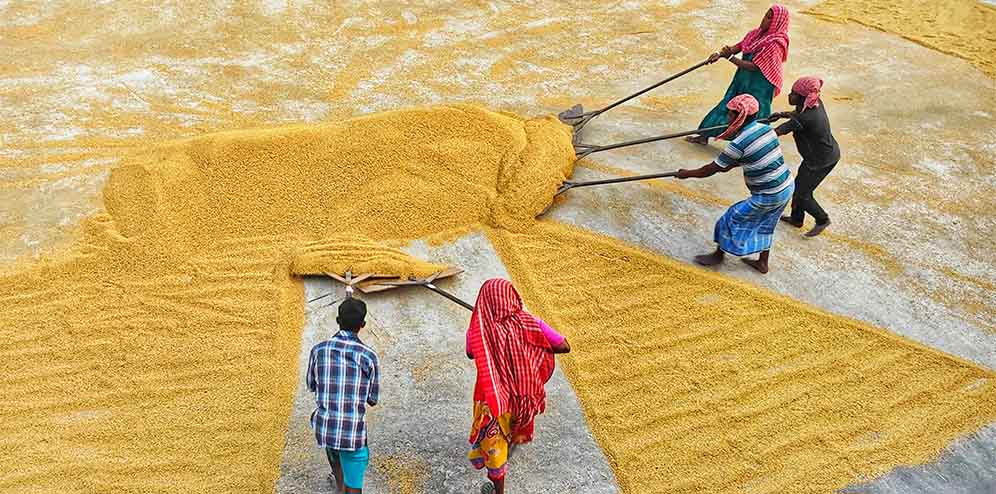
Men and women work together in a field in West Bengal. Researchers say crop loss must be looked at from a gender perspective to tackle it effectively. Credit: Dibakar Roy (Pexels)
“The workshops were about listening to farmers and extension workers and learning how they coped with pests, diseases and climate shocks in Odisha,” Kavita Mishra, a gender and inclusion expert at CABI, told SciDev.Net.
“By understanding how crop loss is experienced differently, we can build fairer, more sustainable farming systems that benefit the livelihoods of small and marginal farmers.”
Mapping and modelling
Mishra says GBCL’s data collection, mapping and modelling methods are helping to advance understanding of crop loss patterns at national and continental scales. These approaches combine large-scale field observations with published field trial data and scientific literature, supported by automated text-mining techniques.
Satellite imagery and other remote-sensing technologies are used to monitor the impact of extreme weather and detect pest and disease pressures. Machine-learning models integrate data from multiple satellite platforms to identify early signs of crop stress and potential outbreaks.
India already uses satellite data from the Indian Space Research Organisation’s Resourcesat programme to monitor rice and wheat crops, mapping growth and detecting early-stage weeds and stress. CABI projects draw on both Indian and global satellite data to improve models that predict threats from agricultural pests and diseases, supporting early detection and management.
Yet farmers say technology alone cannot offset mounting climate pressures. In Kerala, unseasonal rains have become a recurring threat.
“Since there is no proper infrastructure to store harvested paddy when it rains and no drying facility, the crops rot,” said Soolapani, of the Thanal Trust, which works on agroecology and biodiversity conservation.
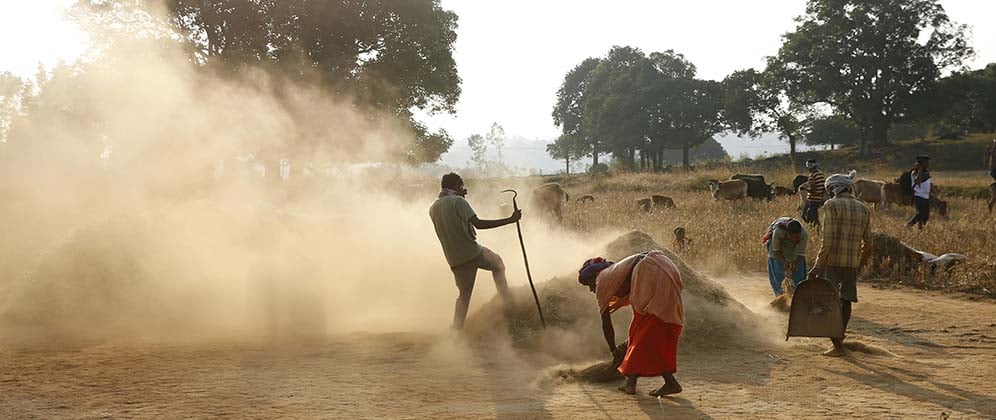
Farmers at work in the Araku Valley of India’s Andhra Pradesh state. Extreme weather such as floods and droughts are recurring problems for Indian farmers. Credit: Ganta Srinivas (Pexels)
“Even the straw, which is used as fodder for cattle, cannot be saved from mildew.”
Farmers cultivating cash crops such as cardamom have also been hit by climate extremes. “Last year, due to drought, cardamom farmers in this area lost their crops completely, necessitating replanting, which is ruinously costly for farmers,” Soolapani said.
Ozone damage
Another emerging threat comes from rising surface ozone levels, particularly across the Indo-Gangetic plains and central India. Ozone damages plant tissues and interferes with grain filling, a stage where starch and nutrients are moved from the leaves to the developing kernels. This reduces both yields and grain quality.
Jayanarayanan Kuttipurath, a scientist at the Indian Institute of Technology who has done extensive studies on the impact of surface ozone on paddy cultivation, estimates that India loses more than US$3 billion US a year to ozone-related damage in rice production alone.
He said solutions include reducing polluting emissions and developing crop varieties that can tolerate higher ozone levels.
In China and East Asia, ozone is estimated to cause substantial yield losses, resulting in huge economic losses. One study estimates that ozone pollution in China causes yield losses of 33 per cent for wheat, 23 per cent for rice.
While ozone is primarily a harmful pollutant, CABI’s research is exploring how it could be harnessed in controlled ways as an antimicrobial agent for pest and disease control, contributing to sustainable food systems.
Across the Asia Pacific region, pests such as rice blast and the brown planthopper continue to pose major threats to staple crops. These pests can now be tracked using remote-sensing data combined with machine-learning models, offering the possibility of earlier warnings and more targeted responses.
For researchers and policymakers, the challenge is not only to reduce losses but to measure them more accurately. Improving data on when, where and how crops are lost—and who bears the cost—is increasingly seen as essential for designing effective, inclusive responses in a changing climate.
This article is supported by CABI’s Global Burden of Crop Loss (GBCL) project. GBCL is funded by UK International Development of the UK government and the Gates Foundation.
This piece was produced by SciDev.Net’s Global desk.