


26/03/26
African climate adaptation finance bolsters defences
Send to a friend
The details you provide on this page will not be used to send unsolicited email, and will not be sold to a 3rd party. See privacy policy.
Climate adaptation finance models have led to measurable results in Benin, Namibia and Ethiopia, AU report finds.
[YAOUNDE, SciDev.Net] A climate change adaptation financing model implemented in Benin that has enabled new flood defences, irrigation systems, and resilient crops, has been hailed as an example to other African nations.
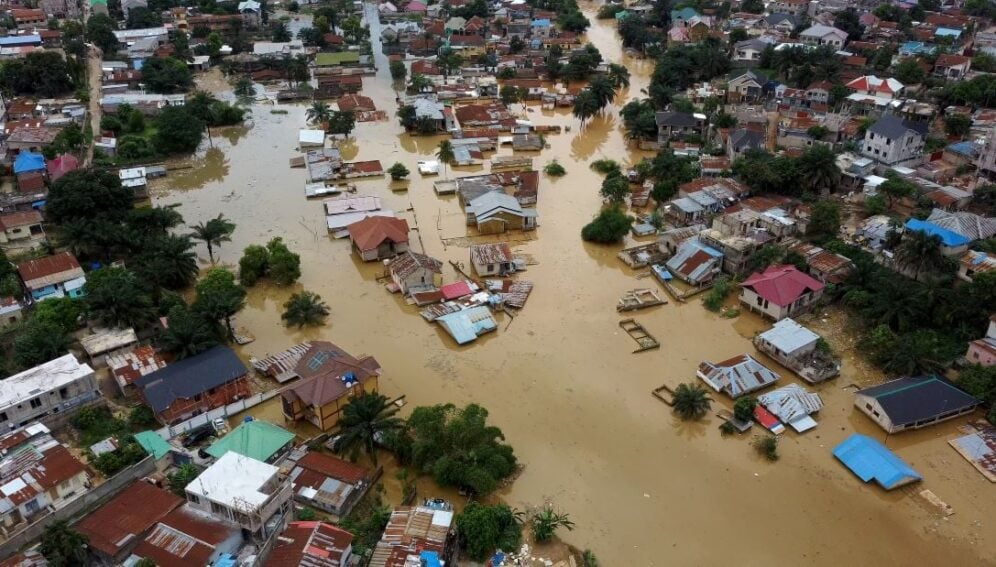
The West African country faces mounting climate-related risks, including frequent flooding, droughts and coastal erosion, which threaten agriculture, water security and infrastructure.
In 2014, the country partnered with the UN Capital Development Fund to launch the Local Climate Adaptive Living Facility (LoCAL), a financial mechanism that helps local government authorities in low-income countries access climate finance.
The mechanism is based on performance-based climate resilience grants, which are integrated into local government budget systems, with the aim of increasing the scale and impact of adaptation financing at the local level.
The grants, administered by Benin’s National Fund for Environment and Climate (FNEC), are directly tied to performance on planning transparency, gender and youth inclusion, and delivery outcomes.
By 2022, over US$9 million in grants from the Green Climate Fund (GCF) had enabled Benin to expand LoCAL to 34 communes, serving around 2.7 million residents in “highly climate-exposed zones”, according to a recent climate adaptation report.

The report entitled “A comprehensive study on climate adaptation intervention in Africa“, was published in February by Global Health Strategies (GHS) in partnership with the Directorate for Sustainable Environment and Blue Economy of the African Union (AU) Commission and looks at what is and isn’t working when it comes to climate adaptation on the continent.
Funding obtained through the LoCAL mechanism in Benin has helped deliver flood protection infrastructure in vulnerable areas, drought-resistant crop varieties, and irrigation systems to strengthen agricultural resilience, the study says.
The country has also deployed a Local Information System for Adaptation, a digital platform enabling real-time assessment of climate risks to shape local planning.
According to the analysis, accreditation of FNEC by GCF improved Benin’s access to international adaptation funds, co-financing from the African Development Bank, and local government contributions supporting the expansion of the programme.
“This model demonstrates that good financial governance can transform climate finance into tangible results,” says Justin Chekoua, programme manager at Forests and Rural Development (FODER), a non-profit environmental organisation, whose work includes supporting rural women to adopt climate change adaptation practices in Cameroon.
The reduction of flood-related losses and improvement of agricultural yields in Benin are examples of those measurable results, says Chekoua.
Targeted investments have resulted in a 20 per cent reduction in flood-related economic losses and a 15 to 25 per cent improvement in agricultural yields, according to the report.
‘Major innovation’
Omonlola Nadine Worou, a scientific coordinator at the International Livestock Research Institute, part of the global research partnership CGIAR, says Benin’s climate challenges are great.
She applauds the fact that the country’s adaptation projects are embedded in national planning policies. “It is a very suitable example in terms of replication,” she tells SciDev.Net.
Similarly, Joseph Magloire Olinga, an expert in local climate action and researcher at the think tank The Okwelians, believes Benin’s model is exemplary for its integration into national tax systems, describing it as “a major innovation”.
According to Emmanuel Siakilo, senior advisor on climate change adaptation and resilience at the AU Commission, the writing of the report was motivated by the need to determine which adaptation interventions work on the continent.
“Climate action needs to be contextually relevant, even though it requires a global kind of effort to manage it,” he said in a video interview with SciDev.Net.
Investment from development partners is forthcoming, but “where will the government be putting that money? We don’t want to be shooting in the dark”, he said.
“We wanted to be very precise and very accurate in terms of where we want to put adaptation money, what works, what will work if we are to scale, so that the communities start realising the benefits of these resources to adaptation.”
Rural connectivity
Along with Benin, the AU report also cites Ethiopia and Namibia as examples of good practice.
In Ethiopia, to strengthen climate resilience amid recurring climate shocks, including prolonged drought, intense rainfall and periodic flooding, the World Bank launched the Rural Connectivity for Food Security Program in 2024.
Supported by a US$300 million grant from the International Development Association and US$80 million in co-financing from the International Fund for Agricultural Development, the initiative aimed to build or regenerate the country’s roads and bridges for year-round connectivity. This meant all-season rural road access increased from 4,200 km in 2021 to over 12,000 km in 2024, according to the report.
Access to a reliable market for farming households rose from 30 per cent to more than 70 per cent. And more than 11.3 million rural households benefited from the program, with post-harvest food losses reduced by up to 30 per cent.
This Ethiopian approach “demonstrates how massive investments in rural infrastructure strengthen food security, improve living standards and stem rural exodus”, says Olinga.
Chekoua adds: “It shows that a significant investment in climate change can help reduce the vulnerability of communities and increase incomes.”
Hazard mapping
In Namibia, interventions were focused on the Oshana region, in the north-central area of the country, which is affected by drought and faces persistent climate variability characterised by irregular rainfall and progressive land degradation.
Interventions included hazard mapping by women’s groups, as well as the implementation of micro-irrigation systems, trials of drought-resistant crops, and sustainable livestock management practices. Radio programmes and plays were also used to raise awareness of climate risks and adaptation strategies.
They were co-financed by the Climate and Development Knowledge Network’s innovation fund, local government development budgets, and community contributions in kind, such as labour, land and materials.
Representation of women
Thanks to this initiative, women’s representation in climate adaptation decision-making processes increased from 40 per cent in 2021 to 72 per cent in 2024 and the lessons learned from the Oshana pilot project have been integrated into Namibia’s National Action Plan on Gender and Climate Change.
“Placing women at the centre of the action can produce significant results, because they suffer the most from the impacts of climate change and can therefore adapt to it better,” says Chekoua.
Overall, he concludes: “These three examples show that if climate finance is better channelled through mechanisms of transparency and community participation, it can have significant positive impacts on the well-being of communities.”
However, Worou, of the International Livestock Research Institute, wants to see more emphasis on the smaller projects, which might not be attracting funding through such mechanisms.
“When talking about local initiatives, we don’t see the small projects that are put in place by the communities,” she says.
She also notes that financing “requires complexity, analysis and perhaps reforms”, adding that more information is needed to navigate such mechanisms.
Chekoua agrees that access to climate change adaptation financing remains difficult for African countries due to the cumbersome nature of some mechanisms.
“The procedures are complex and difficult to access for both states and civil society organisations that support communities on a daily basis,” he says.
“More flexible and simple mechanisms should be found to allow African organisations and states to access these funding opportunities.”
This article was produced by SciDev.Net’s Sub-Saharan Africa French edition, with the support of Global Health Strategies.