


09/04/26
Irrigation a must for smallholders in changing climate

By: Richard Colback
Send to a friend
The details you provide on this page will not be used to send unsolicited email, and will not be sold to a 3rd party. See privacy policy.
Investing in irrigation technologies will make food security a more achievable goal in the decades ahead, writes Richard Colback of the International Finance Corporation.
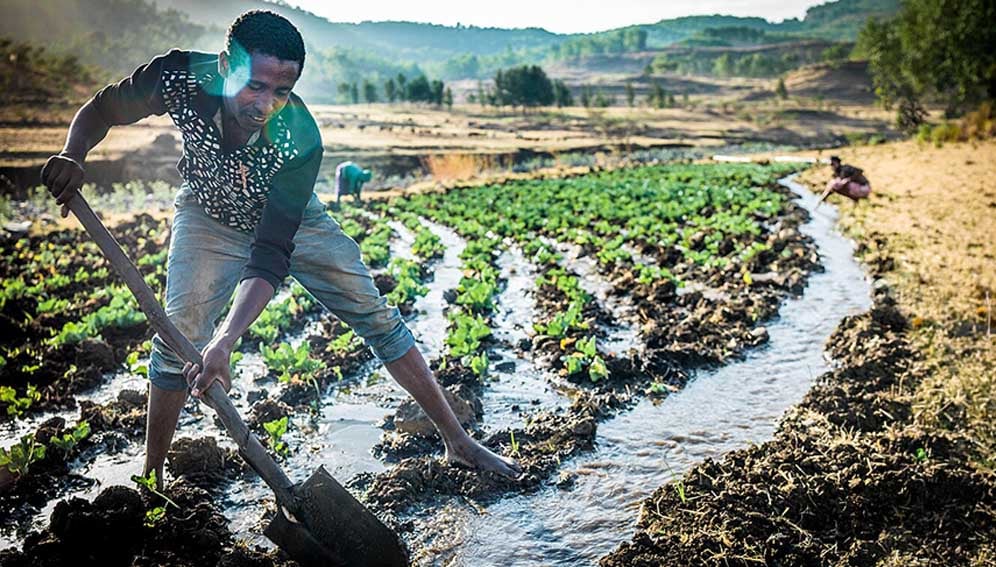
[SciDev.Net] Just six per cent of cultivated land in Africa is irrigated. On a continent where small-scale farms produce around four fifths of the food consumed across Asia and Sub-Saharan Africa, that figure is striking—and it points to an opportunity that has gone largely unrealised for far too long.
For decades, advances in irrigation, together with improved crop varieties, fertilisers, and integrated pest-control methods, have profoundly increased food production and spared tens of millions from hunger and malnutrition. Yet while irrigation is widespread in high-income countries, less than one-fifth of cropland is irrigated globally.
Small-scale farmers in Africa, South America, and Asia largely depend on rainfall, which prevents them from cropping their land during increasingly long dry seasons. As global food demand grows and weather patterns become more unpredictable, that dependency is becoming harder to sustain.
The case for expanding irrigation is clear. Reducing smallholder farmers’ dependency on rain can significantly lower their vulnerability to changing weather patterns, making food and nutrition security a more attainable goal in the decades ahead.
With the global population projected to approach 10 billion by 2050, agricultural production will need to expand by around 60 per cent. The 500 million small-scale farms that produce the majority of food in Asia and Sub-Saharan Africa will be central to meeting that demand—but not if they remain at the mercy of rainfall that is growing less reliable every year.

The good news is that the tools to address this are already available. Farmer-led, small-scale irrigation systems—shared, owned, or procured as a service—typically require lower investment while yielding higher returns than large-scale systems. They are easier to maintain, offer more control to the farmers using them, and require less complex operational management.
Africa holds vast groundwater reserves, with enormous areas where water lies within seven metres of the surface, easily accessed by pumps. Solar-powered irrigation systems carry a 95 to 97 per cent smaller emissions footprint than pumps running on diesel or grid electricity.
Precision irrigation technologies can deliver water directly to plant roots, while sensor-based systems allow farmers to measure soil moisture in real time.
Kenyan farmer Kinaro Waithaka is one example of what becomes possible. For years, low and erratic rainfall limited what he could grow on his four-hectare plot of maize, beans, and mangos. After installing a small solar-powered system—collecting rainwater from his roof, pumping it to an overhead tank, distributing it through buried pipes—he was able to cultivate tomatoes, watermelons, and other high-value crops year-round. He earned more than KES 40,000—around US$400—from his tomato harvest alone. The technology was modest. The impact on his livelihood was great.
Broader investments tell a similar story. In Ghana, where less than three per cent of cultivated land was irrigated and longer dry periods were reducing productivity, the government, with World Bank Group support, launched the Ghana Commercial Agriculture Project, investing US$62 million to modernise public irrigation and drainage infrastructure, including installing concrete linings for canals and adding piped networks to fields.
The project benefited some 14,000 people and helped boost average rice yields from 4.5 metric tonnes per hectare in 2017 to about 5.5 MT/Ha.
These are not isolated success stories to be filed under promising pilots. They are proof of concept for a model that can be replicated—if governments and funders choose to do so.
Expanding irrigation further will not be straightforward. Costs are projected at US$26 billion to US$50 billion annually over the next two decades. There are genuine challenges to manage: surface water availability, groundwater depletion, salinisation—which has already rendered nearly one-third of irrigated land commercially unproductive—and the risk of runoff and pollution from inefficient systems.
For irrigation technology providers, fragmented markets and the absence of supportive government policies make it costly to enter low- and middle-income countries. Many smallholders still lack access to the credit needed to invest in or maintain systems.
But these are challenges with known solutions, not reasons to hold back. Impact financing organisations can provide blended finance options that reduce the risk of investing in such markets. Precision irrigation and appropriate management practices can minimise runoff and salt accumulation.
Collaborative governance frameworks can help prevent the over-abstraction of groundwater. And transboundary water agreements, still rare despite shared rivers accounting for 60 per cent of global freshwater flows—can unlock more equitable and sustainable use across borders.
The Food and Agriculture Organization’s Water Scarcity Program and the joint IFC-IFAD Handbook for Scaling Irrigation Systems offer practical frameworks that governments and development institutions can draw on. What is needed now is the coordination and commitment to bring them to bear at scale—across governments, development institutions, agribusinesses, irrigation technology companies, and farming communities working together.
Smallholder farmers across Africa and Asia have shown, time and again, what they can achieve when the right conditions are in place. The water is there. The technology is there. Helping more farmers access both is one of the clearest investments available in the food security of the decades ahead.
Richard Colback is the Global Lead, Water for Food at the World Bank Group (WBG), and Industry Specialist for the International Finance Corporation (IFC).
This piece was produced by SciDev.Net’s Sub-Saharan Africa English desk.