


30/01/26
African scientists push for homegrown pharma innovation

By: Gilbert Nakweya
Send to a friend
The details you provide on this page will not be used to send unsolicited email, and will not be sold to a 3rd party. See privacy policy.
[NAIROBI, SciDev.Net] Africa’s health future hinges on its ability to finance and commercialise its own medical innovations, rather than rely on increasingly uncertain international funding, African science leaders have warned.
In a commentary published in Nature Health, the inaugural cohort of the Calestous Juma Science Leadership Fellowship argue that decades of underinvestment have weakened Africa’s ability to develop clinical solutions to the continent’s huge disease burden.
They say an “overreliance” on now dwindling international funding has often led to research and development priorities being set by non-African actors.
The scientists call for increased national investment to support private-sector led pharmaceutical research and development (R&D), coupled with accountability mechanisms to ensure pledges are met.
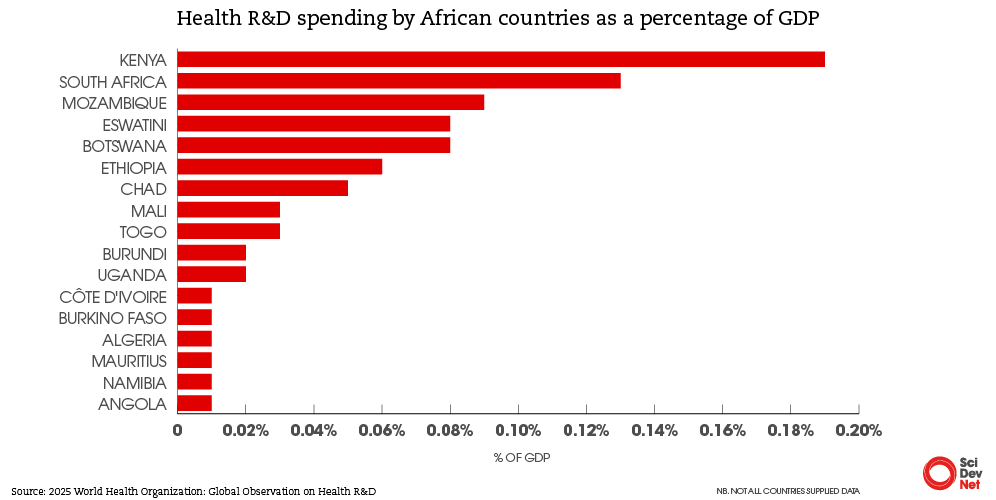
According to their report, gross domestic expenditure on R&D in Africa averaged just 0.33 per cent in 2023—despite commitments to invest at least 1 per cent of gross domestic product.
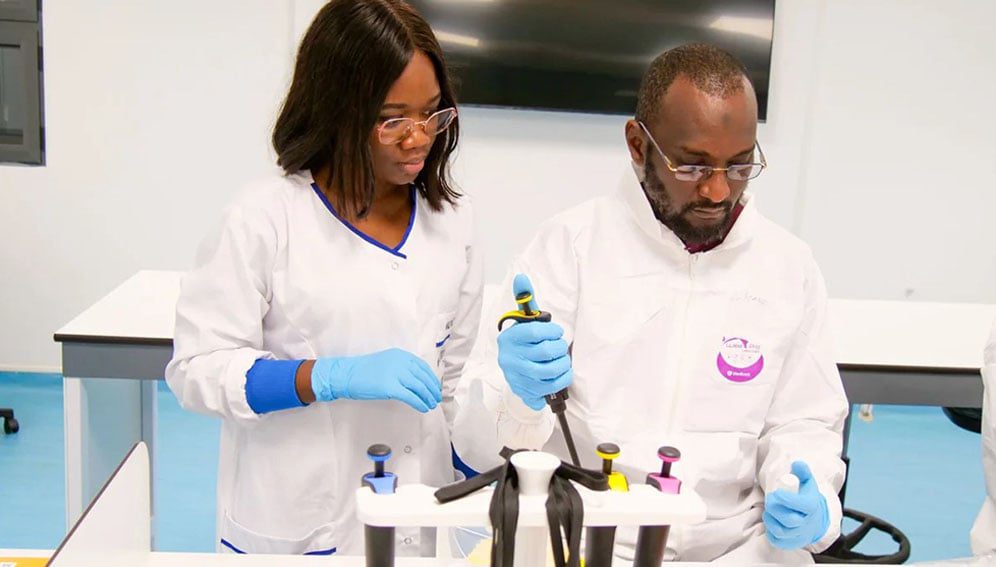
Yaw Bediako, chief executive of Yemaachi Biotech and dean of research and innovation at Ashesi University, Ghana, believes strategic investment in product development can translate to significant economic and health gains.
“[It] can transform youth potential, biodiversity, and scientific ingenuity into innovation, real-world impact, and prosperity for future generations,” Bediako, one of the fellows, told SciDev.Net.
Established in 2021 with funding from the Gates Foundation, the Calestous Juma Science Leadership Fellowship supports African researchers to advance scientific leadership while collaboratively strengthening research and innovation ecosystems across the continent.

The researchers, drawn from Cameroon, Ghana, Kenya, Mali, Nigeria, South Africa, Uganda and Zimbabwe, argue that while national and regional policies have sought to address long-standing health barriers, implementation failures continue to stall progress.
They say recent US aid cuts and other global health disruptions demand an urgent new set of Africa-led strategies to build resilient, locally-driven health innovation systems and foster long-term progress.
The fellows say reforming procurement and import regulations, fixing weak supply chains and developing African-led research partnerships are essential to moving from knowledge generation to usable health products.
Procurement ‘bottlenecks’
Africa could significantly boost pharmaceutical production, such as vaccines and treatments, with more agile regulations for moving scientific materials across borders, according to the scientists.
Procurement bottlenecks and import rules currently delay laboratory work and local manufacturing, they say, despite the COVID-19 pandemic proving that faster systems are possible.
Iruka Okeke, professor of pharmaceutical microbiology at Nigeria’s University of Ibadan and a co-author of the article, says African scientists face unfair market conditions when purchasing materials from global suppliers.
“Currently we pay more and receive less vendor support,” she told SciDev.Net.
“This might be improved through pooled procurement and enhanced visibility of African scientists to potential vendors that could be accomplished by a virtual observatory.”
Low-cost policies
Okeke believes that this kind of policy reform doesn’t need to be costly.
“Importation rules could be implemented with little financial consequences as specialist scientific materials yield little import duty and most institutions that need them are duty exempt anyway,” she explained.
Better working conditions and merit-based promotion systems would also strengthen scientists’ funding prospects, according to Okeke.
“When researchers are properly supported, they are better placed to secure private-sector and other funding, even amid current shortfalls in external support,” she added.
‘Within reach’
Tom Kariuki, chief executive officer of the Nairobi-based Science for Africa Foundation, says the fellows’ call aligns with a growing movement across the scientific community demanding delivery-focused, locally grounded reforms.
Kariuki, who is not involved in the fellowship, says their call is “an invitation to act together, using approaches that are already within reach”.
This piece was produced by SciDev.Net’s Sub-Saharan Africa English desk.