


28/01/26
Human-led AI opens tech jobs for refugees
By: Cecilia Butini
Send to a friend
The details you provide on this page will not be used to send unsolicited email, and will not be sold to a 3rd party. See privacy policy.
This article was supported by the International Development Research Centre (IDRC), Canada.
AI can help displaced people avoid exploitation, but humans must call the shots, warn experts.
[BARCELONA, SciDev.Net] For Susan Achiech, life began in Kenya’s Kakuma refugee camp, where her South Sudanese parents fled to for safety in the early 1990s.
Now 26, she lives in Canada, running her own gaming company, Tech Femme Algorithms, while working as an insurance advisor and studying gaming programming.
Her tech journey began when she sought programming training from the non-profit Learning Lions, while living in Nairobi where she had grown up after leaving Kakuma. She later secured remote coding work through Na’amal, a social enterprise that supports economic inclusion of refugees.
“When it comes to human processes and human development, you cannot take the people out of it.”
Sabina Dewan, executive director, JustJobs Network
“As a refugee, it’s challenging,” Achiech tells SciDev.Net.
“Most people don’t have the education or the skills required for high-end jobs. So training is an issue for migrants.”
Na’amal—meaning both “we work” and “we hope” in Arabic—equips refugees and other under-resourced communities with in-demand digital skills, and “essential human skills”, for the global labour market, explains CEO Lorraine Charles.
AI training has become central to this work, says Charles.

“We know that AI capability now carries a real hiring premium, so we are being deliberate about ensuring everyone who goes through our training develops practical, applied AI skills,” she tells SciDev.Net.
The Na’amal Agency, launched in 2024, recruits skilled refugees to work on tech-based projects. The initiative seeks to plug a persistent employment gap in the digital economy, says Charles.
“While digital skills training for refugees has expanded rapidly in recent years, access to formal, paid work has not kept pace,” she explains.
“Despite the growth of training programmes, skilled refugees remain largely excluded from income-generating opportunities.”
The company is developing an AI-supported platform to connect refugee digital talent to paid work. But Charles stresses that human oversight will remain crucial.
“AI will assist with initial matching based on skills [and] project needs, but human oversight ensures quality and ethical checks,” she explains.
‘Thoughtful’ AI use
This balance of AI and human input is also evident at EqualReach, an organisation that connects refugees with clients for remote and digital work across the world.
Here, teams of refugee workers are matched with clients, in industries such as IT and design, through a digital platform. The platform uses AI to draft project descriptions, but not to match workers with prospective clients, according to EqualReach founder Giselle Gonzales.
“We are using it thoughtfully, and I think our superpower is our relationship network building approach,” she tells SciDev.Net, explaining how the company serves as a facilitator of work relationships between refugee teams and employers.
She notes that people seeking protection often move from their country to one with similar challenges and income levels, creating competition for jobs and tensions between refugees and locals.
“It impacts people economically and further silos those groups,” says Gonzales, whose work aims to address some of these challenges.
Preventing exploitation
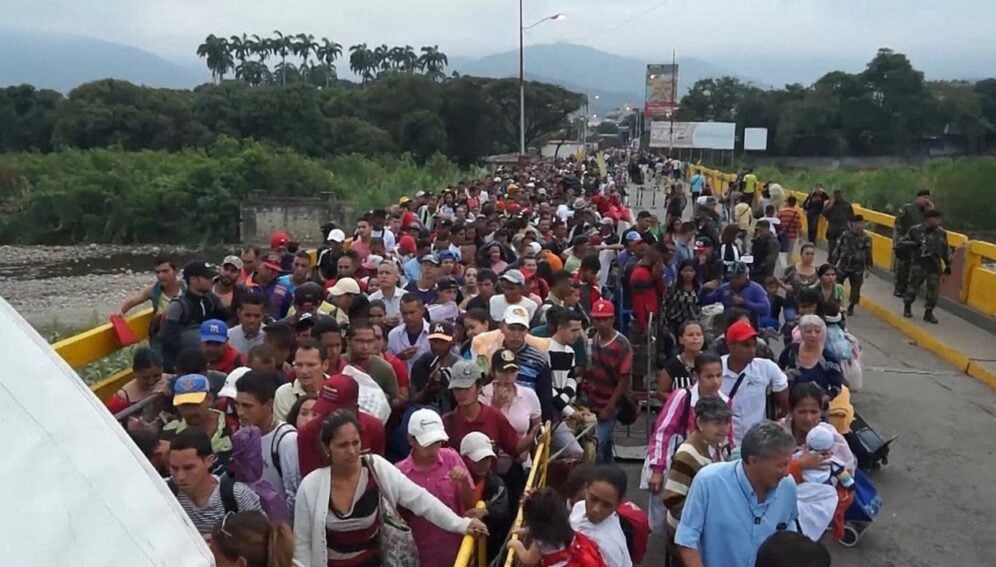
The number of refugees and forcibly displaced people in the world has increased dramatically in the last decade. According to the UN refugee agency, UNHCR, the number of forcibly displaced people had risen to an estimated 122.6 million by mid-2024, marking an 11.5 per cent increase compared to just the previous year.
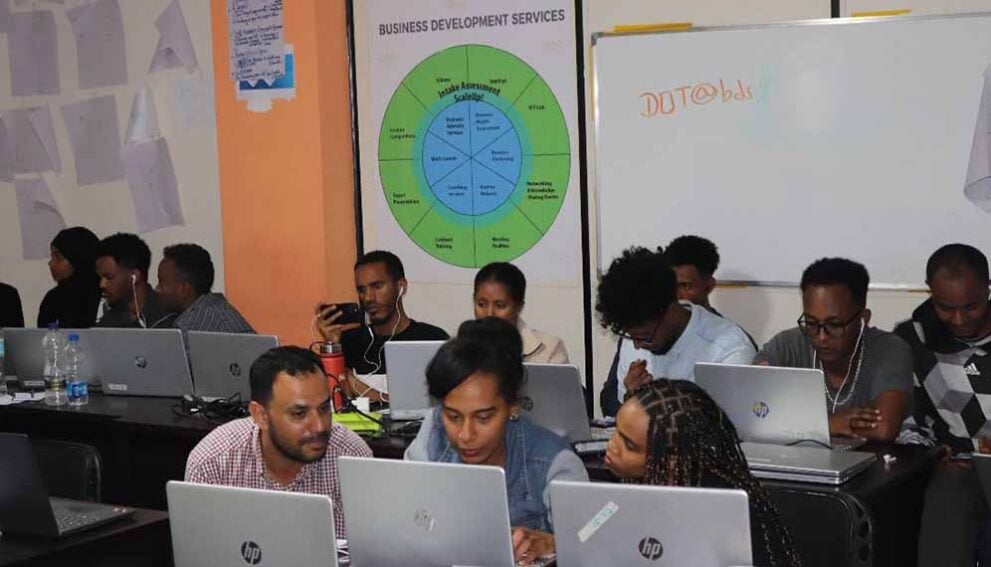
Na’amal refugee and host community learners, pictured in class in Ethiopia for the Accelerating Digital Livelihoods in Ethiopia programme.
When arriving in a new country, migrants and refugees often face language barriers, administrative issues and discrimination, which can make them vulnerable to exploitation, says Yvonne Giesing, deputy director of the Center for Migration and Development Economics at the University of Munich’s Ifo Institute, in Germany.
In the current political climate, where countries are increasingly tightening their immigration rules, she believes it’s important not to create false hopes around AI being able to support a migration journey when prospective destination countries are closing their doors.
Avoiding middlemen
Tech platforms that help people sift through options can help people minimise the risk of falling into exploitative situations, says Sabina Dewan, founder and executive director of the JustJobs Network, which has been partnering with Canada’s IDRC as part of the FutureWorks Collective research consortium.
Such exploitation is usually orchestrated by middlemen or people smugglers who make false promises to extort money or labour, she explains.
She believes using technology and AI-based systems to look for work can help migrant workers create direct channels with prospective employers, helping them avoid the middlemen.
“However, there’s a big other side of it,” she cautions.
Workers who get jobs through tech platforms can still find themselves disenfranchised and helpless when issues arise.
For migrants who might not be fully aware of their rights in the new country, “not having effective redressal mechanisms, or relegating redressal mechanisms to an AI platform, can actually be deeply problematic,” says Dewan.
Social connections have traditionally been vital tools for most migrants to orient themselves in a new place, figure out practicalities and get help in case of need.
“Those kinds of human support networks are not something that AI can replace,” she adds.
Human in the loop
One common hurdle that migrants face when attempting to enter the workforce in a new country is recognition of their qualifications, and AI can safely help with this, says Giesing.
Indima, an Austria-based startup founded in 2023, is attempting to do just this. The company charges a small amount to automatically compare the grading system of a person’s school or university with that of the country that they intend to migrate to, according to Emin Vojnikovic, one of the company’s co-founders.
Indima’s users mostly hail from India, Pakistan and other parts of Asia, as well as Nigeria, he tells SciDev.Net.
The platform uses AI to extract information from transcripts and diplomas, using Optical Character Recognition models and “the secret sauce of extraction”, says Vojnikovic, without divulging details.
“We are constantly testing improving and benchmarking with sets of hundreds of different documents to continuously improve the extraction results,” he adds.
Making sure this tool is unbiased is an essential consideration, he stresses: “As we are supporting decisions on somebody’s future education or job perspectives, we are working hard to remove bias in data and results… [and] our on bias in for example data aggregation and research.”
However, like other organisations working in this space, AI is not doing all the work for Indima.
The conversion of credit points from one country’s system into another’s is not AI-powered, Vojnikovic notes. Instead, Indima uses a big dataset and a deterministic model to make the right credit points conversion.
“We don’t solely rely on AI, because AI could be a black box, and if we make a decision about someone’s future, we want to be pretty sure about our outcomes,” he says.
AI processes aren’t explainable to the user, so shouldn’t be left to make decisions about that user, he believes.
“There should always be human oversight, or it should be deterministic solutions which are traceable or explainable to the user,” Vojnikovic adds.
Never fully automated
Petro Kosho, the author of a paper on ethical AI use in immigrant workforce development, believes that decisions about people should never be left entirely to AI, because of its inherent bias.
“AI learns from the data you feed it,” says Kosho, from the University of Arkansas at Little Rock, US.
“When that data doesn’t include different types of people, from different backgrounds or different parts of the world, then it is already biased.”
At Na’amal, job matching, contracting and project delivery remain subject to human oversight, reducing the risk of bias and exclusion, says Charles.
She adds: “AI does not replace human judgment, automate hiring decisions, or remove accountability. All delivery remains human-led, with oversight, safeguarding, and contextual understanding embedded throughout.”
For Dewan of the JustJobs Network, the increasing use of technology to manage recruitment processes for migrant workers, including those coming from low- and middle-income countries, is a good thing. But she stresses: “When it comes to human processes and human development, you cannot take the people out of it.”
This article was supported by the International Development Research Centre (IDRC) of Canada.
The article was produced by SciDev.Net’s Global desk, with additional reporting by Ruth Douglas.