


20/10/26
Global deforestation falls, but 2030 goal off track
Send to a friend
The details you provide on this page will not be used to send unsolicited email, and will not be sold to a 3rd party. See privacy policy.
[SÃO PAULO, SciDev.Net] Global deforestation fell last year, but not enough to meet the goal of zero deforestation by 2030, with action missing to stop tree loss in the Congo Basin, a new analysis has found.
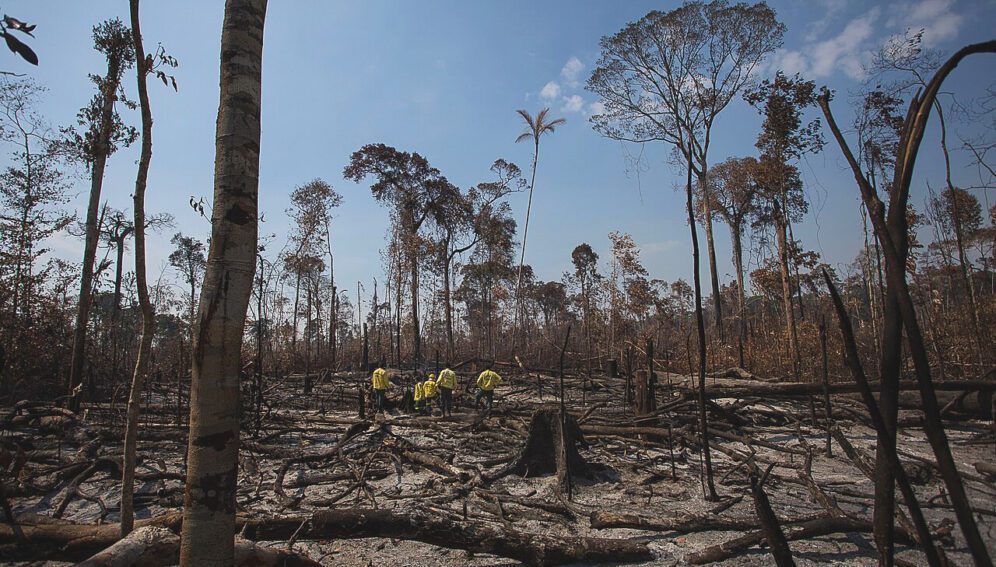
Deforestation destroyed seven million hectares of native forests globally in 2025, 15 per cent less than in 2024, according to the 2026 Forest Declaration Assessment, released ahead of the UN climate summit COP31 in November.
But while tree loss declined in the Amazon, it continued at pace in Central Africa’s Congo Basin, the second largest area of forest in the world, the assessment found.
Prepared by a coalition of civil society and research organisations, the report assesses progress towards commitments made at COP26 in Glasgow in 2021 to end deforestation and restore 30 per cent of degraded forest ecosystems by 2030.
It measures annual variations in forest loss compared to the 2018-2020 baseline period when deforestation reached an average of 8.3 million hectares per year.
Erin Matson, co-author of the report, told SciDev.Net: “This year, for the first time in a while, the headline actually starts with some good news.”
But she warned: “A dip in a bad trend is not yet a bend in the curve. Despite the improvement in 2025, the world is still 70 per cent off track from halting deforestation by 2030.”

Between 2021 and 2024, annual deforestation barely deviated from the baseline of 8.3 million hectares, according to the report.
To stay on course for zero deforestation by 2030, forest loss needed to decrease by about one million hectares a year, says Matson, a senior consultant at Climate Focus, an international advisory organisation focused on reducing greenhouse gas emissions.
She explained: “At that rate, by 2024, it should have been no higher than 5 million hectares but was instead 8 million. By 2025, it should have dropped to 4.2 million hectares but totalled 7 million instead.”
If we were on track to reach zero, “10.7 million hectares of forest, an area the size of Iceland, would still be standing,” added Matson.
Regional differences
For the first time, deforestation in tropical Africa is now happening at a scale comparable with Latin America, one of the world’s main deforestation hotspots, according to the report.
The Congo Basin is the second largest forested area in the world after the Amazon and home to one of the largest remaining areas of intact tropical forest on the planet. In 2025, the region lost 2.4 million hectares of forest while Latin America lost 2.5 million.
According to the report, over the last five years, measures adopted in some Latin American countries—such as the reactivation of an action plan against deforestation in the Amazon and the strengthening of oversight in Brazil—contributed to reducing deforestation by 33 per cent in the region. This decline was the main factor behind the global drop recorded in 2025.
In contrast, in the Congo Basin, where forest loss is mainly due to the expansion of agriculture, logging and mining, the report failed to identify any similar initiatives underway to curb deforestation.
Advances at risk
Ane Alencar, scientific director of the Amazon Environmental Research Institute, who was not involved in the assessment, told SciDev.Net: “I think [the report] brings a very important message: We’re able to reduce deforestation.
“In Brazil’s case, we managed to do that without sacrificing agricultural production or economic development. And I think this is very important.”
Even in Latin America, however, there is no guarantee that the gains of recent years will be sustained.
According to the report, forest protection in the region “depends largely on the decisions of a small number of governments,” whose policies can change rapidly depending on election results.
In Colombia, newly elected President Abelardo de la Espriella has signalled a break with his predecessor’s forest protection policies by revoking restrictions on mining and pledging support for the expansion of oil and gas exploitation. Both measures pose potential threats to forests.
Meanwhile, in Peru, President Keiko Fujimori has promised to accelerate investments in mining, including through a system of express approval and tax incentives, putting even national protected areas in the Amazon at risk.
In Brazil, the current government has maintained a pro-forest stance, but a change in the presidential election in late October could have serious implications for the future of the Amazon, especially in the face of growing climate threats.
“Brazil’s next president will govern during a window of extreme vulnerability, in which curbing deforestation will be the only lever left to keep the Amazon from the brink of disaster,” said Alencar.
She added: “Regardless of the outcome, the agribusiness sector has shown that it can live with a significant reduction in deforestation.
“In recent years, we have achieved a significant reduction in deforestation and the sector has not been harmed.”
This article was produced by SciDev.Net’s Latin America and Caribbean desk.