


By: John Musenze
Send to a friend
The details you provide on this page will not be used to send unsolicited email, and will not be sold to a 3rd party. See privacy policy.
[HONG KONG, SciDev.Net] In Uganda, where cancer patients can travel hundreds of kilometres to access cancer treatment, an automated voice call system is helping doctors monitor them between treatments.
The system, developed by the Uganda Cancer Institute (UCI), calls patients after treatment to check for side effects and alert doctors when they may need to return to hospital earlier than scheduled.
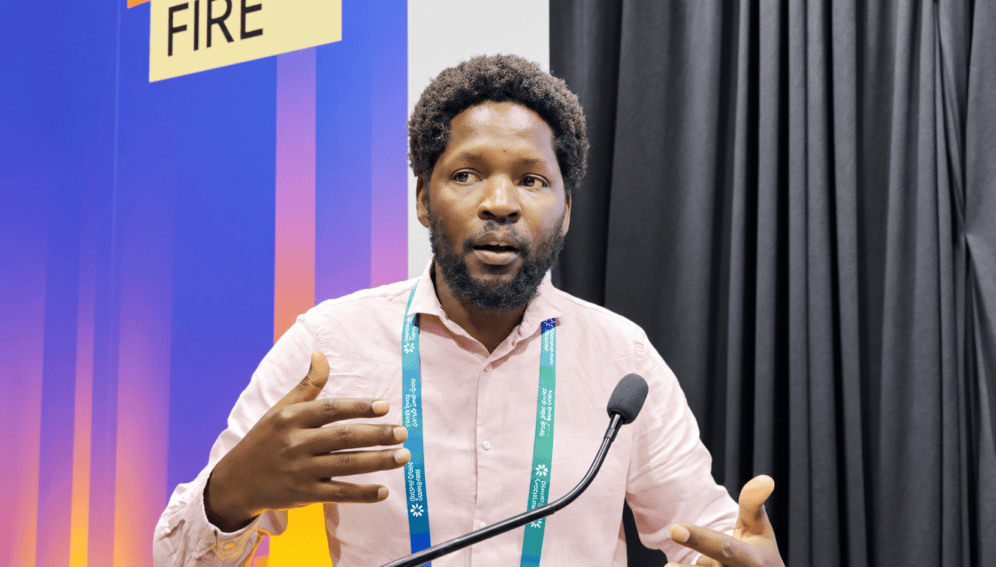
It was presented at the World Cancer Congress in Hong Kong by Johnblack Kabukye, medical doctor and informatician at UCI.
Kabukye said the Institute, with support from the Uganda Communications Commission, first set up call centres where people can call in and receive cancer information from operators in seven different languages. Now the fully automated service is calling up patients itself.
“When patients leave after receiving treatment sometimes, they get vomiting, pain, nausea, wounds in the mouth, we don’t have a way to ask them to follow up on this,” Kabukye told SciDev.Net on the sidelines of the Congress.
“Only when they come back three weeks later is when we know. Sometimes they don’t even come back.”
With this model, when a patient comes in, nurses collect their phone number, preferred language and preferred time for calls. A computer then automatically calls them every few days.
“No human is involved and it is more inclusive,” said Kabukye.
“No need for internet or smartphone. It’s safe with privacy and no need of education to use like it is with smartphones.”
He explained that the system asks pre-recorded questions about things that are commonly experienced by cancer patients and patients respond by choosing from one of four options.
According to Kabukye, that information is sent to their doctor who decides whether they need to return to hospital earlier than their scheduled date.
Free and easy
The system is built on Interactive Voice Response (IVR) and is free to use for the patient because the call is initiated by the hospital. It also has the advantage of not requiring the patient to have any level of literacy.
The system, which started as a research pilot on about 100 patients with blood cancers, made about 700 automated calls a week. In about 18 cases, patients were asked to return to hospital before their scheduled appointment because of serious side effects, according to Kabukye.
The pilot research was funded with US$50,000 from International Cancer Foundation in Switzerland. Besides patient follow-ups, it was designed for cancer awareness and education, especially with in-patients.
UCI currently has six channels for the system, said Kabukye, adding that scaling it nationally would require increasing this to 100 channels, adding more languages, and securing funding for airtime.
“We do not want our patients to be left [without follow up],” he said.
“We hope government can partner with telecom companies because we have tested it and it is 100 per cent without any problem.”
In a country affected by power instability, Kabukye says the team plans to use solar power to drive the system, making it energy-saving and environmentally friendly.
Hospital bills saved
Getrude Nakigudde, a Ugandan breast cancer survivor and cancer advocate, says free-to-use solutions like this are a lifeline for people in low-income settings where most patients pay their hospital bills out of pocket.
“It’s a game-changer because the patient doesn’t spend on anything,” she told SciDev.Net.
“During our time, many patients died because no one followed them up and they could not come back to the hospitals before the given dates,” said Nakigudde, recalling her time as a cancer patient 20 years ago.
“Most of the cancer patients are poor. Such innovations are made for us and benefit us.”
Nakigudde called on African governments to think about how their people can access innovations by sustainable financing.
Daniel Kyabayinze, director of public health at Uganda’s Ministry of Health, told SciDev.Net there were plans to adopt the tested system at the UCI. He said this was timely because cancer is on the rise in Uganda.
“Since this will not have manpower, it’s cost-saving to even the government from employing people to man it,” Kyabayinze said.
“After its success, we can then think about making systems for each region at regional cancer centres.”
Cancer rising
Global data presented at the 24-26 September Congress, organised by the Union for International Cancer Control (UICC) showed cancer cases are rising globally, especially in low-income countries.
According to the World Health Organization and the International Agency for Research on Cancer, there were 20.6 million new cancer cases and almost 10 million deaths in 2024, with incidence projected to rise to nearly 35 million by 2050.
UICC president Ulrika Årehed Kågström warned that the global economic cost of cancer from 2020 to 2050 will reach US$25.2 trillion. She said 50 per cent of cancers are detected at an advanced stage and while two fifths of countries have national cancer control plans, less than one in ten are fully funded.
Kabukye says the team is now adapting the automated call system for patients with other cancers, such as breast cancer, with questions varying depending on the type.
“We can follow up on them where they are, anytime and any day at no cost to the patient,” he said.
There are also plans to extend the model beyond Uganda to other African countries, he added.
This piece was produced by SciDev.Net’s Sub-Saharan Africa English desk.