


Send to a friend
The details you provide on this page will not be used to send unsolicited email, and will not be sold to a 3rd party. See privacy policy.
Some of the most severe cases of land degradation in semi-desert areas could be reversed with the right policies, researchers in Ethiopia have concluded.
A study of a dry region in the north of the country, whose population had increased ten-fold and whose land had become highly degraded, found that local people have nevertheless managed to coax it back into recovery.
Key to the study was a collection of sepia photographs taken during Great Britain’s military expedition to Abyssinia in 1868, which researchers were able to compare with more recent images — building up a story of the semi-arid landscape spanning 140 years.
The scientists, from Belgium and Ethiopia, used the photographs — which covered a 10,000 kilometre square area of the Tigray region in northern Ethiopia in the dry seasons of 1868 and 2008 — to compare levels of vegetation and other indicators of land health. They combined this information with field research and ratings from land management experts.
The climate in the region is temperate, making it suitable for agriculture, said Jan Nyssen, a professor in the department of geography at the University of Ghent, Belgium, and lead author of the study.
But the land is also made up of steep hillsides. With no land management practices in place, and a soaring population, the land had severely eroded and the vegetation decreased to a fraction of what it was.
However, after the famine in the 1980s, "people became conscious both within and outside Ethiopia that [the land degradation] could not continue", says Nyssen.
Starting in the 1980s, the government terraced the steep slopes with ‘stone bunds’, built stone walls that follow the contours of hills to prevent erosion and flooding; closed extremely degraded areas to grazing, crop cultivation and tree-felling; and replanted forests.
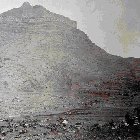
The Bolago valley in 1868
Royal Engineers of the British Navy, Courtesy of Kings Own Museum, Lancaster, UK
The authors show that there has been a "remarkable recovery of vegetation and also improved soil protection". This, they say, "invalidates hypotheses of the irreversibility of land degradation in semi-arid areas".
Crucially, while the recovery began as a top-down approach initiated by the government, local communities came to recognise the value of such conservation work because they could see for themselves its benefits — such as reduced flooding, says Nyssen. In fact, they had no option but to improve their land husbandry, say the researchers.
"What we’ve tried to show is that whatever small amount of support can be given by government in terms of policies and budgetary provision, our land which has been degraded can respond positively," said Mitiku Haile, president of Ethiopia’s Mekelle University and a co-author of the study.
"The government in Ethiopia has been encouraged by such studies and now they are carrying out massive areas closure, reforestation programmes and also wise use of these resources."
Ced Hesse, director of the dryland programme at the International Institute for Environment and Development in London, UK, said that the phenomenon of "more people, less erosion" has arisen elsewhere when a combination of rising populations and favourable markets have led to investment in land preservation.
But Andrew Warren, a professor at the department of geography at the UK-based University College London was more pessimistic. "The findings should not be extrapolated outside their study area," he told SciDev.Net. "There are lots of reports of things getting better, but also lots saying they’re getting worse."
Researchers have concluded that, with the right policies in place, coaxing a severely degraded region back into recovery is possible.