


By: Syriacus Buguzi
Send to a friend
The details you provide on this page will not be used to send unsolicited email, and will not be sold to a 3rd party. See privacy policy.
This article is supported by SIDA
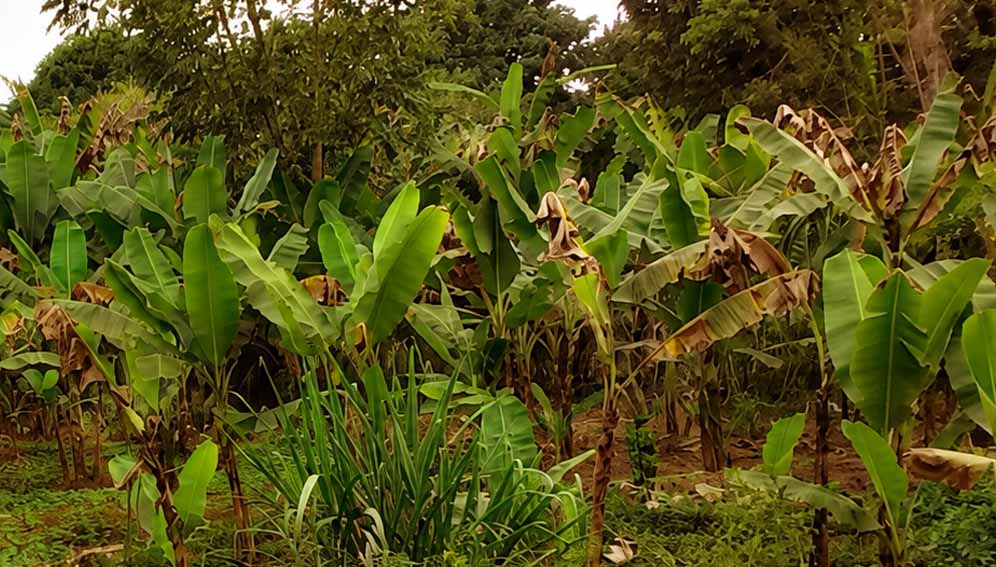
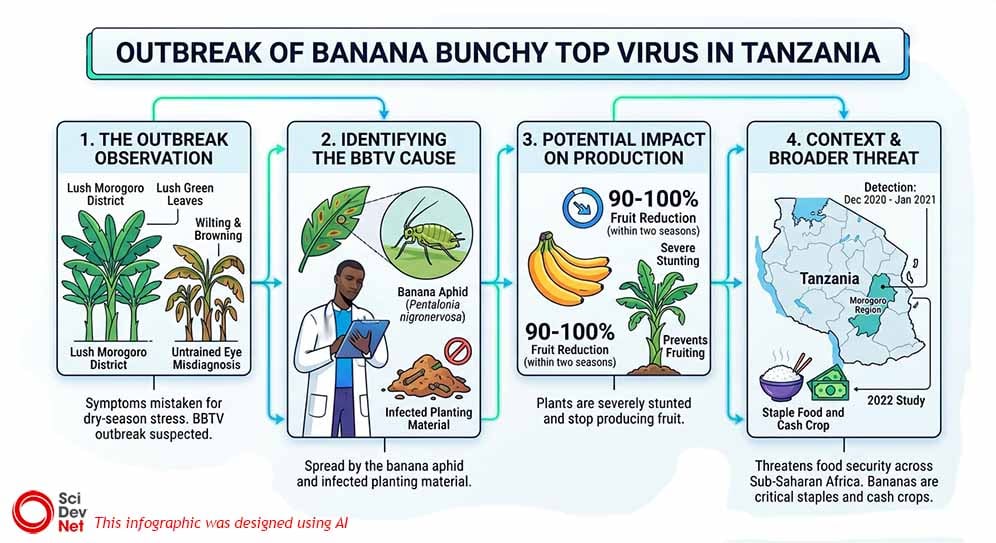
[DAR ES SALAAM, SciDev.Net] Lush banana plants once stood bright and green across a farm in central Tanzania’s Morogoro district. But three weeks ago, science journalist Ashton Balaigwa noticed something unusual.
The once green leaves of the banana plants were beginning to wilt, losing their colour and turning brown.
To an untrained eye, the symptoms might have appeared to be the result of dry-season stress or a lack of water. But Balaigwa recognised them.
A year earlier, he had taken part in science-reporting training focused on agriculture, where scientists taught journalists how to recognise symptoms of crop diseases.
Balaigwa took photos of the affected plants and shared them in a WhatsApp group that connects science journalists with agricultural researchers.

The responses pointed to a possible outbreak of banana bunchy top virus (BBTV), a plant disease that can severely stunt banana plants and prevent them from producing fruit.
BBTV is spread by the banana aphid Pentalonia nigronervosa and through infected planting material. The virus causes severe stunting and can reduce fruit production by 90 to 100 per cent within two seasons.
The banana disease was first detected in Tanzania between December 2020 and January 2021, according to a 2022 study. It threatens food security across Sub-Saharan Africa, where bananas are an important staple food and cash crop.
For farmers, identifying infected plants early is important because the disease can spread to surrounding healthy plants. Removing affected plants and using disease-free planting material are among the measures recommended to limit its spread, Balaigwa told SciDev.Net.
Armed with information from researchers in the WhatsApp group, Balaigwa returned to the farm in Kauzeni village and spoke with the owners about the possible infection.
“You need to act fast before it spreads further,” Balaigwa recalled telling the farmers as he shared scientists’ advice on removing affected plants and sanitising farming tools to protect neighbouring banana crops.
Disease detectors
For Deogratius Protas, principal research coordination officer at the Tanzania Commission for Science and Technology (COSTECH), the incident demonstrates the value of training journalists to recognise signs of crop diseases and connect their observations with scientists who can verify them.
Protas was among those involved in training 27 journalists in Tanzania, including Balaigwa, to improve reporting on science for community development.
The training followed the 2021 BBTV outbreak in Tanzania in 2021, which prompted scientists and other partners to step up efforts to raise awareness about the disease.
Protas said the journalist’s intervention helped stop the spread of the disease.
Without the engagement of journalists, “the disease would have remained largely unknown in these communities, leading to severe economic and food security consequences for smallholder farmers,” Protas told SciDev.Net.
“When journalists are empowered to spot symptoms and verify them directly with scientists in real time, it becomes easier to raise public awareness, reassure farming communities, and support immediate mitigation measures,” he added.
Banana replanting
For farmers who are already dealing with the disease, however, awareness is only part of the challenge.
Kosa Kondo, a farmer from Mzinga ward, also in Morogoro district, said BBTV had sharply reduced his banana production.
“After every three months, I would reap up to 30 to 40 banana trees, but currently, due to the disease, I can only afford a banana plant for my family to feed on, not for business,” Kondo told SciDev.Net.
Kondo said farmers also struggle to find disease-free planting material to replace infected crops. After his farm was affected, he decided to stop growing bananas temporarily and plant beans instead.
“After learning from the experts, I have decided to stop the banana plantation,” he told SciDev.Net.
“I have planted beans and am waiting. After some years, I want to restart bananas after getting seeds that have no problems and in soil that is not yet affected.”
Kondo says it is often difficult for farmers to access seedlings for planting new banana plants. “I believe we need to raise more awareness on this, on top of what the experts have been telling us,” he added.
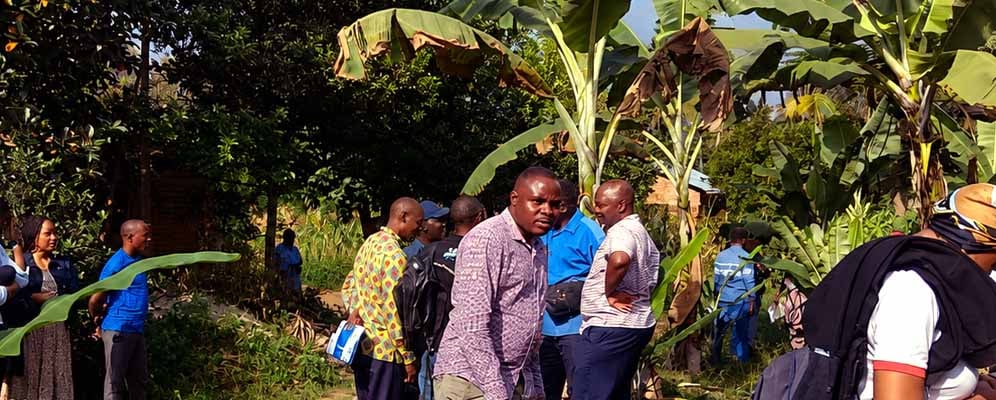
A team of journalists and researchers in Tanzania during a field visit to farms affected by Banana Bunchy Top Virus (BBTV) in Morogoro Region, Central Tanzania. Photo courtesy of Tanzania Commission for Science and Technology (COSTECH).
Science in the field
Hosea Mtui, a researcher and lecturer in the department of crop science and horticulture at Sokoine University of Agriculture, Tanzania, said combining scientific research with media-driven awareness gives smallholder farmers a better chance of responding to the disease.
“This approach is immensely important to Tanzanian farmers because it connects scientific knowledge on the ecology of the banana aphid, the vector of banana bunchy top virus, directly to practical guidance in the field,” Mtui explained.
“Implementing integrated management strategies based on this science allows farming communities to reduce disease spread, lower production costs, improve overall banana yield and quality, protect treasured local banana cultivars, and ultimately safeguard household income and national food security.”
This piece was produced by SciDev.Net’s Sub-Saharan Africa English desk.