

By: Naomi Martin
Send to a friend
The details you provide on this page will not be used to send unsolicited email, and will not be sold to a 3rd party. See privacy policy.
The "One Laptop per Child" (OLPC) scheme, which has sent over a million US$100 laptops to children in the developing world, has been criticised by researchers who found that, unless they are introduced with care, they become little more than distracting toys in the classroom.
The study, conducted in Ethiopia, revealed that students wanted more content on the laptops and teachers were not adequately trained on how to make use of them.
The OLPC scheme was launched in 2005 to provide each child in the developing world with a low-cost laptop to encourage "self-empowered" learning. More than one million laptops have been distributed.
David Hollow of the UK-based ICT4D Collective at Royal Holloway, University of London, and his team evaluated the OLPC initiative in Ethiopia by observing classroom sessions and interviewing students and teachers.
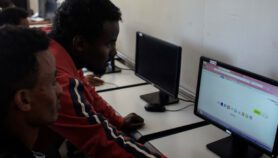
They told Africa Gathering — an information and communication technology and social networking conference organised by the London International Development Centre in April — that students tended to play with the machines, largely for taking pictures with the built-in digital camera.
Teachers were left frustrated because the students were better at using the laptops and played on them during lessons instead of listening to the teachers, Hollow told the conference.
"If I had the money, I would not spend it on laptops," Hollow told SciDev.Net. "It will cost about US$3 billion dollars to give every [Ethiopian] child a laptop. And as a proportion of the national budget for education, that’s just ridiculous."
The approach "doesn’t actually empower people in the way that we’d like. It just undermines the teacher … It’s impossible to integrate it".
The ICT4D team worked with Swiss educational software provider BlankPage to develop Akili, a textbook reader that was used to download books and increase the educational content on the laptops.
"We felt that Akili was something of a bridge because it enabled the children to explore and engage with their own learning but, at the same time, they were still based within the national curriculum and the teacher’s authority was not undermined."
Hollow said that in Ethiopia many children only attend school for a year or two so the priority is to give them good basic literacy and numeracy skills.
He suggested that introducing laptops in secondary schools would be more appropriate "because you’ve got a smaller group of people, which is far cheaper, and you’ve got a group of people who are actually more likely to be the decision-makers of the future".
But Matt Keller, OLPC’s director of Europe, the Middle East and Africa, rejects the criticisms. He says that when children take the laptops home they extend the school day. "When a child uses a laptop, he constructs and engages with it in a way that is far more dynamic and interactive than anything that he does at school."
He disputed Hollow’s recommendation to focus on secondary schools: "By the time most kids [are older], they’ve lost complete interest in school … And that’s partly because school is rote, you sit there and you’re taught to memorise what [you ought] to know".
"What technology can do is pique a child’s curiosity and engage them at an interest level that’s far greater than what a bricks and mortar school can do."
With regards to integration, Keller said that teachers in Ethiopia had been a "little bit slow to come around" in comparison to other countries. "But from what I’ve seen already, after a few months they’ve adapted quite nicely."
Hollow told the meeting that, for ICT4D projects to work, it is essential to take a long-term view and assess the impact of the project afterwards. This should involving talking to beneficiaries to discover their perceived needs.
More on ICTs