

Send to a friend
The details you provide on this page will not be used to send unsolicited email, and will not be sold to a 3rd party. See privacy policy.
[CAPE TOWN] A method for diagnosing tuberculosis (TB) that harnesses technology used in airport security could lead to more reliable screening.
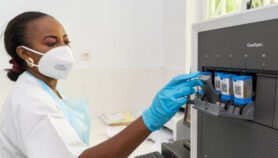
The South Africa-developed system, TBDx, takes digital ‘pictures’ of patients’ sputum samples and looks for TB’s structural ‘fingerprint’ — in the same way that airport scanners can identify types of explosives.
The TBDx system can diagnose TB within 24 hours. It requires little manual microscopy work, so special skills are not required to operate it. TBDx can operate 24 hours a day.
It can take conventional TB microscopy — of fresh sputum from the lungs, or of samples cultured in the laboratory — days or weeks to make a diagnosis.
The system — developed by the Aurum Institute, South Africa’s National Health Laboratory Services and imaging company Guardian Technologies International — has been tested over the past 12 months and is due to be trialled in its fully-automated mode in the next few months.
TBDx is at least ten per cent more accurate at identifying TB bacteria than conventional testing, David Clark, deputy chief of the Aurum Institute, told SciDev.Net.
Clark said the system could be useful for pre-screening samples to determine which need further analysis, for example it could identify the species of TB bacteria causing the disease.
He added that affordability is another benefit. "There are other new technologies which are a lot more sensitive and accurate but they are very expensive. TBDx diagnoses TB using relatively low-cost microscopy but improves things by making the process more efficient and effective," he said.
The more expensive machines have not yet been applied in TB diagnostics, Willem Sturm, dean at the Nelson Mandela School of Medicine and interim director of the KwaZulu-Natal Research Institute for Tuberculosis and HIV, told SciDev.Net.
He said that while TBDx will be helpful, microscopy remains too insensitive to accurately diagnose TB, even if the machine can identify a higher percentage of cases than can the human eye.
Paul van Helden, professor of medical biochemistry at South Africa’s University of Stellenbosch, said the system offers hope if it can address the issues of insensitivity and slowness in TB diagnosis.
"[The system] merits attention but will probably not be able to solve all diagnostic problems — for example, testing for TB drug-resistance, which occurs in parts of the body other than the lungs," said van Helden.
Clark said that if further testing goes well, the system could be on the market later this year. The price is expected to be comparable to conventional microscopy without the added expense of staff.
More on Disease